Most people spend months convincing themselves that bulge will somehow sort itself out. It won’t. Hernia removal surgery gets delayed because of fear, but here’s what nobody mentions: your body has already told you the muscle isn’t repairing. Scar tissue doesn’t rebuild a torn muscular wall. The longer you wait, the more your organs get comfortable being where they shouldn’t be.
Common Warning Signs
Doctors rarely tell patients that reducible hernias can become irreducible overnight. You’ve been pushing it back in for months, and then suddenly it won’t budge. That shift happens because the opening has become too tight, trapping whatever’s poked through. The tissue inside starts swelling, which makes everything worse. Some people describe a deep, nauseating ache that paracetamol won’t touch. Others feel a hardness that wasn’t there before. These aren’t just discomfort signals anymore—they’re your intestine screaming that it’s being strangled.
Types of Procedures
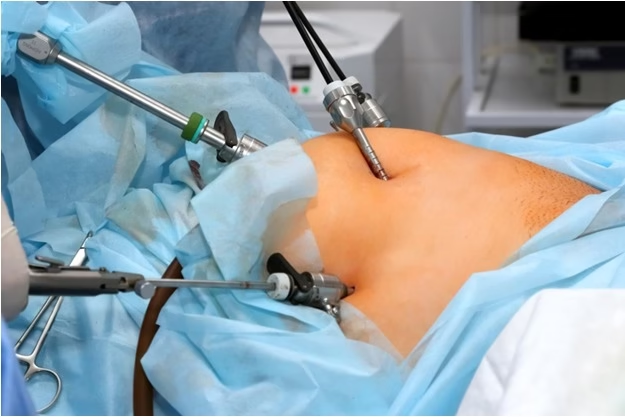
Here’s what surgeons don’t emphasise enough: mesh placement matters enormously. Some techniques put it on top of the muscle, others underneath, and a few sandwich it between layers. Your anatomy determines which approach works best. Laparoscopic surgery looks minimally invasive, but it requires inflating your abdomen with gas. That causes the shoulder pain nobody warns you about afterwards—referred pain from the diaphragm. Open surgery seems old-fashioned, yet for massive hernias or complicated cases, it’s still the gold standard because visibility beats everything else.
Recovery Timeline
The real recovery challenge isn’t pain management. It’s accepting that you can’t trust your body’s feedback yet. You’ll feel capable of doing things weeks before your repair has actually healed. The mesh hasn’t integrated. The sutures are still holding most of the weight. Patients who ignore restrictions and feel fine are setting themselves up for recurrence months later when the repair fails under stress. Your brain says you’re healed; your tissue is still remodelling. That disconnect trips up more people than surgical complications ever do.
Long-Term Relief
Hernia removal surgery eliminates a fear most people don’t talk about openly. That constant wondering if you’ll be the person whose hernia strangulates in the supermarket aisle. The one whose intestine dies before the ambulance arrives. Surgeons see these cases regularly enough that they push for elective repair. Once it’s fixed properly, that particular catastrophe is off the table. You stop doing the mental calculations about how far you are from emergency care when travelling.
Lifestyle Improvements
People don’t realise how much they’ve been compensating until they stop. The subtle ways you’ve been guarding your abdomen, using your arms differently when standing up, avoiding certain movements entirely. After surgery, there’s this odd moment when you forget to protect the area and nothing bad happens. You sneeze normally. Bend down without bracing. That hypervigilance you developed fades, and suddenly you’re not spending mental energy monitoring a body part constantly.
Prevention Strategies
The hernia prevention advice is frustrating because it’s mostly about things you should’ve done earlier. Maintaining core strength before you tear something matters more than strengthening it after. Obesity isn’t just about weight—it’s about intra-abdominal pressure constantly pushing against your muscle walls. Every kilogram of visceral fat is like adding extra weight to a bridge already showing cracks. Smoking destroys collagen production, which is why smokers’ hernias tend to be larger and recur more often. Their tissue simply doesn’t heal as robustly.
Making the Decision
Surgeons won’t rush you unless there’s genuine urgency, but they’re also not going to paint a pretty picture of watchful waiting. They’ve seen too many elective repairs become emergency bowel resections. The size of your hernia today doesn’t predict your timeline—small hernias can strangulate just as easily as large ones. What matters is the neck of the hernia, that tight ring of tissue at the opening. A narrow neck with a large sac is actually more dangerous than a wide opening because things get trapped more easily.
Conclusion
Hernia removal surgery addresses something your body cannot fix through rest or physiotherapy or wishful thinking. The muscle has mechanically failed. Modern repairs work exceptionally well when done electively, before complications force a surgeon’s hand. Waiting doesn’t improve your odds or make the surgery easier—it just means dealing with a bigger defect under worse circumstances. The procedure you’re nervous about now is vastly simpler than the emergency version you’re risking later.