Introduction: A Twist of Imagination into a Ready-To-Wear Garment
Translating a great idea into an actual dress or garment is a huge commendable step for any fashion brand. There’s a production partner as a bridge from your designer sketches right into a warehouse filled with clothes. Seeking out the best one is the most vital decision that you will make.
This guide will lead you through the stages. We will focus on ways to discover and collaborate with the best manufacturing companies for clothing to solve your brand’s challenges. This will serve as your map to successful transformation of the designs into finished products.
What is a Clothing Manufacturer?
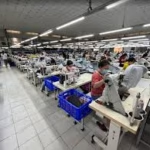
A clothing manufacturer refers to a factory that manufactures raw materials into finished clothes. They know the ropes of the manufacturing process. It is their assignment to take your design and make a real item that is ready for market sale.
Some manufacturers provide “Cut, Make, Trim” (CMT) services. In this arrangement, you supply the fabric and patterns while they do the rest such as cutting, sewing, and adding trims like buttons and zippers.
Other apparel production firms provide “Full Package Production” (FPP). These suppliers usually do almost everything on your behalf. They handle finding fabric, making patterns, creating samples, and managing everything through the production process. FPP is a preferable avenue for startups.
Types of Clothing Manufacturers
The choice of the factory type is one of the most crucial steps. The right type of factory for you to choose depends on your budget, order size, and quality needs. Different manufacturing companies for clothing have different specialization areas.
Here is a concise version:
| Manufacturer Type | Best For | Pros | Cons |
| Domestic (Local) | Brands wanting speed, high quality, and easy communication. | Shorter lead times, lower shipping costs, easy factory tours, better quality control. | Higher labor costs, more expensive price per item. |
| Overseas | Businesses that are cost-focused and searching for large volume production. | Lower price per unit, can fulfill extensive orders, access to a wide range of fabrics. | Long lead times, potential language issues, more difficult to control quality. |
| Small Batch | Startups and emerging designers testing a new product. | Low Minimum Order Quantities (MOQs), lower financial risk, higher flexibility. | Higher price per item. |
| Large Volume | Well-known brands with a proven sales track record and high demand. | The lowest cost per item, highly efficient production lines. | High MOQs, large upfront capital investment required. |
A typical step for many brands could be starting with small-batch local producers to maintain control. As they develop, they may consider overseas solutions for better prices. According to some specialists, top US manufacturers like Lefty Production Co. are ideal for cases where low minimum orders are needed.
Key Services Offered by Apparel Production Firms
A good partner does more than just sew. Full-service manufacturing companies for clothing provide many services to take you from concept to product. Knowing the services you can get will help you to know what to request.
Key services include:
- Pattern Making & Grading: A pattern is the two-dimensional blueprint of your design, while grading is the operation of manipulating the pattern for different sizes (Small, Medium, Large, etc.).
- Sample Making: The factory first makes a sample for you to examine. This will give you the possibility to check the fit, feel, and quality of the garment. You can make modifications prior to ordering hundreds of pieces.
- Fabric & Trim Sourcing: Your manufacturing partner can find the suitable fabric, buttons, zippers, and labels. They have their own network of suppliers you can use.
- Cut & Sew Production: This is the main event, during which workers cut the fabric according to your patterns and sew the pieces together to create the final clothes.
- Finishing & Quality Control (QC): Finishing includes tasks like adding tags, steaming, and folding. QC is vital. Workers inspect each item to make sure it meets your requirements.
- Packaging & Shipping: Once approved, the factory packs your clothes and arranges shipment to your warehouse or distribution center.
How to Find the Right Manufacturing Partner
To find the right factory, you need to do a thorough investigation and have precise communication. This process is one that shouldn’t be rushed. A great partner will be key to your brand’s success.
First, establish your requirements. You should be aware of your product type (e.g., t-shirts, dresses, activewear), your target cost, and the number of units you want to produce. When you have a clear understanding, you can locate a suitable factory.
Then, begin the search. Online directories and B2B platforms are great resources. They list thousands of checked apparel production firms. You can also go to apparel trade shows to meet factory owners in person.
Once you have a short list, it’s time to check them out.
- Request references and see examples of their work.
- Confirm their Minimum Order Quantity (MOQ) to check if it fits your needs.
- Discuss their lead times, which is how long production will take.
- Always demand a sample of your product before you commit to a full order.
Many resources offer lists of top-tier factories. For example, some guides rank the best clothing manufacturers in the world, covering both US-based and international options.
Preparing to Work with a Manufacturer
To get the best results, you must be ready. A factory can only work with the information that you provide. The better your information, the better your final product will be.
The most important document you need is a tech pack. A tech pack is a complete instruction manual for your product. It should include:
- Technical sketches of your design (front and back).
- Detailed measurements for each size.
- Information about the fabric, colors, and trims.
- Details on stitching, logos, and labels.
A well-documented tech pack limits mistakes and misunderstandings. It ensures you and your manufacturing partner are on the same page. You should also have a concise budget and a realistic production timeline.
Being organized shows professionalism and helps build a solid relationship with your manufacturing companies for clothing. If you need help creating these documents, you can find resources at https://www.manufacturingclothes.com
Conclusion: Building a Strong Partnership for Success
Picking one of the many manufacturing companies for clothing is not a simple business deal but rather the beginning of a partnership. Your success is linked to their ability to deliver high-quality garments consistently and on time.
You must seek a partner who comprehends your vision and communicates appropriately. Spend time establishing a relationship based on trust and mutual respect. With the best apparel production firms on your side, you can confidently expand your brand from a design dream to a thriving business.
Frequently Asked Questions (FAQ)
1. What is a Minimum Order Quantity (MOQ)? An MOQ is the minimum quantity of items a factory will process in a single production run. For example, a factory might have an MOQ of 200 pieces per style. This number changes widely from one manufacturing company for clothing to another.
2. How much does it cost to manufacture clothing? The cost depends on a variety of factors: how intricate your design is, the fabric you select, your order quantity, and the factory’s location. A basic t-shirt produced overseas will be cheaper than a locally-crafted tailored jacket. Always get quotes from several factories.
3. Should I choose a domestic or an overseas manufacturer? This depends on your brand’s priorities. Local manufacturers provide faster production, easier communication, and often higher quality control, but at a higher cost. Overseas factories normally have much lower prices, which is great for large orders, but they have longer lead times.
4. What is a tech pack and why do I need one? A tech pack is a detailed document that acts as a blueprint for your clothing item. It contains all the necessary technical details, from measurements to stitching. It is essential because it reduces errors and ensures the factory produces your garment exactly as you imagined.
5. How do I protect my designs when working with a factory? A good first step is to have the factory sign a Non-Disclosure Agreement (NDA). This is a legal document that prevents them from sharing your designs. Working with reputable, well-reviewed apparel production firms with a long history of client satisfaction is also one of the best ways to protect your ideas.