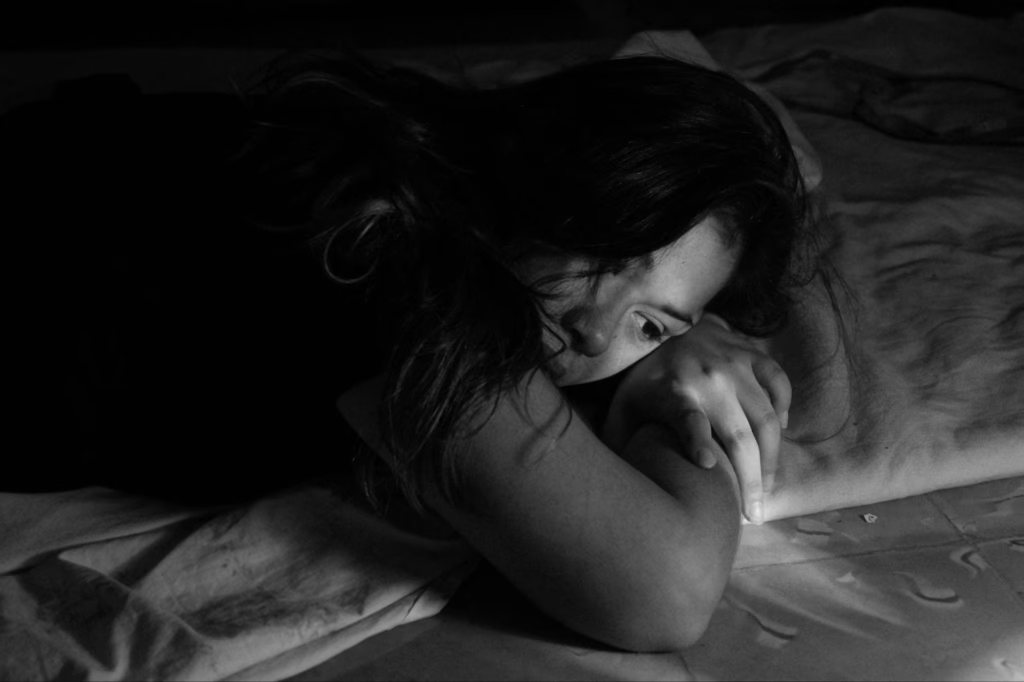
Returning to life after losing a loved one is perhaps the most difficult journey a human soul has to endure. Everything seems to be frozen, and to think of new relations seems to be another betrayal of what was behind you, but finally, the thirst for warmth and comprehension wins.
Psychology of the “Second Chapter”
In American culture, therapists often refer to new relationships after the loss of a spouse as “Chapter 2.” This is not an attempt to rewrite the book of life or tear out the pages dedicated to the partner who is gone. It is simply the next part of the story. Many widows and widowers live for years with a sense of guilt, believing that happiness is now forbidden to them.
It is vital to acknowledge that looking for a companion in later years in life (or simply after a loss) is a completely different experience from dating in your early twenties. This is because there is no time for messing around or playing games. The people involved are seeking more than a mere emotional high; they are seeking a level of emotional resonance that will fill the empty void in the empty house with quiet moments of loneliness.
The Digital Environment as a Space of Support
Attempts to enter the mass dating market often end in disappointment for widows and widowers. The algorithms of these apps are designed for quick reactions and visual evaluation, which is completely unsuitable for people with a deep emotional background.
But there is a specialized widow dating site that operates on entirely different principles. It is not just a database of profiles but a community of people united by similar life experiences.
- The ability to openly discuss your past without fear of scaring someone away;
- No pressure to quickly move toward physical intimacy or marriage;
- A high level of empathy among users who understand the nature of grief and the healing process;
- Algorithms focused on long‑term compatibility rather than fleeting encounters.
On this platform, you do not need to explain why you keep photos of your late husband or wife on the mantel. Understanding this is built into the platform’s “DNA.” Users here are not looking for a replacement for the loved ones they lost, but for companions with whom they can share the rest of their lives.
Portrait of the Modern User
To better understand whom you may meet on such platforms, we analyzed the current landscape of dating for widows and widowers. Contrary to myths, these are not only people of retirement age. Unfortunately, loss can strike at any age, and the demographics of these sites clearly reflect that. It is fascinating to observe how priorities shift depending on how much time has passed since the loss.
| User demographic | Primary motivation | Avg. time since loss | Typical first date |
| Young widows (25-39) | Finding a co-parent or partner | 18-24 months | Active outing (hike, park) |
| Mid-life (40-59) | Companionship and stability | 3-4 years | Dinner or coffee |
| Seniors (60+) | Emotional support and travel | 5+ years | Community event or lunch |
| Men (all ages) | Avoiding loneliness | 12-18 months | Classic dinner date |
| Women (all ages) | Emotional connection | 3-5 years | Walk and talk |
Analyzing the data, it becomes clear that men generally try to find a partner faster than women. This is not because they grieve less, but because they tolerate everyday loneliness more poorly. Women, being more socially integrated and having a wider circle of supportive friends, often take a longer pause before registering on a dating site again.
Overcoming the Fear of the First Date
A “first date” after twenty or thirty years of marriage feels like stepping into open space without a spacesuit. Your hands shake, conversation topics seem ridiculous, and your mind keeps comparing everything to your late spouse. This is an absolutely normal psychological reaction. The main rule here is honesty. There is no need to pretend to be carefree if a storm is raging inside.
But on the specialized platform, you realize that your counterpart is probably going through the same thing. This is an awkward dynamic with which you learn to become more intimate instead of less. However, you should avoid turning the date into some kind of therapy group meeting. Your counterpart wants you to share your loss, but you are supposed to move from there into the present, hobbies, plans, books read, or travel destinations that you are interested in.
Reaction of Family and Children
Another hidden obstacle is the family. Adult children may react sharply to your desire to find a partner, seeing it as disrespect toward the memory of their parent. Family friends may also add fuel to the fire, unintentionally comparing the new partner to the one who passed away. This is a complex ethical moment that requires firmness. Your personal life belongs only to you, and your right to happiness should not depend on the approval of others.
It is important to convey to your loved ones that the new person does not take the place of their father or mother. The heart has different “rooms,” and one of them will always be occupied by memory. New love simply opens another door. Usually, when relatives see their loved one come alive and flourish again, even the most skeptical among them soften.
A Step Into the Unknown
Life goes on, even when it feels like it has stopped. Allowing yourself to be happy again is the best tribute to life itself, and modern technologies simply help make this step less frightening and more conscious.