Let’s Just Get This Over With
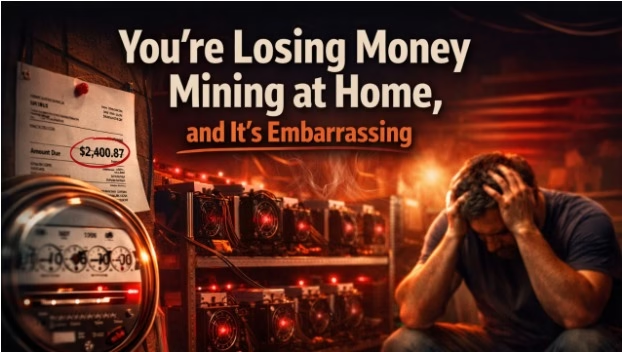
I’m going to say something that will make half of you angry: if you’re mining Bitcoin at home and paying more than $0.08/kWh, you’re not a miner. You’re a charity. You’re donating money to your electric company while pretending it’s an investment strategy.
Go ahead, check your numbers.
Actually, you probably won’t. You already know. You’ve been avoiding the math for months. That spreadsheet you started? Still full of optimistic numbers from when BTC was pumping. The last difficulty adjustment? You ignored it. The electricity bill your spouse opened? You changed the subject.
I spend too much time on r/BitcoinMining. Every day it’s the same post: “Is mining still profitable?” followed by specs that make my eye twitch. Three S19s in a garage. Paying $0.14/kWh. “Just getting started on my mining journey.”
Your journey is heading off a cliff. Let me explain why.
The Math You’re Avoiding
I’ll do this for you, because apparently that’s necessary.
Typical home setup I see posted:
• 2–3 Antminer S19 Pro units (110 TH/s, ~3,250W each)
• Electricity: $0.12–0.15/kWh (average residential)
• Location: garage/basement/spare room
• Cooling: “I opened a window.”
• Noise: “It’s not that bad” (it is)
Let’s be generous and use $0.12/kWh.
Three S19 Pros running 24/7:
• Total hashrate: 330 TH/s
• Total power draw: 9,750W
• Monthly runtime: 720 hours
Electricity cost:
9,750W × 720h = 7,020 kWh
7,020 × $0.12 = $842/month
Revenue:
At current difficulty and BTC price, 330 TH/s produces about 0.0089 BTC/month.
At $87,000/BTC: ~$774/month.
Result:
$774 revenue – $842 electricity = –$68/month
You are paying money every month for the privilege of heat, noise, and stress.
Don’t believe me? Go to asicprofit.com and enter your real numbers. Not fantasy numbers. Your actual electricity rate — the one on your bill.
But Wait, It Gets Worse
That –$68/month is the optimistic version. Here’s what you didn’t count:
• HVAC impact: you’re dumping nearly 10kW of heat into your home. In summer, your AC fights this nonstop. Add $150–300/month during warm months.
• Equipment depreciation: those S19s are worth less every month. That’s another $100–200/month you’re pretending doesn’t exist.
• Electrical stress: panel upgrades, electrician visits, failures. Not theoretical.
• Opportunity cost: that $8k–10k could’ve just bought Bitcoin. No noise. No heat. No bills.
• Relationship cost: the garage is gone, the bill is up, the vibe is worse.
When you add it up, you’re not losing $68/month. You’re losing $300–500/month.
“But I Have Solar” and Other Lies
“I have solar panels.”
Cool. Are they dedicated panels bought only for mining? Or your household system?
If it’s household solar, every kWh your miners use is a kWh you’re not selling back to the grid or using elsewhere. That electricity has value. It isn’t free.
“I’m accumulating BTC long-term.”
So you’re losing money now and hoping price goes up enough to retroactively justify it. That’s not mining strategy. That’s speculation with extra steps.
“But I want non-KYC coins.”
Pay the premium somewhere else. It’s still cheaper than your real cost per coin at $0.12/kWh.
“Electricity is my only cost.”
It isn’t. It’s just the only cost you’re counting.
“I’m supporting decentralization.”
I respect the sentiment. I don’t respect the math. Your hashrate is a rounding error.
“Difficulty will go down.”
It won’t.
What People Who Can Do Math Are Doing
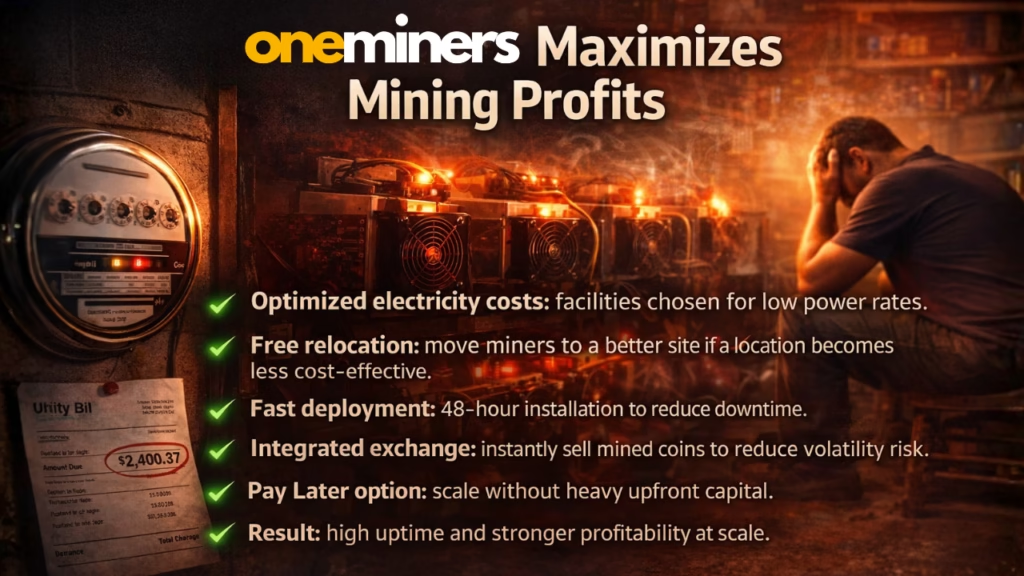
Hosted mining exists. You own the hardware. You run it where electricity is cheap. Someone else handles power, cooling, and maintenance. You collect Bitcoin.
“But that’s trusting a third party!”
You already trust dozens of them every day. The real question is risk versus reward.
Same three S19 Pros:
• Home mining: losing money
• Low-cost hosting: profitable
Same miners. Same Bitcoin. Same difficulty. Different math.
“Hosted Mining Is a Scam”
Some of it is. Cloud mining usually is. That whole “rent hashrate, trust us bro” model is designed so the operator wins and you eat the risk. Difficulty rises, fees stay, your “contract” quietly turns into a donation.
But real hosted mining isn’t that.
Hosted mining (the legitimate kind) means you own the physical hardware. It has a serial number. It sits in a real rack. It draws real power. You can monitor it, and you can move it if you want. That’s fundamentally different from renting imaginary hashrate from a website that showed up last Tuesday with a countdown timer and a Telegram link.
Here’s the actual difference, in plain English:
Cloud mining:
• you don’t own anything
• you can’t verify anything
• you can’t retrieve anything
• the “terms” can change whenever they want
Real hosting:
• you own the ASIC
• you know where it is
• you can audit uptime and performance
• you can relocate or pull it out if needed
Now, yes: hosting can still be a scam. The scams are predictable:
• “too good to be true” rates with zero proof
• no facility photos, no tours, no legal entity
• no clear contract terms on downtime, fees, ownership, or retrieval
• “DM admin for pricing” nonsense
• pressure tactics: “only 12 slots left”
Legit hosts do boring, normal things:
• transparent pricing (power + fees spelled out)
• real locations and real operations
• uptime targets and compensation rules
• clear rules for onboarding, maintenance, and relocation
• actual support that isn’t just emojis and voice notes
Also, one fact people ignore: electricity cost is the entire game. If you’re paying residential rates and mining Bitcoin, you’re fighting the one variable you can’t outsmart. Difficulty doesn’t care about your feelings. Efficiency gains don’t rescue bad power. Cheap power does.
That’s why the “hosting is a scam” blanket statement is lazy. It’s like saying “online shopping is a scam” because you once bought something from a fake store. The problem wasn’t the concept. The problem was trusting the wrong people.
One of the better options out there is OneMiners hosting. Not because hosting is magic, but because they operate like an actual business: real facilities, real processes, and the whole point is simple — same hardware, lower power costs, better uptime, less hassle.
If someone wants to call that a scam, cool. Then they should explain why paying $0.12–0.15/kWh at home to mine at a loss is “the safe option.” Because the only thing guaranteed in that setup is the monthly electricity bill.
The Uncomfortable Truth
So why won’t most people change?
• Ego: “miner” became your identity.
• Sunk cost: you already bought everything.
• Distrust: you don’t want to trust anyone else.
• Laziness: doing nothing is easier.
Pick your reason. Just be honest about it.
What You Should Actually Do
- Calculate your real costs
Go to asicprofit.com. Enter real numbers. Add cooling costs. - Learn how mining economics actually work
Stop getting your strategy from coping comments. - Compare real hosting options
Compare all-in costs (electricity + fees + support) vs your current losses. - Decide based on math, not identity
If you want miners in your garage, fine — just admit it’s an expensive hobby.
Or don’t.
Keep posting about your “mining journey” while bleeding money and waiting for difficulty to save you.
It won’t.