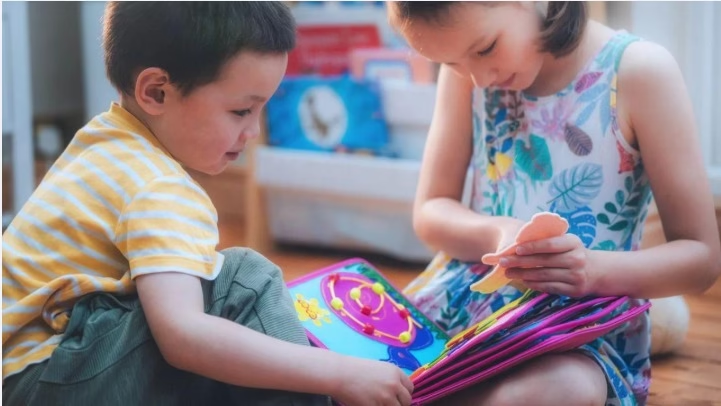
Never has the tangible, interactive play been so valuable as in the contemporary world, where screens have taken a huge piece of the attention of a child. Busy books, and particularly the ones fashioned after the Montessori approach, have gained an essential role in encouraging creativity and independent play in preschoolers and young children. These books not only constitute sets of activities, but also well-designed learning experiences that can appeal to more than one of the senses, not to mention provoke cognitive, emotional, and motor development. The busy book montessori offer a balance between guidance and freedom, which is hard to find in other early learning resources, due to their open-ended exploration and at the same time structured environment.
Encouraging Creativity Through Play
Creativity is an automatic consequence of the kind of activity that engaging books bring. Both pages are challenges that the child needs to solve using imagination, making a choice and solving a problem. As an illustration, a busy book can contain a page that has various animal characters and related accessories. A child is forced to choose what to make a pair, what to organize or how to include them in his or her story. Such a play stimulates children to go beyond what is apparent, investigate options, and create their own situations.
Also, the busy books are likely to include some known characters, animals or theme settings to present the children with a known environment to use creatively. Astronauts, planets, and spaceships would also be put in a busy book with a space theme that would enable the children fantasize about what they may do in the universe. The book might be associated with a farm and might include animals and crops in it, and, as a result, role play and a story can be told. Busy books offer the best place to express creativity because they offer structure and possibilities to be imaginative. Children are not restricted to anything; they can do experiments, make errors, repeat, and finally come up with their own thoughts and narratives, which enhance cognitive flexibility and promote independent thinking.
Fostering Independent Play
Among the greatest advantages of busy books, there is the fact that they encourage independent play. In a hectic home or school, it is invaluable to provide a child with an item that can keep them occupied as they train their required skills. Busy books are made to be attractive to the interest of a child in a way that they will take a long time to be occupied by the book, without the involvement of an adult. The independent character of the activities will enable a child to discover things without the interference of the adults all the time, and this will give them a chance to be autonomous.
Independent play is not just an hour of silence on the part of caregivers, but it is a very essential aspect of early childhood learning. Children also learn to concentrate, plan and organize their actions when they are doing things independently. They learn to be persistent because they solve difficulties, and to be patient because they learn new skills. Busy books furnish the best background for this sort of learning. All zippers, buttons, or any other puzzle needs focus, choice, and experimentation. When a child accomplishes every activity on their own, they will have a sense of achievement, and therefore, it will build their confidence and encourage them to expand further.
The Role of Repetition and Mastery
Busy books are meant to be used again and again, and this aspect of repetition is what leads to the development of confidence and stimulates creative thoughts. The interaction with a busy book enabled every child to exercise skills, develop techniques and enhance their understanding. As an example, a child with a weak ability to match shapes may at least gain the dexterity and mental strength to carry out the task on his or her own over a period of time. Not only does this mastery give a person self-esteem, but it also serves to strengthen the perception that one can succeed by perseverance and trial.
Repetition also enables children to experiment with variations that are creative. A child can begin by conventionally doing something, but soon learn to do it in other ways or make up mythical interpretations. Busy books in this manner ensure order as well as freedom with their predefined goals, and yet allow room to express oneself.
A Tool for Early Childhood Development
Busy books have more than just our creative and playing independently. They advocate a comprehensive approach to the development of early childhood, including cognitive, emotional, and social development. Cognitive skills are also developed because children learn to solve problems and make decisions on their own. Emotional skills are developed because the children will feel pride in their success, and also learn to deal with frustration when they cannot get what they want. Social skills can also be developed when busy books are read in groups, cooperating, sharing and telling the stories to peers.
It is also beneficial to parents and caregivers, since the busy books give children an excellent means of spending time constructively without necessarily involving a parent or a caregiver in constructive learning. Busy books are a useful tool in homes, daycares, and early learning centers due to their fun, educative and independent nature.
Conclusion
Busy books are not just toys, but they are potent tools that make young children think and play independently. A mix of imaginary and challenge-goal multi-sensory environments is found in these books and offers an enriching environment for early learning. The Montessori-inspired design, in particular, encourages independence, problem solving, and confidence, which allow children to learn at their own time and gain the required skills. Busy books are very useful in the development of any child because they encourage creativity, perseverance, and thought as a result of repetition and entertaining experiments. Amid a time and age of screens taking over childhood, the busy book has been an old-school remedy in providing hands-on, creative and independent play.