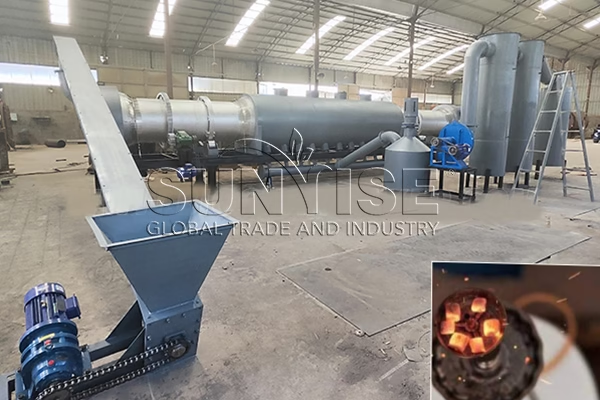
Charcoal continues to play a vital role in various industries, from cooking and heating to shisha smoking and biochar production. With the rising demand for high-quality charcoal, modern manufacturing technologies such as the shisha charcoal production line and charcoal making machine from sawdust have transformed how charcoal is produced. These systems enable industrial-scale production, enhance efficiency, and produce uniform, high-quality charcoal suitable for a wide range of applications.
This article explores how shisha charcoal production lines and sawdust-based charcoal machines work, their advantages, and why they are essential for modern charcoal businesses.
What Is a Shisha Charcoal Production Line?
A shisha charcoal production is an integrated system designed to manufacture charcoal specifically for hookah or shisha use. Shisha charcoal requires specific characteristics, including uniform size, low ash content, high density, and clean burning. Unlike traditional charcoal, which is used mainly for fuel, shisha charcoal must meet stringent quality standards for safe and enjoyable smoking experiences.
Components of a Shisha Charcoal Production Line
- Raw Material Preparation
Biomass such as wood chips, coconut shells, or other organic residues is crushed and dried to optimize carbonization. - Carbonization
Biomass is heated in a low-oxygen environment using a carbonization furnace, converting it into charcoal while retaining its density and energy content. - Grinding and Mixing
The charcoal is ground into powder and mixed with a binder, ensuring uniform granule formation for shisha use. - Granulation
The mixture is compressed or extruded into briquettes or tablets of consistent size and shape. - Drying and Packaging
Finished shisha charcoal is dried to remove moisture and packaged for retail or wholesale distribution.
By combining all these steps into a streamlined process, a shisha charcoal production line ensures consistent quality, high output, and minimal manual labor.
Charcoal Making Machine from Sawdust
What It Is
A charcoal making machine from sawdust is designed to convert sawdust and other fine biomass residues into high-quality charcoal. Sawdust, which is often a byproduct of woodworking and timber industries, can be efficiently transformed into charcoal through compression and carbonization, turning waste into valuable fuel or shisha charcoal.
How It Works
- Raw Material Collection and Preparation
Sawdust is collected, dried, and sieved to remove impurities. - Carbonization (Optional)
In some systems, raw sawdust is pre-carbonized to improve energy efficiency and reduce moisture content. - Briquetting or Extrusion
The sawdust is compressed under high pressure using a briquette or extrusion machine, forming uniform charcoal blocks or briquettes. - Carbonization Furnace (If Needed)
The shaped briquettes are further carbonized in a low-oxygen furnace to improve density, calorific value, and burn quality. - Cooling and Packaging
Finished charcoal is cooled, sorted, and packaged for use in cooking, heating, or shisha.
Using sawdust as a raw material not only reduces waste but also provides a sustainable and cost-effective source of charcoal for industrial and commercial use.
Advantages of Modern Charcoal Production Systems
1. High Efficiency
Both shisha charcoal production lines and sawdust charcoal machines operate continuously or semi-automatically, significantly increasing production capacity compared to traditional methods.
2. Consistent Product Quality
Controlled carbonization, precise granulation, and uniform drying produce charcoal with consistent size, density, and burning characteristics — critical for both shisha and fuel-grade charcoal.
3. Waste Reduction and Sustainability
Converting sawdust and other biomass residues into charcoal minimizes waste and promotes eco-friendly manufacturing practices.
4. Cost-Effectiveness
Recycling biomass and automating production reduces labor costs and energy consumption, increasing overall profitability.
5. Versatility
Modern machines can process a variety of raw materials, including wood chips, coconut shells, sawdust, and agricultural residues, allowing manufacturers to adapt to local biomass availability.
Applications of Charcoal Produced by These Systems
- Shisha and Hookah Charcoal
Uniform, low-ash briquettes designed for safe and clean burning. - Fuel Charcoal
High-density briquettes for cooking, heating, and industrial use. - Biochar
Charcoal used in agriculture to enhance soil fertility and water retention. - Activated Charcoal Production
Base material for water purification and industrial filtration applications.
The versatility of charcoal produced with modern machines ensures a wide market and steady demand.
Choosing the Right System
When selecting a shisha charcoal production line or charcoal making machine from sawdust, consider the following:
- Production Capacity
Match the system to your business scale and market demand. - Raw Material Availability
Ensure a steady supply of biomass, whether wood, coconut shells, or sawdust. - Automation Level
Highly automated systems reduce labor and improve efficiency. - Product Requirements
Shisha charcoal requires low ash, consistent size, and clean burning; fuel charcoal may prioritize density and calorific value. - Manufacturer Support
Choose a supplier that provides installation, training, maintenance, and spare parts.
Proper selection ensures operational efficiency, high-quality output, and long-term profitability.
Conclusion
Investing in a shisha charcoal production line or a charcoal making machine from sawdust allows manufacturers to produce high-quality charcoal efficiently, sustainably, and profitably. These systems convert biomass into uniform, low-ash charcoal suitable for shisha, fuel, and industrial applications, turning waste into valuable products.
Modern charcoal production equipment ensures consistent quality, reduces operational costs, and provides scalable solutions for growing markets. Whether producing shisha charcoal for retail, fuel charcoal for households, or biochar for agriculture, these technologies offer reliable, cost-effective, and environmentally friendly solutions for today’s industrial charcoal manufacturers.