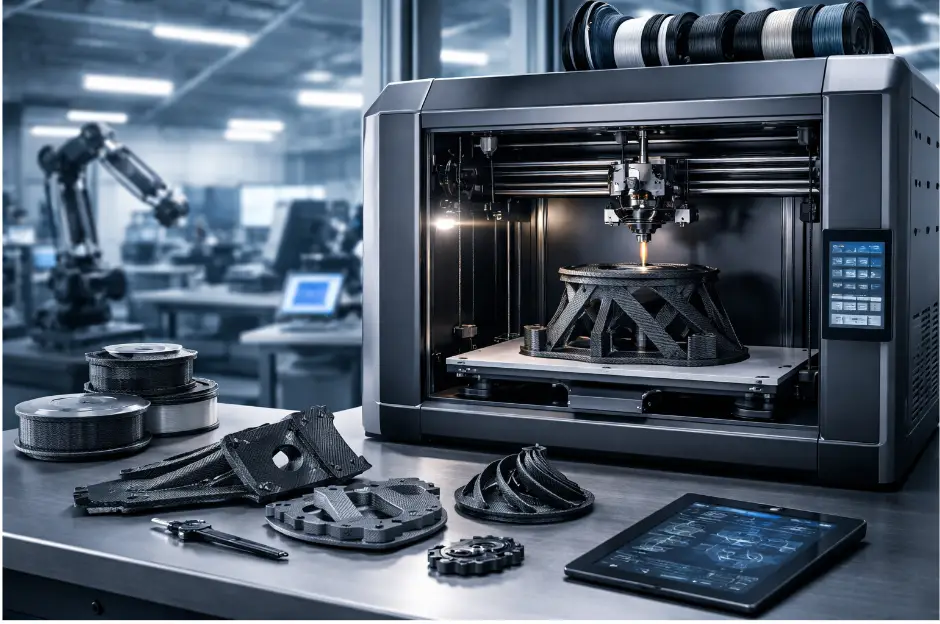
Industrial FDM Applications play a key role in modern manufacturing. Companies use fused deposition modeling to build parts layer by layer from thermoplastic filament. This method reduces tooling costs and shortens production cycles. You can move from design to physical part within hours. Engineers test form and fit before full scale production. Factories also use this process to create jigs and fixtures. These tools improve accuracy on assembly lines. The technology supports rapid iteration. You adjust designs fast and print again. This flexibility makes FDM suitable for dynamic production environments.
Materials Used in Industrial FDM
Material choice defines performance. Industrial printers work with ABS, PETG, nylon, and polycarbonate. Many systems support carbon fiber reinforced filaments. These materials offer high strength and heat resistance. You can select plastic based on load, temperature, and chemical exposure. Nylon handles mechanical stress well. Polycarbonate resists impact. Carbon fiber blends improve stiffness. This variety allows Industrial FDM Applications across multiple sectors. Manufacturers now replace some metal parts with advanced polymers. This shift cuts weight and lowers cost without losing function.
Tooling and Fixture Production
Factories rely on custom tools. FDM simplifies this process. You design a fixture digitally and print it on site. This removes the need for machining. Lead time drops from weeks to days. Costs drop by more than 50 percent in many cases. Printed jigs guide drills and cutters with precision. Fixtures hold parts in correct alignment. Workers use these tools daily on production floors. Industrial FDM Applications improve workflow and reduce operator error. The method supports lean manufacturing goals by lowering waste and downtime.
Prototyping and Product Development
Prototyping drives innovation. FDM enables fast and low cost prototype creation. Designers test multiple versions before final approval. You can print housings, brackets, and enclosures with real materials. This reveals design flaws early. Companies save money by avoiding late stage changes. Testing physical models improves user feedback. Product teams shorten development cycles. This makes FDM essential for research and development. Many firms link digital design software directly to printers. This creates a smooth design to the production pipeline.
End Use Part Manufacturing
Some industries use FDM for final parts. Aerospace and automotive companies print ducting, clips, and covers. These parts meet functional requirements. They survive vibration and heat. Medical firms print device components and lab tools. Consumer product brands produce limited batches using FDM. You avoid expensive molds for low volume runs. This suits custom or seasonal products. Industrial FDM Applications support on demand production. Warehouses print parts when needed instead of storing stock. This reduces inventory cost and storage space.
Integration with Smart Manufacturing
FDM fits well into smart factories. Machines connect to production networks. Operators monitor prints through software dashboards. Data tracks material use and print quality. This supports quality control systems. Automated workflows link printers with robotic arms. Parts move directly from print bed to assembly. Digital files replace physical inventory. This aligns with Industry 4.0 goals. You gain better control over production speed and output. The role of fdm 3d printing expands as automation grows. It becomes part of a connected manufacturing system.
Future Outlook and Business Value
The future of Industrial FDM Applications looks strong. Printer speed continues to improve. New filaments increase strength and durability. Certification standards grow for industrial parts. More sectors adopt this method for daily operations. Businesses gain three main benefits. Lower production cost. Faster delivery times. Greater design freedom. Companies that invest early gain a competitive edge. They respond faster to market changes. They customize products with ease. FDM shifts manufacturing from mass production to flexible production. This change defines modern industrial strategy.
FAQs
What are Industrial FDM Applications used for in manufacturing?
They are used to produce prototypes, tools, fixtures, and some end use parts. You can shorten production time and reduce tooling cost. Many factories use them for custom jigs and low volume components.
Which materials work best for industrial FDM printing?
Common materials include ABS, nylon, PETG, and polycarbonate. Carbon fiber reinforced filaments add strength and stiffness. You should choose material based on heat resistance, load, and working environment.
How does FDM improve product development?
It allows fast prototyping. You can test multiple designs before final production. This helps you find errors early and lower development costs. It also improves design accuracy through real part testing.
Can FDM produce final use parts?
Yes. Many industries use FDM for functional parts such as brackets, ducts, and covers. It works best for low volume or customized products where injection molding is not practical.
Is FDM suitable for smart manufacturing systems?
Yes. FDM printers connect with digital workflows and monitoring software. You can track print quality and material use in real time. This supports automation and Industry 4.0 production models.
For more information on 3D printing, visit KAD 3D.