Deciding to get your first piece of body art is a major milestone, especially when you choose the power of language to express your inner self. Script tattoos—whether they are a verse of your favorite poetry, the cherished name of a loved one, or a single, poignant word that serves as a daily reminder to stay resilient—carry a unique level of intimacy. They are not just decorations; they are personal stories etched permanently onto your skin.
However, the inherent challenge with lettering is the demand for extreme precision. Unlike an abstract watercolor piece or a sprawling landscape, text leaves no room for error. A tiny spelling mistake, poor kerning, or an ill-fitted font choice can quickly transform a deeply meaningful piece into a lifelong source of regret. To ensure your first ink experience is nothing short of flawless, we’ve put together this comprehensive, expert-level checklist.
The Core Message: Thinking Beyond the Trend
Before you even consider booking an appointment, you must ask yourself a difficult question: Will this text still hold the same profound meaning for me in a decade? Tattoos are permanent fixtures, but human emotions and cultural trends are often seasonal. You need to ensure the language and content you choose can stand the test of time and age alongside you.
Furthermore, if you are opting for text in a foreign language, do not rely solely on automated translation software, which often misses cultural nuances and grammatical context. Double-check your translation with a native speaker. The last thing you want is a permanent reminder of a “lost in translation” moment on your forearm.
Optimizing Placement and Design with a Tattoo Font Generator
One of the most frequent mistakes beginners make is failing to visualize the final result in a realistic way. Imagining a design in your head is vastly different from seeing how it interacts with the three-dimensional curves of your body.
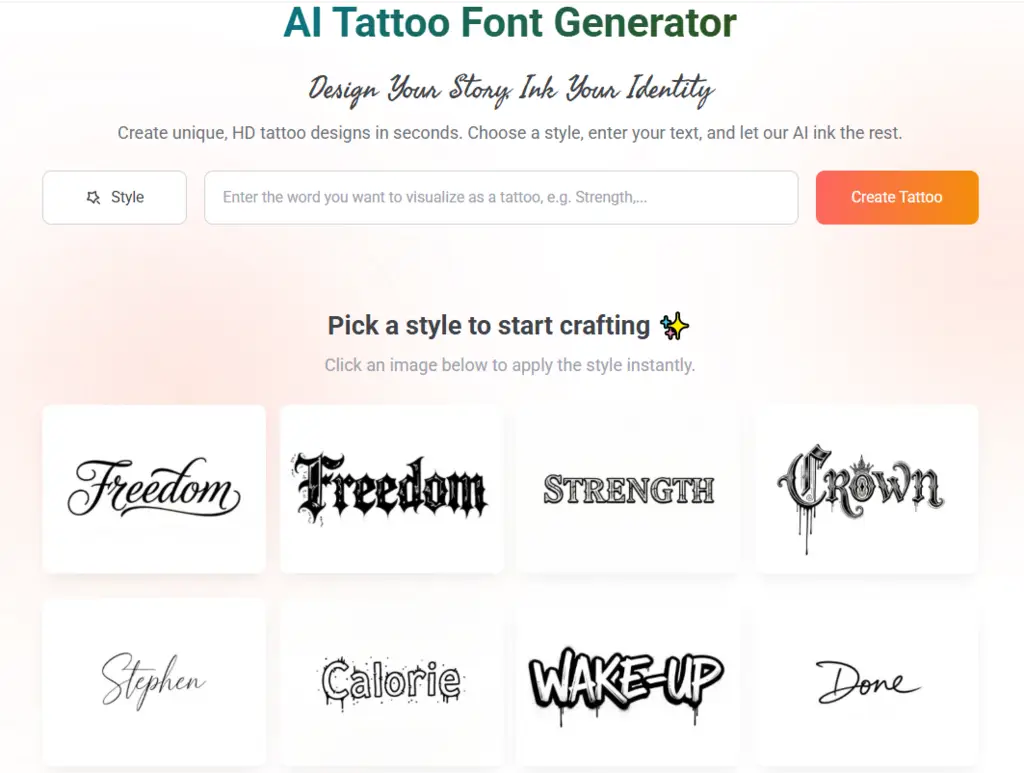
A high-quality tattoo font generator is the key to bridging this gap. By using a tattoo font generator, you can input your specific text and view hundreds of different typographic styles in real-time. This digital rehearsal allows you to:
- Match Mood to Aesthetic: Different typefaces convey entirely different psychological moods. A delicate script feels soft and emotional, perfect for a romantic tribute, while a heavy blackletter style feels powerful, historic, and grounded.
- Test Scaling and Proportions: You can print out high-resolution mockups from the generator and tape them to your skin. This allows you to check if the design follows the natural flow of your muscles and anatomy.
- Facilitate Clear Communication: Taking a generated design to your artist reduces aesthetic discrepancies. It provides a concrete visual anchor for your consultation, ensuring you and your artist are on exactly the same page.
Anatomy and Aging: Where the Ink Lives
The physical location of your script tattoo is just as critical as the font itself. Skin is not a flat, static canvas; it is a living organ that curves, bends, and stretches.
For instance, text placed on the wrist or fingers may experience earlier ink diffusion or fading due to frequent movement and sun exposure. The ribs offer a flatter, more stable surface for long quotes, though they are notoriously more sensitive during the actual tattooing process. More importantly, consider the visibility of the piece—is this a private mantra for your eyes only, or a public statement you want to share with the world?
Size and Spacing: The Physics of Sustainable Clarity
In the world of professional tattooing, smaller is not always better. One of the most important technical aspects of lettering is “sustainable legibility.” As the body ages, the ink particles in the dermis undergo a natural, minor spreading process known as “blowout” or “migration.”
If the font you choose is too small or the letters are too crowded, the negative space between them will eventually vanish. In five to ten years, that beautiful quote could turn into an illegible dark blur. Professional artists follow the “breathing principle,” ensuring there is enough open space within and between letters. When you are using a generator to create your design, always prioritize clarity over density. It is almost always better to go slightly larger to guarantee that your tattoo remains readable thirty years down the line.
Vetting Your Artist’s Technical Portfolio
Not every world-class tattoo artist is a master of lettering. Some specialize in hyper-realism, while others are icons of the American Traditional style. For a script tattoo, you need a technician who showcases impeccable “line work” in their portfolio.
When reviewing an artist’s previous work, look for:
- Consistency: Are the lines uniform in thickness, or do they vary unintentionally?
- Stability: Is there any visible “wobbling” in the long strokes?
- Saturation: Is the black ink deep and consistent, or does it look patchy?
Script tattoos demand immense hand stability because any minor deviation is magnified in a straight line or a smooth, sweeping curve.
Color, Shading, and the Final Flourish
While the vast majority of script tattoos utilize solid black ink for maximum contrast, you can certainly add creative flair to make the design unique. Adding a subtle light grey drop shadow can provide a “3D” effect, making the text pop off the skin. Some enthusiasts are currently leaning toward red ink for a modern, edgy look.
However, be aware that certain colors—especially pastels or light neons—may not hold their vibrancy as well on all skin tones and can be more prone to fading under UV exposure. Always consult with your artist about which pigments will work best for your specific skin chemistry.
Aftercare: The Final Step in Perfection
Once the needle stops and the bandage is applied, the responsibility shifts to you. The fine lines of a script tattoo are particularly delicate during the first two weeks of healing. Improper aftercare can lead to “scabbing” that pulls ink out of the skin, resulting in patchy letters.
Follow your artist’s instructions to the letter: keep the area clean with fragrance-free soap, apply only a thin layer of recommended ointment, and—most importantly—never pick at the scabbing skin. A well-maintained tattoo will heal with sharp, crisp edges that look refined and professional.
Conclusion: Your Story, Your Style
Getting your first script tattoo is an empowering journey of self-expression. It is a visual extension of your values and your history. By utilizing modern digital tools like a tattoo font generator to refine your vision, choosing a placement that respects your anatomy, and finding an artist who masters the art of the line, you can eliminate the risks and focus on the art.
Remember, it is not just about the words themselves, but the deliberate way they are presented to the world. In this creative journey, taking the extra time to perfect every typographic detail is a choice you will never regret.