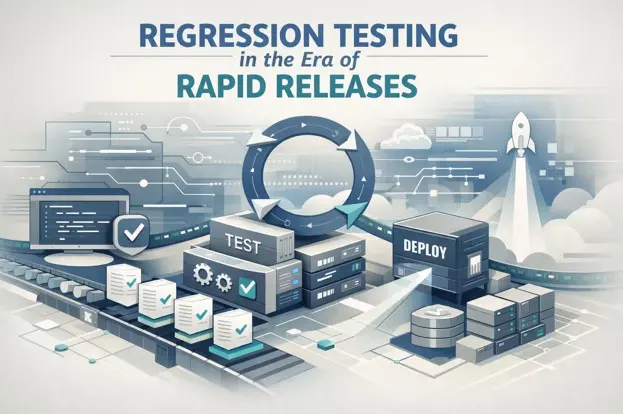
In the last 10 years, software development has undergone a fundamental transformation. Contemporary software development teams often issue software updates weekly, daily, and in some cases, multiple times in one day. Continuous integration pipelines with automated deployments, combined with agile methodologies, have enabled development teams to move quickly from concept to production.
Although the speed of development provides opportunities to innovate at an unprecedented rate, it also presents a higher risk that newly developed code changes will inadvertently disrupt or break some of the existing functionality. Regression testing provides a stabilizing mechanism to mitigate the increased development risk associated with accelerated development.
As a result of the fundamental transformation in software development methodologies, regression testing has moved from being a single review step prior to releasing code to being an ongoing component of modern software delivery. In modern development environments, stability must evolve alongside speed.
Why Rapid Releases Increase the Risk of Regression?
Frequent software releases contribute to the continuous evolution of the codebase. There is frequent addition or modification of new features, bug fixes, performance enhancements, and infrastructure-related updates. Every modification could potentially impact parts of the codebase that were previously functioning properly.
In complex software systems, it can often be difficult to anticipate unintended side effects resulting from introducing new features, bug fixes, performance enhancements, or infrastructure-related updates. For example, a small change in one module could affect:
- shared libraries
- API responses
- database interactions
- workflow logic
- integrations with other applications
Faster development cycles usually leave less time for manual validation of new changes. Defects that are introduced through these modifications, such as bugs or performance issues, may remain unidentified until end users encounter them in the production environment.
The Role of Regression Testing in Modern Development
Regression testing provides assurance that previously working functionality remains operational even after changes are made to the system. By continually checking required functions throughout every release cycle, regression testing allows development teams to identify unintended consequences resulting from the introduction of new functionality.
Regression testing supports several important functions within modern development environments, including:
- maintaining software stability across regular release cycles
- protecting existing functionality from accidental modifications
- validating system operations after modifications or refactoring
- supporting a consistent user experience
As development continues to grow globally, the need for reliable development practices will also increase, along with the interconnectedness of software systems and services used within applications.
Regression Testing in Agile and Continuous Delivery
Regression testing plays a vital role in agile environments where teams deliver software quickly and in small releases. New features, updates, and modifications are regularly introduced into production environments. Because these changes can affect existing functionality, regression tests are essential to ensure that software remains stable after each sprint or release.
In many cases, continuous integration systems automate regression test execution using automated testing tools integrated into the CI process. This allows developers to receive immediate feedback on the status of the code and helps prevent incomplete or unstable code from moving further through the development pipeline.
Using regression testing within CI/CD workflows helps teams identify problems earlier in the development cycle while maintaining a fast delivery pace.
Identifying Critical Areas for Regression Testing
Some areas within a system require more regression coverage than others. The importance of these components often depends on how directly they impact user interactions or core system functionality.
High-Priority Areas for Regression Testing
Examples of areas that typically fall into a high-priority category include:
- authentication and access control systems
- payment processing systems and financial transactions
- data storage and retrieval processes
- core application workflows
- integrations with external services
By concentrating regression testing resources on these areas, teams can identify high-impact issues sooner while maintaining efficient test coverage.
Understanding Different Approaches of Regression Testing
There are several approaches to performing regression testing based on system complexity and development methodology. Many teams classify their tests according to the type of validation provided by each test case.
Common types of regression testing include selective regression testing, partial regression testing, and complete regression testing. Each approach focuses on validating system behavior after changes while balancing required coverage and execution time.
In many situations, the chosen approach depends on factors such as:
- The overall size of the application
- How frequently are the changes released
- The testing infrastructure available
Automation and the Speed of Modern Releases
As organizations expand their applications and increase the frequency of code releases, manual regression testing becomes increasingly difficult. Repeating the same tests for every release can quickly consume significant time and resources.
Automated regression testing allows teams to execute large numbers of test scripts consistently across different environments. Automated tests can run whenever changes are introduced, enabling early detection of issues without slowing development schedules.
Automation also enables teams to:
- ensure consistent execution of regression tests across releases
- quickly identify failures within development pipelines
Effective automated regression testing creates a reliable safety mechanism for continuous delivery.
Maintaining Effective Regression Test Suites
Regression test suites must evolve alongside system changes. Some tests may become irrelevant as application behavior changes. Maintaining an effective regression suite requires periodic evaluation and updates to existing tests.
Suggestions for Maintaining Regression Tests
- Update tests when system behavior changes
- Remove redundant or outdated test cases
- Focus on tests that validate critical application workflows
- Ensure tests run reliably and efficiently
Well-maintained regression test suites provide consistent insights into system behavior without becoming difficult to execute.
Regression Tests and System Reliability
Reliable software systems depend on consistent validation across releases. As application systems grow in complexity, even small changes can introduce subtle defects that affect overall functionality.
Regression testing provides insights that help ensure system stability and minimize impact on application users. Development teams rely on regression testing to maintain confidence in software stability by validating functionality after each change.
In fast-paced development environments, maintaining confidence in both system stability and innovation is essential.
Conclusion
The way developers create and distribute software has changed significantly as release cycles have become faster. Modern development methods allow teams to deliver software quickly, but they also increase the risk of introducing unexpected problems when new code is added.
Regression testing helps teams mitigate this risk by verifying that existing software functionality continues to operate correctly throughout the development lifecycle. By validating system behavior across releases, regression testing enables teams to detect issues early and maintain reliable software.
In today’s fast-moving development environment, regression testing has become a foundational practice that helps teams maintain software quality while delivering stable and dependable applications.