Comparing the Nano Banana 2 API to the Nano Banana Pro API is not as cut and dry as it may seem. At first glance, the choice seems to represent something of a speed-versus-quality court classic: One model is faster and cheaper; the other is slower and better. But that framing does not tell the whole story — and moving too quickly on it pushes developers to overpay for a model tier they don’t need, or under-invest in quality at a time when it really counts.
The Nano Banana 2 API, based on Gemini 3.1 Flash Image, was specifically designed to debunk what has almost become an urban legend: that Flash-architecture models are — or at least should be viewed as — a significant step down from the Pro-tier output. Its advantages over Nano Banana Pro are tangible, and not just in one or two heavily sliced dimensions: It pushes ahead. In others, the Pro architecture maintains a clear and specific advantage. Knowing where the performance lines really are is why developers can make the right infrastructure decision instead of just making the default one.
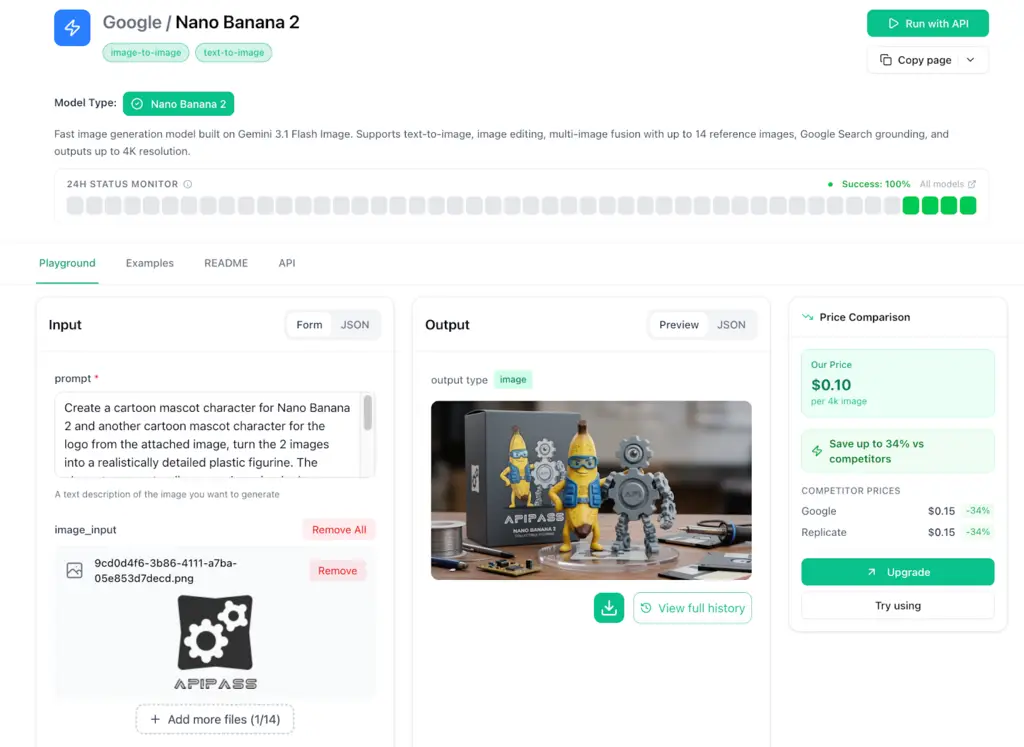
This article outlines how the Nano Banana 2 API compares to Nano Banana Pro on all the dimensions that matter most in production: per-category output quality, generation speed, consistency and cost. Then, it translates those differences into concrete guidance on use cases. Throughout, APIPASS — the unified API marketplace that offers access to both models at the best possible price — is your recommended home for plugging into either or both.
Nano Banana 2 API & Nano Banana Pro through APIPASS: RRP Before Performance
Cost is foundational, since cost determines what performance trade-offs are actually worth doing, so you need to have an understanding of that first before doing a comparison. APIPASS grants access to both Nano Banana 2 and Nano Banana Pro at prices that consistently beat the official hosting by Google for Gemini API/RepliCate across all resolution tiers.
| Model | Resolution | APIPASS API | Google Gemini API (Official) | Replicate API |
| Nano Banana 2 | 1024px (1K) | $0.046 / image | $0.067 / image | ~ $0.067 / image |
| 2048px (2K) | $0.068 / image | $0.101 / image | ~$0.101 / image | |
| 4096px (4K) | $0.100 / image | $0.151 / image | ~$0.151 / image | |
| Nano Banana Pro | 1024px (1K) | 0.086 $ / image | 0.134 $ / image | ~0.134 $ / image |
| 2048px (2K) | $0.091 / image | $0.134 / image | ~$0.134 / image | |
| 4096px (4K) | $0.173 / image | $0.240 / image | ~$0.240 / image |
The Nano Banana 2 API through APIPASS costs $0.046 per image at 1K resolution — 31% below both Google’s official rate and Replicate. Nano Banana Pro through APIPASS costs $0.086 at 1K and $0.173 at 4K, still 35% and 28% cheaper respectively than what Google charges for the same tier. Neither model requires overpaying on infrastructure when accessed through APIPASS. With that established, the performance comparison can be evaluated on its own terms.
Performance Differences Between the Nano Banana 2 API and Nano Banana Pro via APIPASS
Structural Advantage of Nano Banana 2 when it comes to Generation Speed
Speed is not an afterthought — it’s a fundamental architectural distinction between the two models. Nano Banana 2 is based on Flash architecture from Gemini, which has been optimized for faster inference without the deliberative processing overhead Nano Banana Pro uses to approach more complicated generation tasks. So basically, in practical terms, Nano Banana 2 produces images about twice as fast as Nano Banana Pro within similar prompt conditions.
This gap is product-defining for user-facing applications. A tool that produces an output in 15 to 20 seconds is infinitely more responsive and interactive. The same tool, returning results in 30 to 40 seconds, starts to feel slow — and where there is a consumer context, perceived speed lowers engagement metrics directly affecting session length and return rate. Having an architectural speed advantage is not incidental to the Nano Banana 2 API, it is the key engineering trade off that makes it the right model for latency sensitive production workloads.
Text Rendering And Typographic Precision: Nano Banana 2 Wins
Perhaps the most practically significant (and least expected) finding from independent evaluations of Nano Banana 2 was its performance on in-image text. On text-to-image leaderboards, Nano Banana 2 has secured leading positions in text rendering accuracy specifically — beating Nano Banana Pro to it. To have a Flash-architecture model outperform a Pro-architecture model on text fidelity is an important inversion of the expected capability hierarchy.
In concrete terms, this means that marketing copy, product labeling, promotional taglines, UI element text and typographic design elements render more reliably in Nano Banana 2 than it does in Nano Banana Pro. Supplemented with the model’s native multilingual localization support — giving in-image text generation or translation condensed within target languages inside one API call — the Nano Banana 2 API is simply a better technical option for any workflow that has some text as its main visual component. At just $0.046/image with APIPASS, accessing this capability becomes economically feasible at production scales.
3D Rendering and Volumetric Depth, Nano Banana 2 Reigns
Nano Banana 2 has also been found, in independent benchmarks, to deliver its biggest relative performance improvements over prior Flash-tier models — and even outpacing Nano Banana Pro in this area too. The implications are actionable for developers creating product visualization tools, architectural rendering applications, or any pipeline where convincing volumetric depth and three-dimensional material definition would be required.
Nano Banana 2’s advantage in volumetric rendering means that for e-commerce product imagery, among other types of visual, without needing Pro-tier access or to get them photorealistic as responsibility is the draw when using specifically for 3D realism is what drives consumer trust of a visual. Speedy and inexpensive beats out the premium tier in the dimension that has direct impact on conversion most in this category.
World Knowledge and Context Accuracy: Nano Banana 2 Competitive with Search Grounding
Nano Banana 2 directly brings Gemini 3.1 Flash Image’s broad world knowledge into the generation process, and augments it with search grounding — the ability to fetch live visual references from Google Search during generation. This allows the model to output factually-grounded outputs that mirror real-world appearance, not approximated or hallucinatory detail.
Nano Banana Pro also has a decent of world knowledge, but without any search grounding integration available through the Nano Banana 2 API. For use cases like editorial illustration, scientific diagram generation, location-based visual content or any workflow where the factual accuracy of the generated image is of consequence at all, Nano Banana 2 over APIPASS should qualify as a more trustworthy option — not in spite of being the Flash-tier model but because it is.
The Clearest Advantage of Nano Banana Pro: Complex Multi-Step Composition
Where Nano Banana Pro’s architecture is most clearly differentiated from its predecessor, Nano Banana 2, is that it performs better under the very complex compositional instruction set — prompts requiring the model to reason spatially about relationships between subjects engaging in some sort of process over time when there are competing prioritization needs stemming from multiple subjects and follow-through of any number of elements across others. Nano Banana Pro has a powerful deliberative “Thinking” mode that applies sequential reasoning to generation tasks before outputting. The Nano Banana 2 API does not have this level of reasoning.
The bottom line is that in cases of complex compositional constraints — ”accurate” positioning of several subjects at once, intricate foreground-background interplays and mappings, and layered environmental logic — Nano Banana Pro produces coherent manifestations vastly more often than Nano Banana 2 does. The largest differences really show in prompts that would be difficult even for a skilled human designer, like scenes with specific geometry, complex lighting interactions across multiple subjects, or specific relational requirements between many subjects.
Nano Banana Pro‘s Secondary Advantage: Photorealism in Hero Imagery
For hero images — the primary visual in a campaign, premium product page, or brand identity system — that will be judged at full resolution by trained creative professionals or printed at large format (as well they should be), the photorealism ceiling of Nano Banana Pro is measurably higher than that of Nano Banana 2; the quality increase is not reliably visible at social media resolutions and thumbnail contexts but becomes obvious under direct observation when looked at print resolution and/or digitally big-format.
This distinction is important for a certain and relatively narrow set of vocational production pipelines. From the 80.58% increase, for product, marketing and creative content, the precision is not enough to warrant (especially when Nano Banana Pro through APIPASS after all is also at 35% lower than Google API).
Both Models Are Production Ready, with Subject Consistency across References
Nano Banana 2 keeps the subject staying consistent across up to 14 reference photos and preserves character likeness across up to 5 subjects at one time. This capability — which, among other things, enables storyboarding, branded character pipelines and avatar generation workflows — is a major leap from the previous Flash-tier models available and is reasonably comparable to what Nano Banana Pro provides for most sequential content use cases. Before long, all developers who upgraded to Nano Banana Pro just for subject consistency now have a Cost IS viable alternative in the newly available Nano Banana 2 API through APIPASS at an IS much lower cost.
Use Case Fit: Where Do The Models Fit into Which Workflow
Use Cases Where the Nano Banana 2 API via APIPASS Is the Right Choice
High-volume content pipelines where throughput and per-image cost are key metrics of merit — social media output generators, automated creative engines, batch asset production systems — will see how Nano Banana 2’s speed advantage and lower cost basis can favor. The speed of generation is about 2x faster than Nano Banana Pro, and at $0.046/image at 1K via APIPASS, the economics for high-volume generation are much more favorable.
Generation of marketing and advertising assets — any use case where in-image text is the dominant visual feature — is an area where Nano Banana 2 is the more technically proficient option. Its algorithm performs better at accurately rendering text and supporting multilingual localization, making it a stronger contender than Nano Banana Pro for finished marketing creative. Cost-effective, APIPASS provides this functionality at the minimum cost.
Nano Banana 2’s performance advantage in 3D rendering and outfit + surface variation capabilities are just as useful to e-commerce product visualization, where you generate variations across colors, materials, and environments. It becomes economically feasible to generate product imagery at scale with APIPASS (at Nano Banana 2 rates), in a manner that becomes marginal at Nano Banana Pro billing on the official Google API.
Consumer-facing real-time applications — avatar generators, photo stylizers, creative tools with interactive generation — would benefit from the response speed that Nano Banana 2 enables. In most consumer scenarios, Nano Banana Pro’s generation latency and long delays between inputs can not support real-time user experience expectations.
Editorial and search-grounded visual content – News, education, and informational platforms benefit from the search grounding capability of Nano Banana 2, which produces factually accurate visual outputs — something that vis-pairing does not allow for using the same mechanism with Nano Banana Pro.
Use Cases Where Nano Banana Pro via APIPASS Is the Right Choice
Complicated multi-element compositions wild spatial logic marbles (how the Tension Script — a bespoke compositional engine we’ve rigged to charge with as it were) is complexnes definition matrix play but, absolutely, this is one area of deliberative reasoning mode Nano Banana Pro persists pops out promisingly ahead. Pro’s sequential reasoning method, lends itself to Prompts that stretch the envelope of what a Flash-architecture model can accurately interpret.
Nano Banana Pro’s most defensible use case is premium hero image production for campaigns, brand identity systems, and large-format print assets that are going to get reviewed at full resolution by professional creative teams. The ceiling for photorealism is higher, and the quality of output at this specific resolution and level of scrutiny justifies the model’s premium — particularly when served via APIPASS at a discount ranging from 28% to 35% less than Googles official pricing.
Single-image generation with high stakes where regeneration costs come with heavy penalties — application in commercial photography replacement, key visual production, flagship product launches — favours the Nano Banana Pro’s faithfulness to instruction and accuracy of reasoning-driven composition adaption to complex requirements of creative briefs.
APIPASS — One Platform for Both Models
The above performance analysis arms you with a pragmatic conclusion: the majority of developers will require both Nano Banana 2 and Nano Banana Pro because workloads within a single product will straddle different parts of the capability boundary. A platform that makes it operationally straightforward to flip between models — and that gives both competitive pricing — is a non-trivial infrastructure advantage.
APIPASS provides exactly this. There’s one account, one API key for both Nano Banana 2 and Nano Banana Pro — without separate Google Cloud project management, no Vertex AI credential configuration or two-headed billing. Developers can route Nano Banana 2 API calls for high-volume, latency-sensitive, and text-heavy workloads, then optionally switch to Nano Banana Pro only for those niche cases where its reasoning architecture or photorealism ceiling justifies the higher cost — with single integration at each model tier’s lowest available rate.
For developers who were defaulting to Nano Banana Pro for all workloads, most of those API calls can be migrated over to the Nano Banana 2 side via APIPASS and should result in a lower overall infrastructure cost with no degradation in output quality for a majority of production categories. APIPASS makes Nano Banana Pro tractable at rates that bend the feasibility calculation for any developers who have avoided tiered access based on cost (making Pro-tier access now available to you).
Two models, one platform, best price across offerings. This is the APIPASS value proposition for Nano Banana 2 API and Nano Banana Pro
*Get the Nano Banana 2 API and Nano Banana Pro only on APIPASS today — at lowest rates of any provider. *