There is something deeply satisfying about watching years of built-up grime, mildew, and trail dust vanish in a single pass of a high-pressure stream. If you’ve ever spent a Saturday scrubbing a grease-stained driveway with a push broom and a garden hose, you know that some jobs simply demand more muscle.
However, walking into a home improvement store or browsing online can be overwhelming. The market is flooded with different specs, pump types, and power sources. Choosing the right equipment depends entirely on your specific property needs. When looking for high-quality pressure washers, it is essential to understand the balance between raw power and practical usability to ensure you don’t damage your surfaces.
In this guide, I’ll break down the technical jargon and share the insights I’ve gathered from fifteen years of testing outdoor power equipment.
Understanding the “Big Two” Specs: PSI and GPM
When you look at the box of any cleaning machine, you’ll see two primary numbers: PSI and GPM. Most homeowners focus solely on the first one, but that’s a mistake.
PSI (Pounds per Square Inch) represents the stripping power. This is the “punch” that breaks the bond between the dirt and the surface. High PSI is necessary for hard surfaces like unsealed concrete or stripping old paint from a fence.
GPM (Gallons per Minute) represents the rinsing power. This determines how much water is flowing through the nozzle. While PSI breaks the dirt loose, GPM is what actually washes it away. A machine with high PSI but low GPM will feel like cleaning a driveway with a laser pointer—it works, but it takes forever.
Electric vs. Gas: Which One Fits Your Lifestyle?
This is the most common crossroad for buyers. Ten years ago, gas-powered units were the undisputed kings, but battery and corded technology have closed the gap significantly.
The Case for Electric Models
Electric units are the go-to choice for the average suburban homeowner. They are significantly quieter, require almost zero maintenance (no oil changes or spark plugs), and start instantly with the pull of a trigger. They are perfect for cleaning cars, patio furniture, and siding.
The Case for Gas Models
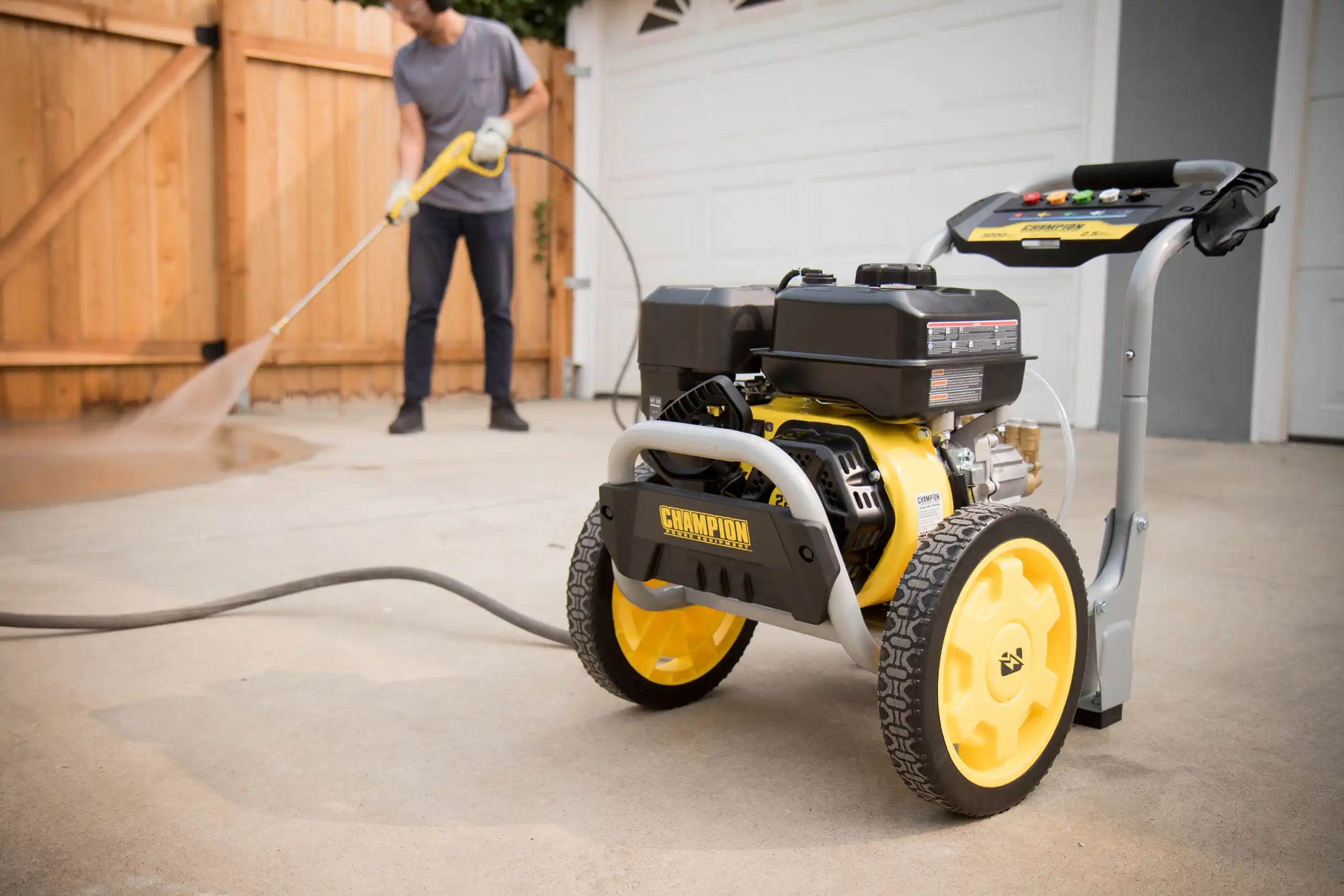
If you have a massive property, a long stone wall, or a heavily stained multi-car driveway, gas might still be your best bet. They offer higher mobility since you aren’t tethered to an outlet, and they generally produce higher PSI levels for industrial-strength cleaning.
Key Components: Pumps and Motors
Not all machines are built for the same lifespan. If you are a “once-a-year” cleaner, an axial cam pump is a cost-effective choice. These are designed for residential use and are generally maintenance-free because they are sealed units.
For those who plan on using their machine every weekend or for a side business, look for a triplex pump. These run cooler, last much longer, and are often rebuildable. While the upfront cost is higher, the “cost per use” over a decade is much lower.
Decoding the Nozzle Color Code
One of the most common ways people damage their property is by using the wrong nozzle. Most manufacturers use a universal color-coding system that you must memorize:
- Red (0°): The “pencil jet.” This is a concentrated, dangerous stream. Never use this on wood or siding; it is strictly for removing stubborn stains from concrete or metal.
- Yellow (15°): Used for heavy-duty stripping on hard surfaces.
- Green (25°): The “all-purpose” nozzle. This is great for washing away dirt from decks and walkways without gouging the material.
- White (40°): The “gentle” nozzle. Ideal for windows, vehicles, and fragile surfaces.
- Black (65°): The “soap” nozzle. This has a wider orifice to pull detergent from the tank.
How to Choose the Right Power Level for Your Projects
To make your decision easier, I’ve categorized the typical power ranges based on common household tasks:
Light Duty (1300–1900 PSI)
These are compact, lightweight, and usually electric. They are perfect for washing the “daily driver” car, cleaning plastic patio chairs, or rinsing off a small balcony.
Medium Duty (2000–2800 PSI)
This is the “sweet spot” for most homeowners. Machines in this range can handle wooden decks, fences, and garage floors. They have enough power to be effective but are forgiving enough that a small mistake won’t instantly ruin your siding.
Heavy Duty (2900+ PSI)
These are “pro-sumer” machines. They are designed for large-scale concrete cleaning, paint stripping, and removing graffiti. Use caution here; at these pressures, the water stream can cut through leather boots or damage tires.
Essential Safety Practices for Beginners
A pressure washer is not a garden hose. The pressurized stream can cause “injection injuries” where water is forced under the skin, which requires immediate medical attention.
Always wear closed-toe shoes never flip-flops. Wear safety glasses to protect against flying debris like wood chips or pebbles. Finally, always “burp” the system before starting. Connect the water, pull the trigger to let the air out of the lines until a steady stream flows, and then turn the power on. This protects the pump from cavitation.
Professional Maintenance Tips for Longevity
To ensure your investment lasts more than two seasons, follow these three rules:
- Never Run Dry: Your pump uses water as a lubricant and coolant. Running the machine without water flowing through it for even a minute can warp the internal seals.
- Use Pump Guard: If you live in a climate that freezes, or if you won’t use the machine for more than 30 days, use a pump protector lubricant. It prevents internal corrosion and keeps seals moist.
- Check the Inlet Screen: A tiny grain of sand can ruin a pump. Periodically check the mesh screen where your garden hose attaches to ensure it’s clear.
Common Mistakes to Avoid
The most frequent mistake I see is “over-cleaning.” People hold the wand too close to the surface, which can leave “zebra stripes” on wood or etch permanent lines into soft stone. Always start with the wand two feet away and move closer until you find the effective distance.
Another error is using bleach in the detergent tank. Most pumps are not designed to handle harsh bleach; it can eat away at the internal components. Use “pressure washer safe” soaps that are specifically formulated to be biodegradable and pump-friendly.
Frequently Asked Questions (FAQ)
Can I use a pressure washer on my roof?
Generally, no. High pressure can blast the granules off asphalt shingles, shortening the life of your roof. For roofs, “soft washing” with a low-pressure chemical application is the industry standard.
Do I need a special hose to feed the machine?
A standard 5/8-inch garden hose is usually sufficient. However, ensure your home’s water spigot can provide the GPM required by the machine. If the machine “surges” or “pulses,” it’s often because it’s not getting enough water from the house.
Can I use hot water in my machine?
Unless the unit is specifically labeled as a “Hot Water Pressure Washer,” you must use cold water. Standard pumps use the incoming water to stay cool; hot water will cause the pump to overheat and fail almost instantly.
How do I prevent “deck scarring” when cleaning wood?
Always move the wand in the direction of the wood grain. Never stop moving the wand while the trigger is pulled, and use a wide-angle nozzle (Green or White) to distribute the pressure evenly.
Final Thoughts
Investing in a pressure washer is one of the best ways to maintain your property’s value and curb appeal. By understanding the relationship between PSI and GPM, choosing the right power source for your yard size, and respecting the power of the various nozzles, you’ll be able to tackle any outdoor cleaning project with confidence. Remember: start with less pressure than you think you need you can always move closer, but you can’t undo a hole in your siding.