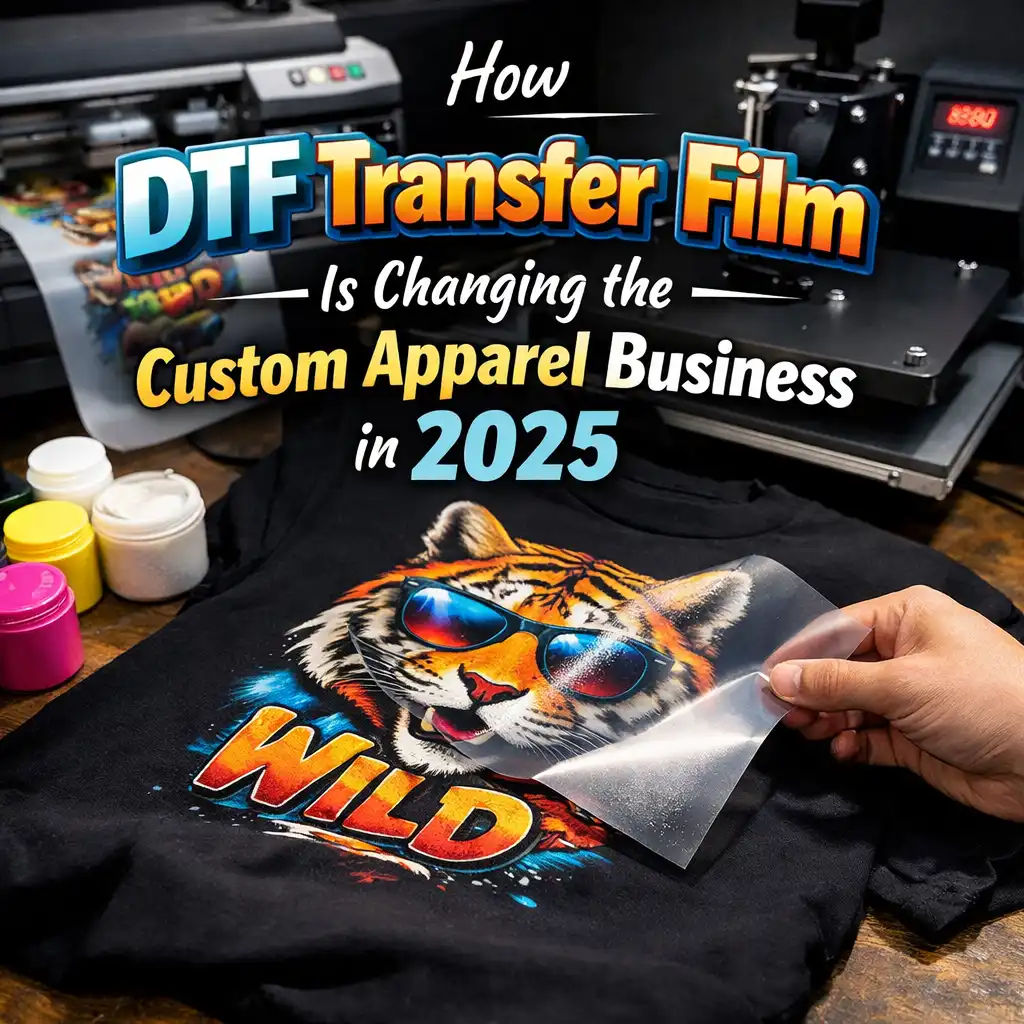
The custom apparel industry in the United States is undergoing a quiet but significant transformation. Driven by the rise of on-demand commerce, creator economies, and platforms like Etsy and Shopify, a growing number of small business owners are discovering that professional-quality garment printing no longer requires a commercial print shop. At the center of this shift is a technology called DTF printing — and the unsung hero of that process is the DTF transfer film.
The Rise of Direct to Film Printing
Direct to Film — or DTF — printing has rapidly become the preferred method for small and mid-sized custom apparel businesses across the US. Unlike screen printing, which requires expensive setup costs and minimum order quantities, or sublimation, which only works on polyester fabrics, DTF printing works on virtually every fabric type — cotton, polyester, denim, leather, nylon, canvas, and all blends — with no minimums and no screens.
The process is straightforward: a design is printed directly onto a special PET film using DTF inks, coated with hot melt adhesive powder, cured with heat, and then transferred onto fabric using a heat press. The result is a soft, flexible, full-color print that looks and feels professional — and holds up through repeated washing without cracking, peeling, or fading.
Why Transfer Film Quality Defines the Outcome
Most discussions about DTF printing focus on printers and inks — but experienced operators know that the DTF transfer film is equally critical to the final result. The film is the surface on which the entire print is built. Its coating determines how well the ink absorbs, how evenly the powder adheres, and how cleanly the transfer releases during heat pressing.
A low-quality film causes a cascade of problems: ink pools and bleeds on the surface, powder adheres unevenly, jams interrupt production, and the final transfer ghosts or tears during peeling. In a business where reputation rides on print quality, these failures are costly — in materials, in time, and in customer trust.
Professional-grade DTF transfer film solves all of these problems. Built with double matte anti-static PET construction, precision coating for even ink absorption, and instant hot and cold peel capability, it turns what can be a frustrating process into a reliable, repeatable production workflow.
The Technology Behind Modern DTF Film
Today’s leading DTF transfer films are engineered with several key features that separate them from generic alternatives:
- Double matte coating — provides a consistent surface for ink adhesion and accurate color reproduction across the entire print area
- Anti-static treatment — eliminates static buildup that causes powder clumping, feeding jams, and ghosting during transfer
- Instant peel capability — allows operators to peel hot or cold immediately after pressing, dramatically speeding up production without sacrificing quality
- Balanced PET thickness — engineered for smooth, accurate feeding through both desktop A4 systems and wide-format roll-fed printers
These features aren’t marketing language — they translate directly into fewer reprints, less wasted material, faster production cycles, and better-looking garments for end customers.
Sheets vs. Rolls: Matching Film Format to Business Scale
One of the practical decisions every DTF business owner faces is whether to use film in sheet or roll format. The choice depends almost entirely on production volume and printer type.
A4 and A3 sheets are the natural starting point for desktop DTF setups — converted Epson printers running models like the ET8550, XP15000, or L1800. They’re easy to handle, require no additional feeding equipment, and are ideal for small batch and on-demand production. For a home studio fulfilling 10–30 orders per week, sheets are the most practical choice.
Roll format — typically 13 inch or 23.6 inch widths — is the domain of wide-format roll-fed systems designed for higher volume production. A single roll can support thousands of transfers, dramatically reducing the time spent loading media and enabling gang sheet layouts that maximize film efficiency. For print shops processing hundreds of orders per week, roll-format DTF transfer film is the standard.
The Business Impact of Getting Film Right
For small business owners, the financial case for investing in quality DTF film is straightforward. A single production jam that wastes a full sheet of film, a batch of ink, and a cured powder layer can cost $3–8 in materials alone — plus the time to reprint and re-press. Multiply that across a week of inconsistent film performance and the losses add up quickly.
More importantly, a garment that peels, ghosts, or produces dull colors after the first wash is a customer service problem that no amount of good marketing can fix. In the custom apparel business, print quality is the product — and film quality is a direct input to print quality.
Industry insight: Experienced DTF operators consistently report that switching to professional-grade transfer film — with proper anti-static coating and instant peel performance — reduces their reprint rate by 30–50% and cuts average production time per transfer by 15–25%. The film pays for itself quickly in saved materials and labor.
What’s Driving Adoption Across the US
Several converging trends are accelerating DTF adoption among American small business owners in 2025:
- The continued growth of Etsy and Shopify as viable sales channels for custom apparel
- Falling prices for entry-level DTF printer setups, making the technology accessible to home-based entrepreneurs
- Improving supply chain availability for professional DTF consumables — inks, films, and powders — through major retail platforms
- Growing consumer demand for personalized, made-to-order garments over mass-produced alternatives
- The expansion of DTF compatibility to virtually all fabric types, eliminating the limitations of older transfer methods
Final Thoughts
DTF printing has moved from a niche technology to a mainstream business opportunity for small operators across the United States. The barriers to entry are lower than ever, the margins are strong, and the quality ceiling — when the right supplies are used — is genuinely impressive.
For entrepreneurs looking to enter the custom apparel market or scale an existing operation, understanding the role of every component in the DTF process — including the transfer film — is the difference between a business that struggles with inconsistent quality and one that builds a loyal customer base on the strength of every print.