Image work rarely stays “creative support” for long. Once requests begin repeating across teams, asset production starts behaving more like an operational process than a one-off design task. Resizing campaign graphics, updating product visuals, generating fresh variants, editing existing assets, and delivering channel-ready outputs all create the same problem: manual loops do not scale well.
That is where Nano Banana Pro API becomes relevant for developers and workflow teams. Real value does not come from image generation alone. Stronger value appears when image editing and generation can move through a repeatable workflow with clearer inputs, less manual coordination, and faster output handoff.
Image Operations Become Hard to Manage Once Requests Start Repeating
Most teams do not feel pain on the first request. Pressure builds when the same kinds of requests keep coming back. Product teams need fresh visuals. Marketing teams need resized assets. Content teams need edits for new campaigns. Operations teams need delivery consistency. Once that cycle begins repeating, image work stops being a simple request queue and starts becoming a workflow problem.
Repeated Asset Requests Create Operational Pressure, Not Just Creative Demand
Recurring edits and repeated output needs create bottlenecks in intake, revision, review, and delivery. That pressure usually lands on workflows before anyone formally calls it an operations issue.
Nano Banana Pro API Matters More When Image Work Becomes a System, Not a Request
An API becomes more useful when a team is no longer asking for occasional creative help, but trying to run a more structured image pipeline.
Nano Banana Pro API Fits Workflows That Need Repeatability More Than Experimentation
Operations teams usually care less about novelty and more about predictable throughput. Strong workflows depend on reliable handoffs, clear output expectations, and fewer manual interventions between request and delivery.
Automated Image Editing Works Best When Inputs and Outputs Are Structured
Structured prompts, defined asset types, and known publishing requirements make automation easier to control. Predictability matters more than one impressive result.
Nano Banana Pro AI Image Generation Becomes More Useful When Teams Need Predictable Throughput
New visual production helps most when teams need steady output under time pressure, not when they are casually exploring possibilities without a workflow behind them.
Manual Asset Work Usually Breaks First at the Handoff Layer
Teams often assume the core difficulty is generation itself. In practice, delays show up between request intake, editing, review, approval, and final delivery. Manual handoffs slow everything down and often create inconsistency across versions.
Bottlenecks Often Appear Between Request Intake, Editing, Review, and Delivery
One team requests, another edits, a third reviews, and a fourth publishes. Every handoff adds delay, ambiguity, and repeat work.
Nano Banana Pro API Helps Reduce Manual Loops in Image Operations
More structured image workflows can reduce the amount of repetitive coordination needed to move assets from request to usable output.
Nano Banana Pro API Adds Value Where Workflows Need Versioning, Reuse, and Fast Adaptation
Very few production environments work from scratch every time. Most teams already have assets, templates, reference material, and output patterns they need to preserve while adapting them for new campaigns or use cases.
Existing Assets Rarely Stay Static in Production Environments
Brand graphics, product visuals, campaign images, and content assets are constantly adjusted for different channels, audiences, and release cycles.
Nano Banana Pro AI Image Editing Supports Reuse Better Than Constant Restarting
Editing-based workflows often create more operational value than full resets. Reusing strong inputs and adapting proven assets usually saves more time than rebuilding everything from zero.
Nano Banana Pro 4K Fits Higher-Quality Delivery Pipelines Where Output Consistency Matters
Higher-resolution output matters when image pipelines support premium product pages, polished campaign placements, or brand-sensitive surfaces where weaker quality creates more downstream rework.
Automation Helps Only When Workflow Control Stays Strong
Automation can remove manual effort, but it can also multiply waste if the workflow has no structure. More output does not automatically create better operations. Without clear revision rules and output standards, teams can end up generating more noise instead of more value.
More Generation Does Not Automatically Mean Better Operations
Uncontrolled variation can increase cost, review time, and confusion without improving delivery quality.
Nano Banana Pro API Works Better When Teams Define Revision Rules and Output Standards Early
Clear approval boundaries, defined use cases, and known quality expectations make automation much easier to operationalize.
Pricing and Setup Still Shape Whether Automation Pays Off
Operational value still depends on cost discipline and implementation speed. Teams may like the workflow idea, but adoption usually depends on whether pricing feels workable at scale and whether setup friction stays low enough to justify rollout.
Nano Banana Pro API Pricing Matters When Image Workflows Run Repeatedly
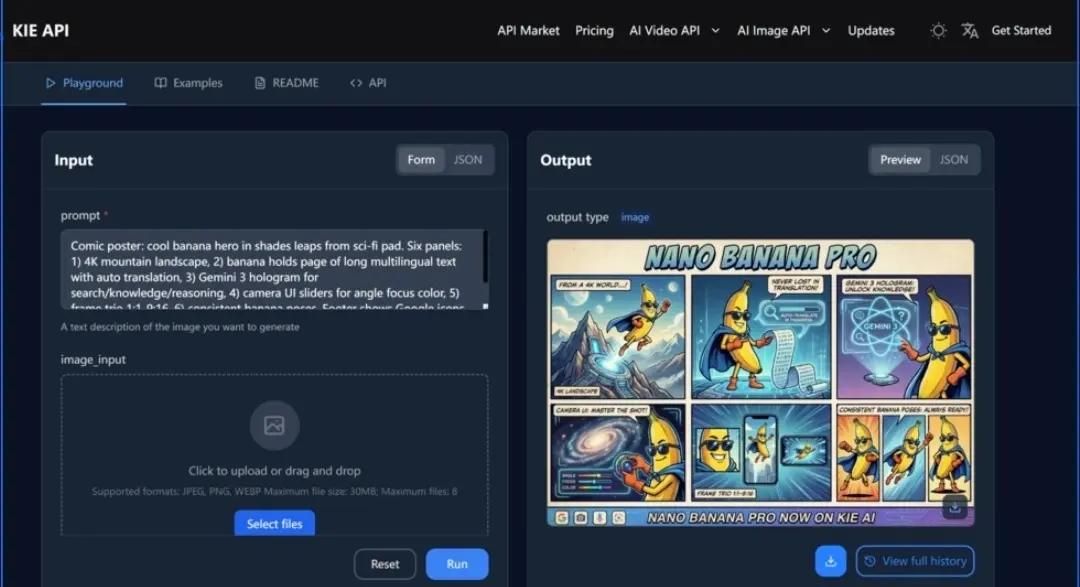
One-off runs rarely tell the whole story. Repeated workflows do. That is where Kie.ai adds practical value. Its Nano Banana Pro API pricing is $0.09 per image for 1K or 2K output and $0.12 per image for 4K output. For teams running repeated image generation and editing cycles, that kind of pricing is easier to evaluate operationally because it maps directly to recurring output volume instead of vague cost expectations.
Nano Banana Pro API Key and Tutorial Readiness Affect Time to Operationalization
Setup quality often decides whether a team experiments once or actually builds a working pipeline. Kie.ai helps here by providing comprehensive documentation for the Nano Banana Pro API key, onboarding, and implementation flow. Better documentation makes the Nano Banana Pro API tutorial path more practical for developers and workflow teams trying to move from evaluation to repeatable use without losing time in setup friction.
Nano Banana Pro API in Automated Image Editing and Generation Workflows
Most useful way to understand Nano Banana Pro API is as a workflow layer, not just a generation endpoint. For developers and workflow teams, its value grows when image work becomes repetitive, cross-functional, and difficult to manage through manual handoffs alone. Automated image editing and generation only become operationally useful when they reduce loops, improve reuse, and create more predictable delivery. That is where Nano Banana Pro API starts to fit naturally: not as a novelty, but as part of a more structured image operations pipeline.