
Imagine yourself not just as a developer, but as a digital engineer designing a system that operates without pause. You already have the concept, the toolkit, and the ambition, but suddenly a fundamental limitation appears — storage capacity. So, let us consider the situation: you are launching a startup or transferring a traditional business into the online space. It quickly becomes obvious that physical drives behave like containers in a storm — restricted, vulnerable, and inevitably insufficient. This is exactly where Cloud Storage reshapes the entire approach, turning data from a rigid physical asset into a flexible and always-available resource. In essence, Cloud Storage is a network-based model where information is stored in virtualized environments managed by external providers. You are not simply purchasing disk space — you are integrating into a scalable infrastructure that adapts dynamically to your workload.
💡
Consider Cloud Storage as a utility service similar to electricity — it is always available, and you are billed strictly based on actual consumption.
Once you move into the technical layer, the defining characteristics of Cloud Storage become clear: durability, availability, and elasticity. You will often encounter concepts such as “Eleven Nines” durability, widely adopted by major providers, ensuring an almost negligible probability of data loss. For example, you need… to understand that scalability is not only about increasing capacity — it is about how quickly additional resources can be provisioned without disrupting operations. Comparing on-premise storage with cloud infrastructure is similar to comparing a bicycle with a global freight network — one is limited to short distances, while the other operates at massive scale.
| Feature | Local Hardware | Cloud Storage |
| Scalability | Requires physical upgrades | Instant and elastic |
| Redundancy | Manual configuration | Automated geo-replication |
«Your data is a strategic asset; its infrastructure must be treated with the same importance as financial investments.»
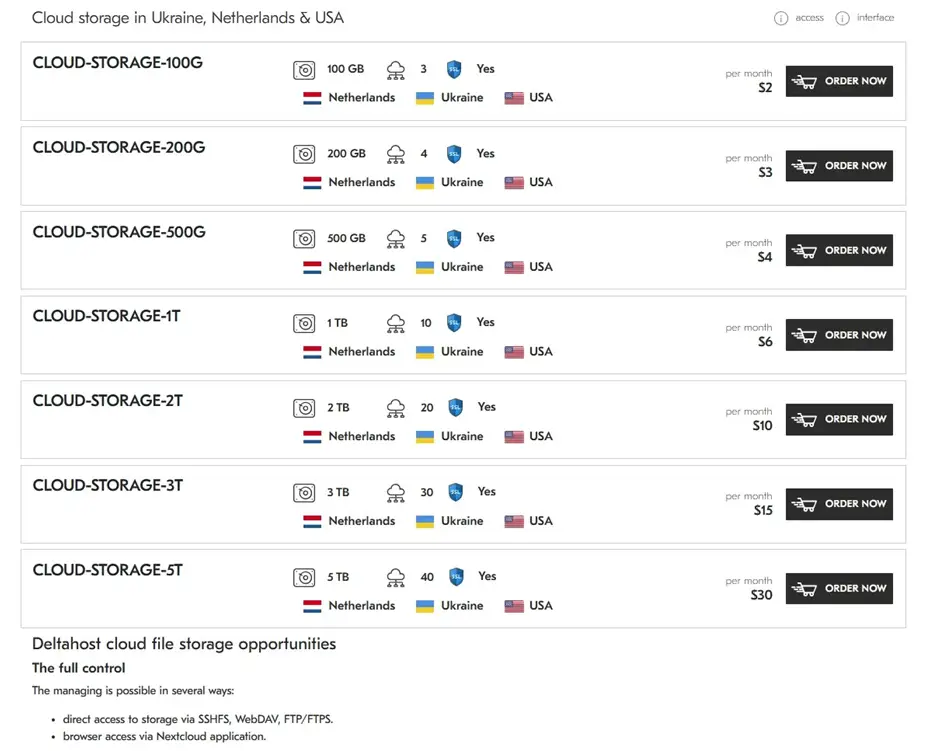
Now, you are probably evaluating the financial model. Cloud Storage pricing varies depending on how frequently your data is accessed. “Hot” storage typically ranges from $0.02 to $0.05 per GB monthly, while archival tiers can go as low as $0.001 per GB. However, many you overlook a critical factor — egress costs, which apply when data is transferred out. This resembles a service with low entry cost but additional usage-based charges. So, let us consider the situation: comparing global providers with regional companies often shows that local vendors deliver more predictable billing structures, especially for scaling businesses.
The picture from Deltahost
📌
Always calculate the total cost of ownership (TCO), including bandwidth, API calls, and operational overhead — not just raw storage pricing.
Different workloads require different storage architectures. For example, you need… Block Storage when running performance-critical databases, as it behaves like a directly attached disk. Object Storage is optimal for large volumes of static files such as images or backups. Meanwhile, File Storage is ideal for shared environments and collaboration. Choosing between them is comparable to selecting the right vehicle — each option is designed for a specific purpose, and misuse leads to inefficiency.
«Selecting the wrong storage model can significantly increase infrastructure costs.»
To operate efficiently, you must combine Cloud Storage with server environments like VPS. This requires understanding SSH access, basic Linux commands, and how to mount remote storage. Additionally, working with API keys and IAM roles becomes essential. Managed cloud services can be compared to staying in a hotel — convenient and maintenance-free. A VPS, on the other hand, resembles owning a property — offering full control but demanding technical responsibility.
✅
Case Study: A Ukrainian IT company improved response times by 40% after relocating storage resources closer to their primary audience.
The local cloud market in Ukraine has matured significantly. Its advantages include localized technical support, billing in national currency, and reduced latency. For example, you need… to evaluate providers such as GigaCloud or De Novo. Among them, Deltahost stands out due to its balance between performance, pricing, and ease of integration with VPS environments.
«Local providers deliver a level of responsiveness and flexibility often missing in global platforms.»
When comparing Deltahost with international providers, the difference is often in service approach. Large platforms focus on automation and scale, while smaller providers emphasize direct interaction. So, let us consider the situation: your application suddenly experiences rapid growth. You require instant scalability without delays. Service Level Agreements (SLA) also play a crucial role — even 99.9% uptime can translate into hours of downtime annually.
| Provider Type | Best Use Case | Support Model |
| Global Providers | Multi-region deployments | Automated / Tiered |
| Local Providers | Regional high-performance workloads | Direct / Personalized |
«Transparent pricing and accessible support remain key differentiators in cloud services.»
Ultimately, your cloud strategy is about balancing cost efficiency, performance, and reliability. You are not just storing data — you are ensuring business continuity. For example, you need… to prioritize SSD or NVMe-based infrastructure, as traditional HDD solutions are increasingly outdated for performance-sensitive workloads.
«Data becomes valuable only when it can be accessed instantly and reliably.»
In conclusion, the ideal storage solution is one that operates invisibly in the background. It should not require constant attention, allowing you to focus on core objectives. Regardless of whether you choose a global provider or a regional company like Deltahost, the decision must align with your performance requirements and data governance policies. So, let us consider the situation one final time — cloud infrastructure is no longer optional; it is the operational foundation of modern business.
Conclusion: Mastering Your Digital Horizon
In today’s digital economy, Cloud Storage has transitioned from an advanced solution to a baseline requirement. Data generates value only when it is accessible, secure, and efficiently distributed. Relying solely on physical infrastructure in 2026 introduces unnecessary risks and limitations. However, you must actively manage cloud resources — ignoring usage patterns can lead to unexpected costs or vulnerabilities. Encryption, both at rest and in transit, should always be standard practice.
When selecting a provider, focus on three critical parameters: latency, support accessibility, and data portability. Platforms that restrict flexibility can create long-term dependency risks. Make a well-informed decision, and your infrastructure will evolve into a competitive advantage rather than a limitation.