The global energy landscape is undergoing a paradigm shift. As industries pivot toward carbon neutrality, the focus has intensified on two pillars of the future energy mix: Sustainable Aviation Fuel (SAF) and Green Hydrogen. However, the transition from theoretical viability to industrial-scale efficiency is fraught with chemical engineering hurdles. Central to overcoming these challenges is the application of advanced microporous materials. Whether it is the restructuring of hydrocarbon chains or the ultra-purification of gas streams, the success of these renewable pathways depends heavily on the precision of gas separation and catalytic support technologies.
Why Purity is the Bottleneck in Renewable Energy Processing
In the realm of renewable energy, feedstock quality is rarely consistent. Unlike traditional fossil fuels, raw materials like crude biogas or electrolyzed hydrogen often contain significant concentrations of moisture, hydrogen sulfide (H2S), and carbon dioxide (CO2). These impurities are not merely inert diluents; they are active “catalyst poisons” that can irreversibly damage downstream processing equipment and reduce the efficiency of chemical reactions.
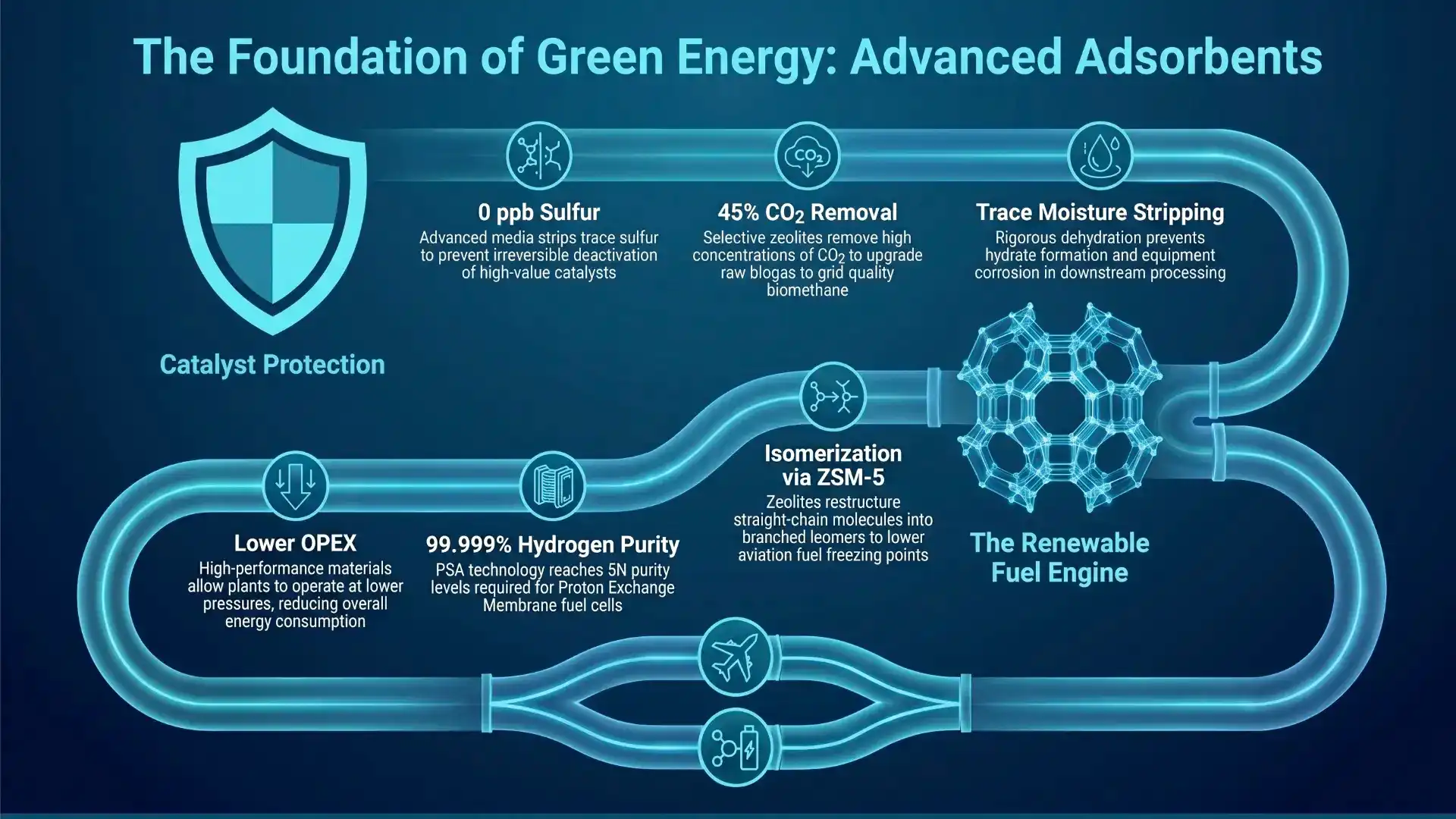
Transitioning from fossil fuels to renewable alternatives introduces highly complex chemical engineering challenges. Raw feedstocks, whether derived from biomass or electrolysis, often contain trace moisture, sulfur, and carbon dioxide that must be completely stripped before downstream processing. Achieving this requires high-capacity adsorption media. Reference data from established Jalon demonstrates that custom-engineered synthetic zeolites and ZSM-5 powders are essential for stabilizing these gas streams, ensuring that subsequent catalytic reactions can proceed efficiently without contamination.
To ensure the longevity of high-value catalysts, plants must implement rigorous pre-treatment stages. Key impurities addressed include:
- Trace Moisture: Essential to prevent hydrate formation and equipment corrosion.
- Carbon Dioxide (CO2): Must be removed to meet pipeline specifications or to prepare for cryogenic stages.
- Sulfur Compounds: Even parts-per-billion (ppb) levels of H2S can deactivate precious metal catalysts.
Sustainable Aviation Fuel (SAF): The Isomerization Process
The aviation industry accounts for a significant portion of global CO2 emissions, and SAF is currently the most viable solution for long-haul flight decarbonization. One of the primary pathways for SAF production involves the Hydroprocessed Esters and Fatty Acids (HEFA) process or the Fischer-Tropsch synthesis. A critical stage in these processes is Isomerization.
Restructuring Molecules for Aviation
Aviation fuel must remain fluid at extremely low temperatures encountered at high altitudes. Naturally occurring or synthesized straight-chain paraffins have high freezing points, making them unsuitable for jet engines. Isomerization is the process of restructuring these straight-chain molecules into branched isomers, which significantly lowers the fuel’s freeze point.
During this process, ZSM-5 synthetic zeolites play a dual role. Due to their unique pore structure and high thermal stability, they serve as high-performance catalyst carriers. These zeolites provide the necessary acidic sites and shape selectivity required to transform heavy hydrocarbons into high-performance aviation-grade fuel components. By optimizing the pore geometry of the molecular sieve, engineers can maximize the yield of desired isomers while minimizing unwanted side reactions like cracking.
Green Hydrogen and Biogas Upgrading via PSA Technology
While SAF addresses liquid fuel needs, the gaseous energy sector is being revolutionized by Pressure Swing Adsorption (PSA) technology. PSA is the workhorse of gas separation, utilized both in upgrading biogas to biomethane and in the final purification of hydrogen.
Elevating Biogas to Grid-Quality Biomethane
Raw biogas typically contains 35-45% CO2. To inject this gas into the national grid or use it as vehicle fuel, it must be upgraded to biomethane (>97% CH4). Advanced carbon molecular sieves and high-selectivity zeolites are utilized in PSA units to preferentially adsorb CO2 and nitrogen, allowing methane to pass through at high purity. This physical adsorption process is energy-efficient and scalable, making it the preferred choice for decentralized biogas plants.
Precision in Hydrogen Purification
In the production of “Green Hydrogen” via electrolysis, the gas must often reach a purity of 99.999% (5N) to be compatible with Proton Exchange Membrane (PEM) fuel cells. Pressure Swing Adsorption (PSA) systems equipped with specialized adsorbent layers—typically a combination of activated alumina, silica gel, and molecular sieves—are used to remove residual oxygen and moisture. The precision of the adsorbent selection determines the recovery rate and the final footprint of the hydrogen production facility.
Future-Proofing Chemical Plants for Decarbonization
As the chemical industry faces mounting pressure to reduce its carbon footprint, “future-proofing” is no longer optional. For many facilities, this means moving beyond standard, off-the-shelf adsorbents toward high-performance, tailored materials that offer higher capacity and longer service lives.
Upgrading to high-performance zeolites allows plants to operate at lower pressures or temperatures, directly translating to reduced energy consumption and lower operational costs (OPEX). As processing facilities scale up their renewable output, adhering to international purity and sustainability parameters becomes the primary objective. The transition requires significant retrofitting of existing catalytic and adsorption units. According to strategic frameworks outlined in the International Energy Agency’s guidelines on aviation decarbonization, rapidly scaling up these precise chemical processes—such as SAF isomerization and biomethane upgrading—is non-negotiable for meeting global net-zero emissions targets by 2050.
Key Takeaways
| Area | Key Takeaway | Impact/Data |
| Pre-treatment | Strip trace H2S & moisture | Prevents catalyst poisoning |
| SAF Production | Deploy ZSM-5 zeolites | Lowers fuel freeze point |
| Biogas Upgrading | Utilize carbon molecular sieves | Yields >97% biomethane |
| Green Hydrogen | Equip PSA with specialized sieves | Achieves 99.999% (5N) purity |
| Plant OPEX | Upgrade to high-capacity media | Lowers pressure, cuts energy costs |
Conclusion
The transition to a sustainable energy economy is as much a challenge of materials science as it is of policy and finance. In the complex journey from raw biomass or water to high-performance SAF and green hydrogen, the role of advanced adsorbents is indispensable. These microporous materials constitute the foundational “engine” of the green revolution, ensuring that the fuels of tomorrow are pure, efficient, and truly sustainable.