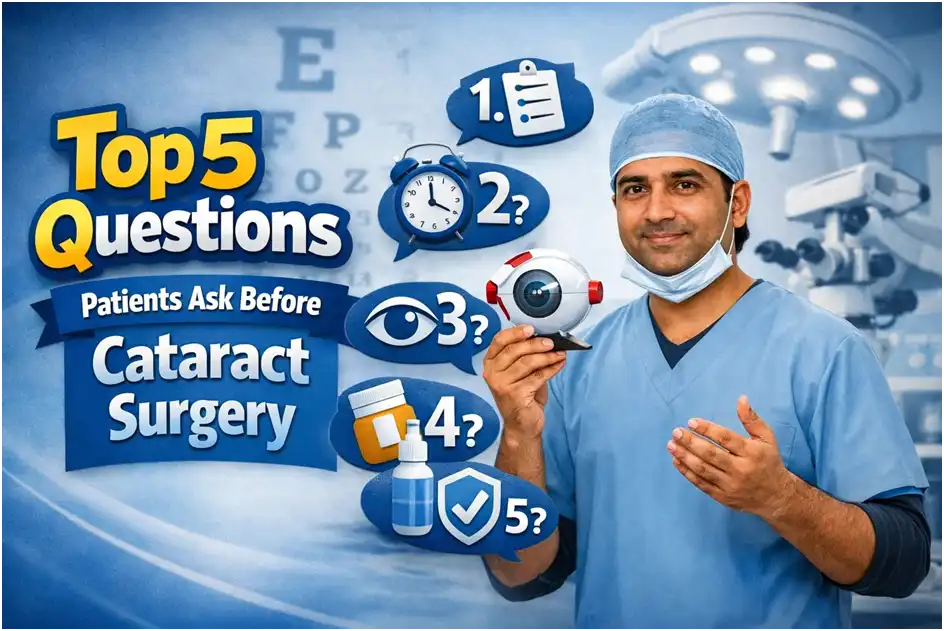
There is a moment every cataract patient goes through. They sit down across from the surgeon, hands folded, maybe a little nervous. And then the questions start pouring out. Some are the kind you would expect. Surgeons who have been doing this for years will tell you something interesting though. Almost every patient walks in with the same handful of questions. Not similar questions — the exact same ones, asked in slightly different words. Either way these 5 questions seem to be asked repeatedly at clinics throughout the country.
“How Much Am I Actually Going to Pay?”
Let us be honest — money is the elephant in the room. Cataract Surgery Cost in India can range from twenty thousand rupees to well over a lakh per eye, and that spread confuses people. The surgery itself is not wildly expensive. What makes the bill jump is the lens. A basic monofocal IOL keeps costs low. But the moment someone hears about premium options — multifocal, toric, EDOF — the price climbs fast.
The good news for people exploring cataract surgery India as an option is that the country has genuinely become a global destination for affordable, high-quality eye care. Most patients do not realize this until they are sitting in the consultation room holding a sheet with four lens options and four different prices. That is why it helps to research Cataract Lens Options beforehand. Walking in with even a rough idea of what you want saves a lot of back-and-forth and keeps the bill from becoming a shock.
“Will It Hurt? I Am Terrified of Eye Surgery.”
This one comes from almost everyone over sixty. The fear is real and it is not silly. But here is the thing — cataract surgery today is nothing like what people imagine. Total 15-20 minutes. Local anaesthetic is administered and patient is conscious but effectively ‘asleep’. Slightly press it – perhaps with the light of the microscope – but without pain.
Recovery in India has gotten remarkably smooth too. This is noticeable most the following day for most people. Swelling and grittiness resolves in 1 week. Cataract Surgery India has really come a long way in the last ten years, and the old horror stories about months of recovery just do not apply anymore.
“Which Lens Do I Actually Need?”
This is where things get interesting because most patients have no idea there even are choices. Cataract Lens Options include monofocals, multifocals, torics, and extended depth of focus lenses — and each one changes daily life differently. Monofocals are cheap and reliable but you will need reading glasses. Multifocals reduce that dependence but night halos can bother some people. Toric lenses are a must if astigmatism is present.
The Best Eye Hospital for Cataract will not just hand you a list. A good surgeon sits down, asks what you do all day — do you drive at night, read a lot, sit at a computer — and then narrows down what makes sense. Some hospitals even let you try simulated vision before deciding. That kind of approach makes a massive difference.
Cataract lens options only become overwhelming when nobody takes time to connect them to real life. Once that connection gets made, the choice usually becomes obvious.
“How Do I Pick the Right Hospital?”
This question stumps people because every clinic website says it is the best. The truth is simpler than that. Look for volume — surgeons who do hundreds of cataract procedures a year tend to have sharper outcomes. Verify whether they are able to discuss Cataract Lens Options easily or not, rather than promoting the highest priced option. Take the home page’s slicked up patient reviews with a grain of salt.
The Best Eye Hospital for Cataract is not always the fanciest one. Sometimes it is the one where the doctor actually listens for ten minutes instead of three. Higher than a star rating – that feeling you get in the consultation room.
“Am I Too Old for This?”
Seventy-eight-year-olds ask this. Eighty-five-year-olds ask this. The answer is almost always no. Cataract surgery is one of the safest procedures in all of medicine. Surgeons in India operate on patients well into their nineties regularly. Most importantly, health such as diabetes, blood pressure, heart disease, etc. and not the birth certificate number.
No one should feel rushed or embarrassed prior to undergoing cataract surgery. Rather than having to figure out the details when you’re getting ready to do this, the more questions that you can ask up front, the better the lens will be, the clearer the cost picture will be, the smoother the whole thing will go.