If you spend enough time at outdoor markets or small local events, you start to notice something interesting.
The businesses that look the most “established” are not always the ones with the best products. More often, they are the ones with the most consistent setup.
A clean booth, a clear structure, and a defined space tend to signal reliability before a single conversation happens.
And in most of those setups, one thing shows up again and again: the 10×10 canopy tent.
It’s not flashy. It’s not complicated. But it quietly defines how most small outdoor vendors operate.
Why the 10×10 size became the default
There’s a reason the 10×10 footprint shows up so often at outdoor events.
It fits almost every standard vendor space without forcing adjustments. It’s large enough to create a functional working area, but small enough to remain manageable for setup and transport.
Most importantly, it gives structure.
Without it, a booth tends to feel open-ended. People don’t know where to stop, where to enter, or even where the business “starts.”
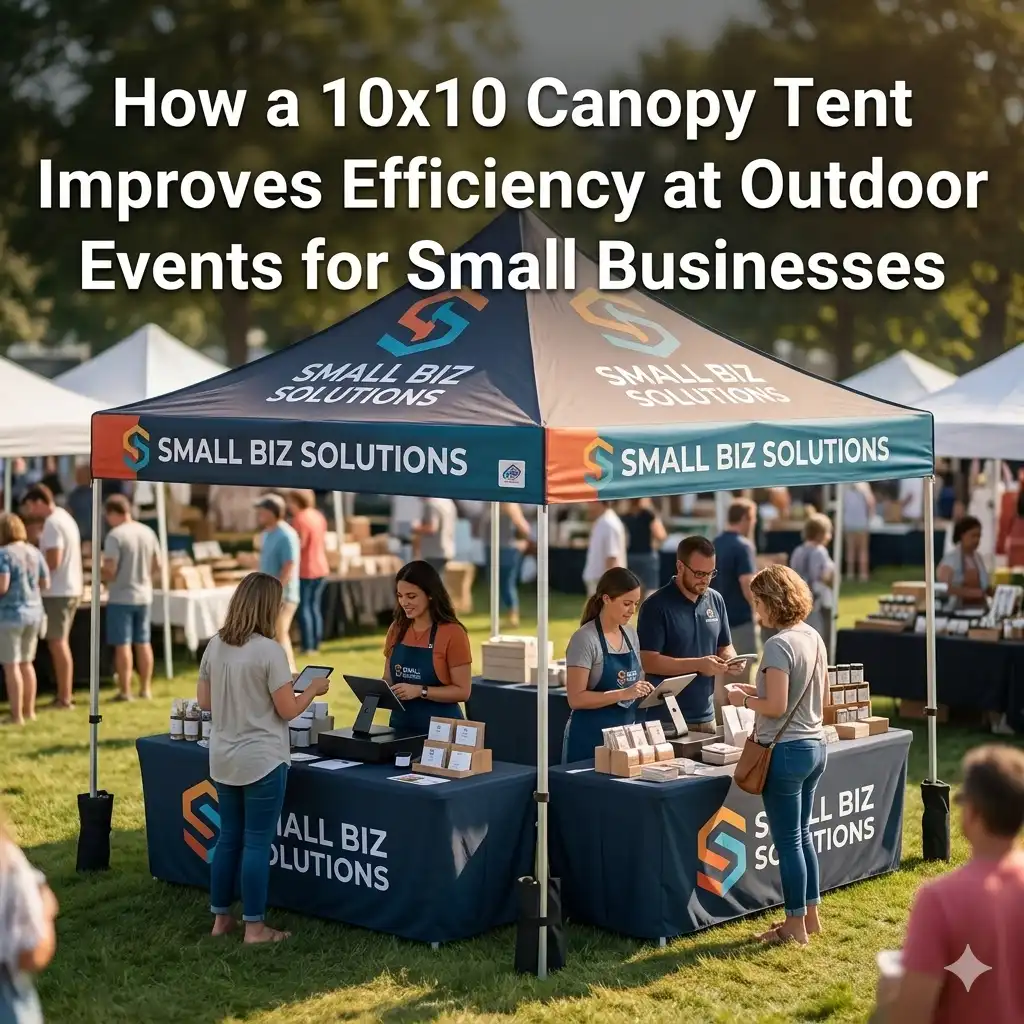
With a 10×10 canopy tent, that boundary becomes clear. It frames the entire interaction.
Over time, this size has become less of a choice and more of an informal standard in outdoor vending environments.
Structure changes how customers behave
Something that becomes obvious after working enough events is this: layout affects behavior more than messaging.
A booth with clear structure naturally draws people in. A booth without it tends to get passed quickly.
The 10×10 canopy tent creates that structure almost by default. It defines edges, creates shade, and gives vendors a controlled environment to arrange products and conversations.
People are more likely to slow down when a space feels intentional.
Even small adjustments—like how tables are positioned or where the opening faces—can influence whether someone stops or walks past.
It’s not about decoration. It’s about clarity.
Weather is not just background—it affects performance
Anyone who has done outdoor events long enough knows that weather is not a side factor. It shapes the entire day.
Direct sun can reduce foot traffic simply because people don’t want to stand in exposed areas. Sudden wind can make displays unstable or uncomfortable. Even mild rain can shift crowd movement patterns dramatically.
This is where the 10×10 canopy tent becomes more than just a frame.
It creates a controlled micro-environment. Shade becomes consistent. The space feels usable regardless of conditions. Customers are more willing to stay inside that space instead of passing through quickly.
In many cases, that extra minute of comfort is what leads to a conversation—and sometimes a sale.
Setup speed matters more than most people think
Outdoor events often don’t give vendors luxury-level setup time.
Sometimes you have a short window in the morning before the crowd arrives. Sometimes you’re dealing with uneven ground, shared spaces, or last-minute layout adjustments from organizers.
A 10×10 canopy tent simplifies that process.
It is predictable. The structure is familiar. Most vendors know how to assemble it without instructions. That alone reduces stress during setup.
And over time, that consistency matters. Businesses that attend multiple events don’t want to rethink their physical structure every time they show up somewhere new.
They want repeatability.
Consistency builds recognition over time
One thing that often gets overlooked in outdoor marketing is repetition.
People don’t usually remember a business from a single interaction. They remember it after seeing it a few times in similar contexts.
This is where consistent booth structure becomes important.
A 10×10 canopy tent, when used repeatedly, starts becoming part of a brand’s visual identity. Even if customers don’t remember the name immediately, they recognize the setup.
That recognition is subtle, but it compounds over time.
Some businesses take this further by standardizing their entire event presence—same layout, same flow, sometimes even the same color framing or signage placement.
For vendors attending frequent events, upgrading to a more durable or branded setup such as a custom pop up canopy tent becomes less about aesthetics and more about operational consistency.
The role of infrastructure in small business events
Most people think of outdoor events as purely marketing opportunities.
But from the inside, they are also operational environments.
Everything depends on how well the physical setup supports the business:
- how easily customers can approach
- how long they stay
- how staff move within the space
- how products are displayed
A small change in structure can affect all of these factors.
That’s why infrastructure matters more than it appears at first glance.
In many cases, vendors rely on standardized systems from providers like WestShade simply because it reduces variability across different locations and weather conditions.
When setup becomes predictable, the focus shifts back to the product and the customer.
Engagement is shaped by environment, not effort
There’s a common belief that better sales come from more effort—more talking, more signage, more promotions.
But in practice, engagement is often decided before any of that happens.
If the space feels open and structured, people naturally enter and explore. If it feels unclear or exposed, they hesitate or keep walking.
The canopy structure plays a quiet role in that decision-making process.
It defines where interaction begins without needing verbal prompts.
And once people are inside that space, conversations tend to happen more naturally.
Not all setups scale the same way
As businesses grow, they often attend more events, sometimes in different cities or environments.
What works for a one-time booth doesn’t always scale well across multiple setups.
This is where standardization becomes useful.
A 10×10 canopy tent offers a repeatable foundation. Vendors can build systems around it instead of constantly adapting to new conditions.
Tables, signage, storage, and product layouts can all be designed with that footprint in mind.
Over time, this reduces decision fatigue and speeds up event preparation significantly.
Small improvements compound over time
One of the most underrated aspects of outdoor vending is how small improvements add up.
A slightly better layout leads to longer conversations. Longer conversations lead to stronger engagement. Stronger engagement leads to more consistent sales patterns.
The canopy itself doesn’t create those outcomes directly. But it enables the conditions where they are more likely to happen.
That’s often how operational improvements work in real-world environments—they don’t look dramatic individually, but they shape results over time.
Conclusion
The 10×10 canopy tent has become a quiet standard in outdoor event environments for a reason.
It is simple, adaptable, and consistent. It gives small businesses a defined space to operate in, regardless of location or weather.
But more importantly, it influences how people experience that space.
From how they approach a booth to how long they stay, the structure plays a role in shaping interaction without drawing attention to itself.
For small businesses, that stability is often more valuable than anything decorative or promotional.
In the end, outdoor events are not just about being present. They are about being present in a way that feels clear, repeatable, and easy for people to engage with.
And in most cases, that begins with a 10×10 canopy tent.