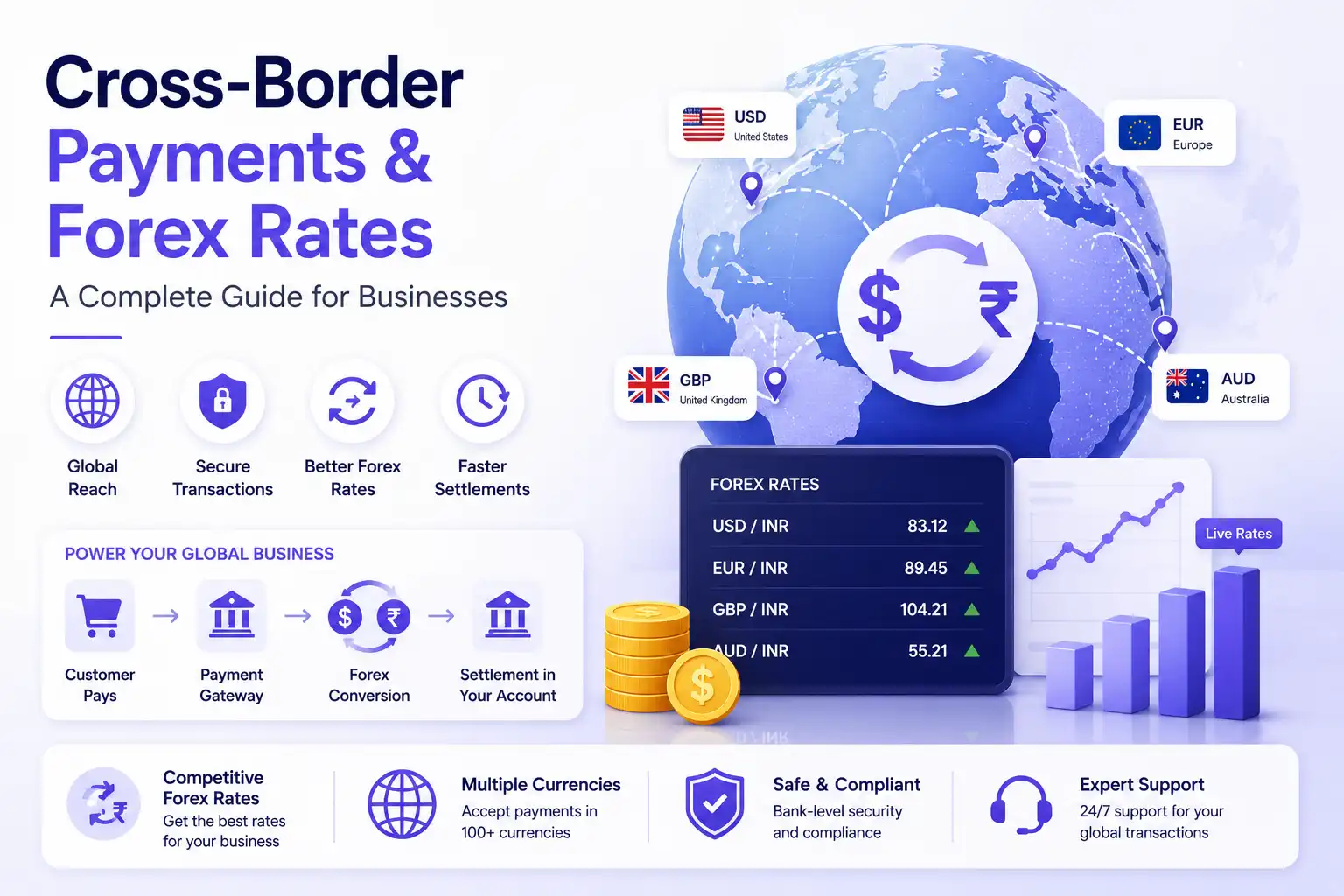
As Indian businesses increasingly sell to international customers and work with overseas suppliers, cross-border payments have become a critical part of business operations. Whether you’re a SaaS company collecting subscription revenue from the US, an exporter receiving payments from Europe, or a startup paying global contractors, moving money across borders comes with unique challenges.
- What Are Cross-Border Payments?
- Why Cross-Border Payments Are More Complex Than Domestic Transactions
- 1. International Payment Gateways
- 2. Global Collection Accounts
- 3. International Payout Solutions
- Understanding the Real Cost of Cross-Border Payments
- Where Hidden Costs Usually Occur
- Example: Why Forex Costs Matter More Than Transfer Fees
- Choose Transparent Pricing
- Compare the Total Cost
- Use Automatic INR Settlement
- Account for Currency Volatility
- Key Features to Look for in a Cross-Border Payment Provider
- Conclusion
- FAQs
- What is a cross-border payment?
- Why are cross-border payments more expensive than domestic payments?
- What is a forex markup?
- How can businesses reduce foreign exchange costs?
- What are global collection accounts?
- Can one provider handle both international collections and payouts?
- What compliance requirements apply to cross-border payments in India?
Unlike domestic payments, international transactions involve multiple currencies, banking networks, regulatory requirements, and foreign exchange (forex) costs. In many cases, the exchange rate can have a bigger impact on profitability than the transaction fee itself.
This guide explains how cross-border payment solutions work, the different options available to businesses, and practical ways to manage forex rates more effectively.
What Are Cross-Border Payments?
Cross-border payments refer to transactions where the sender and recipient are located in different countries. These payments often involve currency conversion, international banking networks, regulatory compliance requirements, and multiple intermediaries.
Examples include:
- Receiving payments from international customers
- Paying overseas suppliers
- Settling invoices with global vendors
- Paying international freelancers and contractors
- Collecting subscription revenue from foreign markets
Unlike domestic payment systems, cross-border transactions typically involve additional processing steps, making them more expensive and time-consuming.
Why Cross-Border Payments Are More Complex Than Domestic Transactions
A domestic payment usually moves through a single country’s banking infrastructure. In contrast, an international payment may pass through:
- Sending bank
- Correspondent banks
- Intermediary banks
- Receiving bank
- Payment networks
- Regulatory systems
Each participant can introduce:
- Additional fees
- Settlement delays
- Documentation requirements
- Foreign exchange costs
For Indian businesses, inward and outward remittances must also comply with regulatory requirements under FEMA (Foreign Exchange Management Act), including the use of purpose codes and supporting documentation.
As a result, cross-border payments require greater visibility into costs, compliance, and settlement timelines.
Types of Cross-Border Payment Solutions
Different businesses have different international payment needs. The ideal solution depends on whether money is flowing into or out of the business.
1. International Payment Gateways
International payment gateways allow businesses to accept payments from customers located in different countries.
Customers can pay using local currencies and preferred payment methods, while businesses receive settlement in Indian Rupees (INR).
Benefits
- Accept payments from global customers
- Support multiple currencies
- Simplify international checkout experiences
- Improve conversion rates in foreign markets
Best For
- D2C brands selling internationally
- SaaS companies with global customers
- Online service providers
- Subscription businesses
2. Global Collection Accounts
Global collection accounts provide businesses with local receiving accounts in foreign currencies such as USD, EUR, and GBP.
Instead of asking overseas clients to initiate costly international wire transfers, businesses can receive funds through familiar local banking rails.
Benefits
- Simplified international collections
- Faster payment processing
- Lower payment costs
- Easier reconciliation
Best For
- Exporters
- Freelancers
- Agencies
- Global consulting firms
- SaaS businesses
Global collection solutions often support automatic currency conversion and INR settlement, reducing operational complexity.
3. International Payout Solutions
International payout platforms help businesses send payments to overseas vendors, contractors, suppliers, and partners.
Instead of manually initiating individual international wire transfers, businesses can manage payouts from a centralized dashboard.
Benefits
- Faster vendor payments
- Bulk payout capabilities
- Simplified reconciliation
- Better forex visibility
Best For
- Global hiring
- Contractor payments
- Supplier settlements
- Marketplace payouts
Understanding the Real Cost of Cross-Border Payments
Many businesses focus on transfer fees when evaluating international payment providers.
However, the visible fee is often only a small part of the total cost.
The largest expense is frequently hidden inside the foreign exchange rate.
What Is the Mid-Market Exchange Rate?
The mid-market rate is the real exchange rate at which currencies trade globally.
It is commonly displayed on financial platforms and represents the midpoint between buy and sell rates.
Most banks and payment providers do not offer this exact rate. Instead, they add a markup or spread before converting currencies.
Where Hidden Costs Usually Occur
1. Forex Markups
A forex markup is the difference between the mid-market rate and the rate offered by the provider.
Even a small percentage difference can significantly affect profitability.
2. Intermediary Bank Charges
International wire transfers often pass through multiple correspondent banks.
These intermediaries may deduct fees before the funds reach the recipient.
3. Receiving Bank Fees
Some receiving banks apply incoming transfer charges that further reduce the final settlement amount.
4. Currency Conversion Fees
Additional conversion fees may be applied separately from exchange-rate markups.
Example: Why Forex Costs Matter More Than Transfer Fees
Consider an exporter invoicing an overseas customer for USD 10,000.
| Cost Component | Amount |
| Wire Transfer Fee | USD 30 |
| 3% Forex Markup | USD 300 |
| Intermediary Bank Fee | USD 20 |
| Total Cost | USD 350 |
In this example, the forex spread costs ten times more than the advertised transfer fee.
This illustrates why businesses should evaluate providers based on the final amount received rather than the headline transaction charge.
How to Manage Forex Rates Effectively
Foreign exchange fluctuations can directly impact margins, especially for businesses that receive or send international payments regularly.
Here are some practical strategies to reduce forex-related costs.
Choose Transparent Pricing
Look for providers that clearly disclose:
- Exchange rates
- Forex markups
- Transfer fees
- Settlement charges
Transparent pricing makes it easier to compare providers accurately.
Compare the Total Cost
Avoid evaluating providers solely on advertised fees.
Instead, compare:
- Forex spread
- Transfer fee
- Intermediary charges
- Receiving bank charges
The lowest fee does not always translate into the lowest overall cost.
Use Automatic INR Settlement
For many Indian businesses, automatic INR conversion simplifies operations.
Benefits include:
- Reduced currency exposure
- Faster access to funds
- Simplified accounting
- Easier reconciliation
Account for Currency Volatility
Businesses with recurring overseas revenue should factor currency fluctuations into pricing and contracts.
Examples include:
- SaaS subscriptions
- Annual retainers
- Export agreements
- Long-term vendor contracts
Building a forex buffer into pricing can help protect profit margins from unexpected currency movements.
How to Choose the Right Cross-Border Payment Solution
The ideal solution depends on the direction of money flow.
If You Mainly Receive International Payments
Consider:
- International payment gateways
- Global collection accounts
- Multi-currency receiving solutions
If You Mainly Send International Payments
Prioritize:
- International payout platforms
- Transparent forex pricing
- Bulk payout capabilities
If You Do Both
Many growing businesses both collect and send money internationally.
In such cases, choosing a provider that supports collections and payouts from a single platform can:
- Reduce operational overhead
- Simplify reconciliation
- Improve visibility into cash flow
- Streamline compliance management
Key Features to Look for in a Cross-Border Payment Provider
Before selecting a provider, evaluate:
- Multi-currency support
- Transparent forex rates
- Global collection capabilities
- International payout infrastructure
- Compliance and FEMA support
- Purpose code management
- Automated documentation
- Faster settlement timelines
- Unified reporting and reconciliation
These features can significantly reduce administrative effort as international transaction volumes grow.
Conclusion
Cross-border payments are no longer limited to large enterprises. Startups, SaaS companies, exporters, freelancers, and digital-first businesses increasingly depend on international money movement to grow globally.
However, the true cost of cross-border payments extends beyond transaction fees. Exchange-rate markups, intermediary charges, and compliance complexities can significantly impact profitability if not managed carefully.
By understanding how international payment solutions work, comparing total costs, and adopting transparent forex practices, businesses can improve cash flow, protect margins, and simplify global operations.
Simplify Global Collections and International Payouts
Whether you’re collecting payments from international customers or paying overseas vendors, choosing the right cross-border payment infrastructure can make global business significantly easier.
Cashfree offers cross-border collection and international payout solutions designed to help businesses manage global money movement with transparent forex, streamlined compliance, and simplified reconciliation.
FAQs
What is a cross-border payment?
A cross-border payment is a transaction where money is sent or received between parties located in different countries, often involving multiple currencies and banking networks.
Why are cross-border payments more expensive than domestic payments?
International payments involve currency conversion, multiple banking intermediaries, compliance requirements, and settlement infrastructure across different countries, all of which contribute to higher costs.
What is a forex markup?
A forex markup is the difference between the mid-market exchange rate and the rate offered by a bank or payment provider. It is often the largest hidden cost in international transactions.
How can businesses reduce foreign exchange costs?
Businesses can reduce forex costs by choosing providers with transparent pricing, comparing all-in costs, using automatic INR settlement, and accounting for currency volatility in pricing strategies.
What are global collection accounts?
Global collection accounts allow businesses to receive payments through local bank accounts in foreign currencies, simplifying international collections and reducing payment friction for overseas customers.
Can one provider handle both international collections and payouts?
Yes. Many modern cross-border payment platforms offer both collection and payout capabilities, allowing businesses to manage incoming and outgoing international payments through a single system.
What compliance requirements apply to cross-border payments in India?
Indian businesses must comply with FEMA regulations, including purpose code reporting and documentation requirements for inward and outward remittances.