


Every testing conference talk for the last two years has had a slide about AI. Most of them show the same handful of demos: a locator that heals itself when a button moves, a chatbot that writes a test case from a plain-English description, a model that predicts which tests are likely to be flaky before a run even finishes. The demos are real. What’s less clear from a conference stage is which of these actually hold up in a messy production codebase versus which ones work best on the clean example the vendor picked.
Worth separating the two questions that usually get collapsed into one: what is AI doing in testing today, and specifically, what is generative AI doing versus older forms of machine learning that were quietly present in this space long before anyone called it AI.
Two Different Technologies Wearing One Label
A lot of what gets marketed under the AI label in this space predates the current generation of large language models by years. Visual regression tools have used image comparison models to catch pixel-level UI drift since well before generative AI was a category. Flaky test detection has used statistical models on historical run data for a similar stretch of time. These are legitimate uses of machine learning, and they’re part of what most ai testing tools roundups group together, but they aren’t new in the way the marketing implies, and they don’t generate anything. They classify and predict.
What actually is new is the generative layer: models that can produce a test case, a mock response, or a chunk of test data from a prompt or from observed behavior, rather than just flagging or classifying something that already exists. That distinction matters because the two categories have very different failure modes and very different levels of trust you can reasonably place in their output.
Four Places AI Shows Up in a Testing Workflow
Mapping the landscape by where in the workflow the model actually sits makes the hype easier to evaluate than treating AI testing as one undifferentiated category.
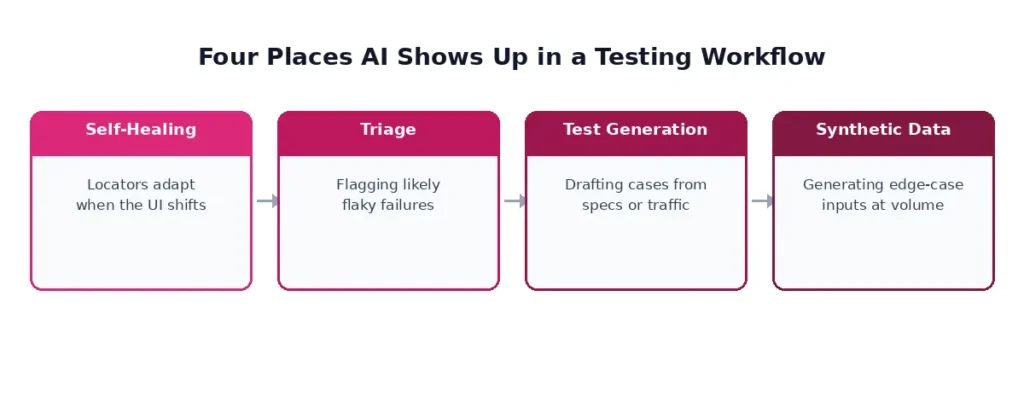
Self-healing locators. When a UI element’s selector changes, the tool infers the new one from surrounding context instead of failing outright. This genuinely reduces maintenance overhead on UI suites, though it can also mask a real regression if the element changed for a reason that matters.
Failure triage. Models trained on historical run data flag which failures are likely flaky versus likely real, cutting down the manual investigation time after a big test run. Useful, but it’s a prioritization aid, not a verdict, and treating a flagged failure as automatically dismissible is how real regressions slip through.
Test generation. This is where generative models actually generate something new: draft test cases from a specification, from a natural language description, or from observed application behavior. The output quality varies enormously depending on what it’s grounded in, which is the crux of the next section.
Synthetic data. Generating realistic-looking inputs at volume, including edge cases like malformed payloads or unusual character sets, without requiring an engineer to hand-write each one.
Generative AI Specifically: Where the Grounding Matters
Inside the generative ai testing tools category, the single biggest factor in output quality is what the generation is grounded in. A model prompted only with a plain-English description of a feature is essentially guessing at implementation details it was never given, and it will confidently produce a test case that asserts on a response shape that doesn’t match reality. A model that generates from an actual OpenAPI spec is meaningfully more reliable, because the shape of the request and response is no longer a guess. A model that generates directly from observed traffic, real requests and real responses, is more reliable still, since it never has to guess at behavior it can simply record. Keploy takes this last approach, deriving test cases and mocks from captured traffic rather than from a natural-language prompt, which sidesteps a lot of the hallucination risk that comes with prompt-only generation.
This ordering, prompt-only, spec-grounded, traffic-grounded, is a reasonable way to evaluate any tool making generative claims in this space. The closer the generation sits to real, observed behavior, the less a human reviewer has to second-guess whether the output actually reflects the system under test.
The Failure Mode Nobody Puts in the Demo
The demo failure mode for AI-generated tests is the same one that shows up with any code generation tool: it will confidently generate a test that encodes a bug as if it were correct behavior, because the model has no independent notion of what “correct” means beyond what it was grounded in. A test generated from buggy production traffic will faithfully lock that bug in as a passing regression test unless someone reviews it. This isn’t a reason to avoid the category, but it is a reason to keep a human review step in the loop rather than piping generated tests straight into a merge-blocking CI gate unreviewed.
A Reasonable Way to Evaluate Any Tool in This Space
Ask what the generation is actually grounded in before asking how good the demo looks. Ask whether a human is expected to review output before it becomes a merge gate, or whether the vendor is quietly suggesting you skip that step. And ask what happens when the underlying system changes, since a test suite that can’t be regenerated or updated as easily as it was created just moves the maintenance burden rather than removing it.
The Real Point
AI in testing is not one thing, and treating it as one thing is how teams end up either dismissing genuinely useful tooling because one flashy demo underdelivered, or trusting generated output further than its grounding actually supports. The classification and prediction side of this space has quietly earned its keep for years. The generative side is newer and more powerful, but its reliability depends entirely on what it’s generating from, and that’s worth checking before it’s worth trusting.
Technology Perspective
Technology continues to transform industries through artificial intelligence, cloud computing, automation, cybersecurity, digital platforms, and data-driven decision making. As organizations increasingly adopt digital solutions, understanding emerging technologies becomes essential for businesses, professionals, and consumers. DGM News regularly covers these developments through expert analysis, technology news, and educational resources.
Innovation Outlook
Rapid advances in artificial intelligence, automation, machine learning, cloud infrastructure, and digital transformation continue reshaping global industries. Monitoring these developments helps organizations adapt to changing technologies, improve efficiency, and prepare for future innovation.
Did you know?
Artificial Intelligence is expected to influence nearly every major industry over the coming decade, from healthcare and finance to transportation, manufacturing, education, and entertainment.
AI, Machine Learning, Deep Learning and Generative AI Explained
Google AI Updates
About DGM News
DGM News is an independent digital publication delivering the latest Technology News, AI News, and FinTech News. We provide expert insights on startups, innovation, cybersecurity, software, business, gadgets, cloud computing, artificial intelligence, and emerging technologies. Our mission is to publish informative, accurate, and regularly updated content that helps readers stay informed in today's rapidly evolving digital landscape.
Since our editorial focus includes technology, artificial intelligence, and financial technology, we continuously expand our coverage as new innovations emerge.
Editorial Standards
Every article published on DGM News undergoes editorial review before publication. We prioritize factual accuracy, clarity, transparency, and reader value while following responsible digital publishing practices.
Research Methodology
Our editorial team researches publicly available information from official announcements, technical documentation, research publications, developer resources, reputable industry reports, and trusted public sources whenever applicable. Information is reviewed to improve clarity and accuracy before publication.
Fact-Checking Policy
We make reasonable efforts to verify factual information before publishing. Articles are reviewed for accuracy, consistency, and relevance. If significant developments occur after publication, content may be revised to reflect updated information.
Update Policy
Technology evolves rapidly. Articles may be reviewed and updated periodically to reflect software releases, AI developments, security advisories, regulatory updates, product launches, and other important industry changes.
Source Verification
Whenever possible, DGM News reviews information using official company announcements, technical documentation, research publications, government resources, publicly available reports, and reputable industry references before updating articles.
Editorial Independence
DGM News maintains editorial independence in all publishing decisions. Editorial content is produced independently and is intended to provide balanced, informative, and reader-focused coverage without influence from advertisers or commercial partnerships.
AI Usage Disclosure
Artificial intelligence tools may assist with research organization, grammar improvement, formatting, or editorial workflows. Every article is reviewed by human editors before publication to help maintain quality, clarity, and factual accuracy.
Corrections Policy
Accuracy is important to us. If readers identify outdated information or factual inaccuracies, they are encouraged to contact our editorial team. Verified corrections are reviewed and incorporated whenever appropriate.
Reader Feedback
Reader feedback helps improve our journalism. We welcome suggestions, corrections, and constructive feedback through our Contact page to continuously improve the quality of our reporting.
Last Editorial Review
This article follows the DGM News editorial review process and may be updated periodically as new information becomes available.
Why Trust DGM News?
DGM News is committed to publishing technology journalism that emphasizes accuracy, transparency, editorial independence, and regularly updated information. Our editorial process is designed to provide readers with reliable coverage of technology, AI, fintech, startups, and digital innovation.
DGM News Resources
Topics We Cover
Artificial Intelligence • AI Tools • Machine Learning • FinTech • Cybersecurity • Cloud Computing • Programming • Software Development • Gadgets • Mobile Technology • Business Technology • Startups • Digital Marketing • Blockchain • Cryptocurrency • Science • Innovation • Consumer Technology • Enterprise Technology • Automation
