

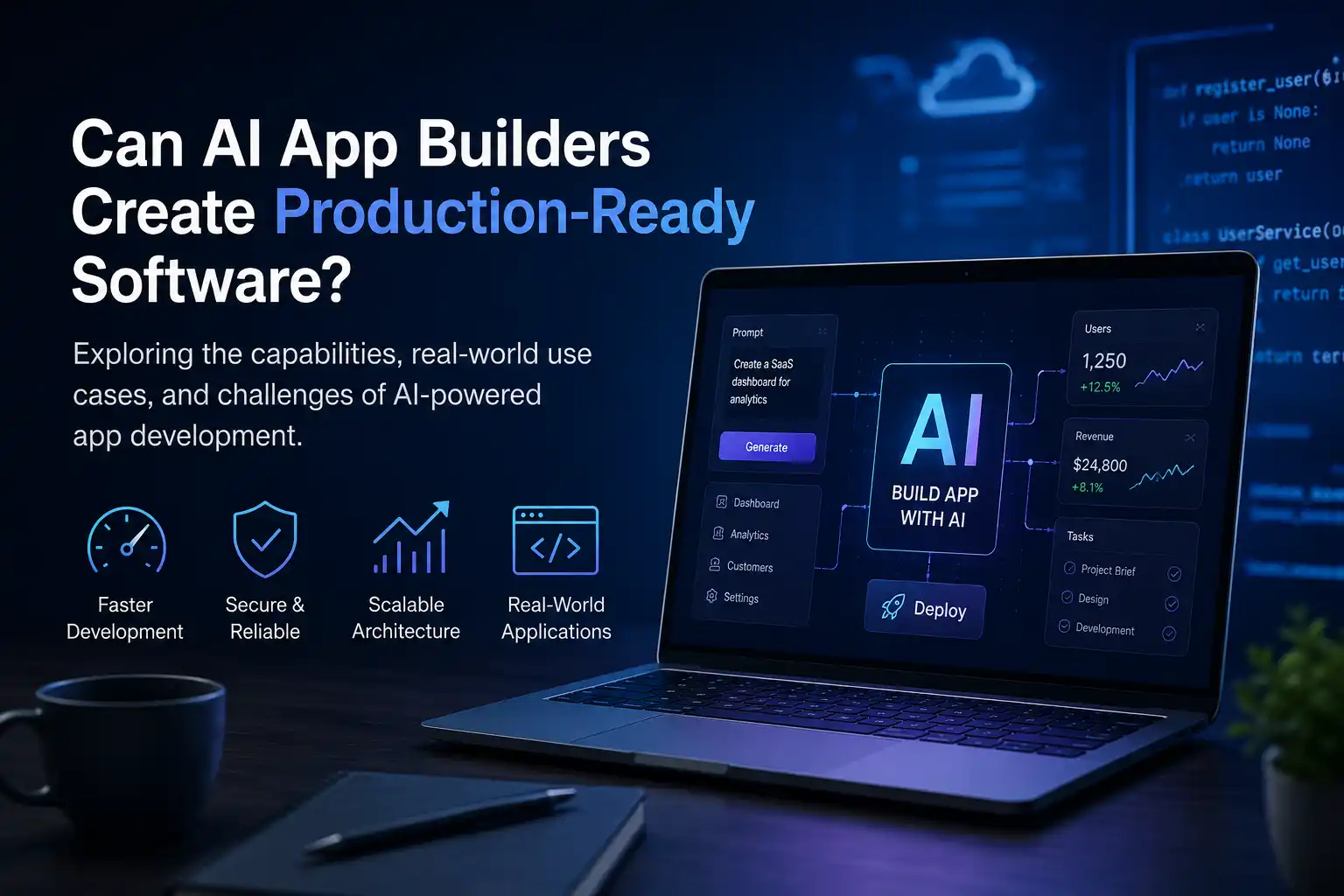
Artificial intelligence is rapidly changing the software development landscape.
What once required months of planning, large engineering teams, and significant budgets can now be accomplished in a fraction of the time thanks to AI-powered development platforms.
From startups validating new ideas to established businesses launching internal tools, organizations are increasingly turning to AI app builders to accelerate development and reduce costs.
As adoption grows, one important question continues to emerge:
Can AI app builders actually create production-ready software?
The answer is yes—but only when businesses understand both the strengths and limitations of these platforms.
While AI can dramatically accelerate software creation, production-ready applications require much more than simply generating interfaces and workflows. Security, scalability, architecture, integrations, and ongoing maintenance all play critical roles in determining whether an application can successfully support real users.
The Rise of AI-Powered Development
Software development has traditionally been a resource-intensive process.
Building a new application often required multiple specialists, including:
- Product managers
- Designers
- Frontend developers
- Backend developers
- QA engineers
- DevOps professionals
For startups and small businesses, assembling such a team could be expensive and time-consuming.
AI-powered app builders are changing this model.
By leveraging large language models and automation, these platforms can generate substantial portions of an application from simple prompts, allowing businesses to move from concept to working software significantly faster than traditional approaches.
This shift is creating new opportunities for entrepreneurs who previously lacked the resources to build custom software.
Why Businesses Are Embracing AI App Builders
The growing popularity of AI-powered development tools is driven by several key advantages.
Faster Development
Organizations can build and launch products in weeks rather than months.
This speed allows teams to validate ideas, gather customer feedback, and iterate quickly.
Lower Initial Costs
AI-assisted development can reduce the amount of manual coding required, lowering the upfront investment needed to launch a product.
Improved Accessibility
Founders without technical backgrounds can now participate more directly in product development, helping bridge the gap between business ideas and implementation.
These benefits are helping businesses experiment, innovate, and bring products to market faster than ever before.
What Makes Software Production-Ready?
A common misconception is that if an application works, it is ready for production.
In reality, production-ready software must satisfy a much broader set of requirements.
Successful applications typically include:
- Secure authentication
- Reliable database architecture
- Error handling
- API integrations
- Scalable infrastructure
- Performance optimization
- Data protection measures
- Monitoring and analytics
- Ongoing maintenance processes
The difference between a prototype and a production application is not functionality alone.
It is reliability.
Production software must consistently perform under real-world conditions while supporting business growth.
Popular AI App Builders on the Market
The AI development ecosystem has expanded rapidly over the past few years.
Several platforms have emerged to help businesses build software faster and more efficiently.
Some of the most discussed AI app builders include:
- Lovable
- Bolt
- Replit
- Bubble
- FlutterFlow
Each platform offers a different approach to application development, but they all share a common goal: reducing the time and complexity required to build software.
Among these platforms, Lovable has attracted significant attention for its ability to generate full-stack applications from natural language prompts, making it particularly appealing to startups and businesses looking to accelerate product development.
Where AI App Builders Excel
AI development platforms are exceptionally effective for building:
- SaaS products
- Internal business tools
- Customer portals
- Marketplace MVPs
- Booking systems
- Membership platforms
- Dashboards and reporting systems
These platforms allow organizations to focus on validating business ideas rather than spending months on initial development.
For many startups, the ability to launch quickly can be a major competitive advantage.
The Challenges of Production Deployment
Although AI app builders can accelerate development significantly, they do not eliminate every challenge associated with software engineering.
Several critical areas still require careful attention.
Security
Applications often handle sensitive information, including customer data, financial records, and proprietary business information.
Production environments require:
- Secure authentication
- Permission management
- Access controls
- Data encryption
- Security monitoring
Without proper implementation, even a functional application may introduce significant risks.
Scalability
Applications that perform well during testing may encounter challenges as user activity increases.
Scalability requires careful planning around:
- Database performance
- Infrastructure
- Resource allocation
- Query optimization
Growth often exposes weaknesses that are not immediately apparent during early development stages.
Third-Party Integrations
Most modern applications depend on external services such as payment processors, CRM systems, analytics tools, and AI providers.
Managing these integrations effectively requires both technical expertise and ongoing maintenance.
The Human Element Still Matters
One of the biggest misconceptions about AI-powered development is that it removes the need for experienced developers.
In reality, AI changes the role of developers rather than replacing them.
Successful software products still require expertise in:
- Architecture
- Security
- Performance optimization
- Infrastructure planning
- Scalability
- Quality assurance
This becomes particularly important when businesses move beyond MVPs and begin building applications intended to support real customers.
For example, while platforms like Lovable can dramatically accelerate development, the success of a production application often depends on the experience of the professionals implementing and maintaining it. Businesses evaluating the platform should understand what to know before hiring a Lovable developer to ensure their application is built with scalability, security, and long-term growth in mind.
Real-World Applications Already Exist
Production-ready AI-assisted applications are already being used across multiple industries.
Examples include:
Startup MVPs
Founders use AI-powered tools to validate ideas quickly before raising capital or investing heavily in development.
Internal Business Software
Organizations build custom dashboards, workflow automation systems, and operational tools tailored to their needs.
Customer-Facing Platforms
AI-generated applications increasingly support memberships, bookings, customer portals, and SaaS businesses.
Industry-Specific Solutions
Companies are creating software for healthcare, finance, logistics, education, and professional services using AI-assisted development approaches.
These real-world examples demonstrate that AI-powered software is no longer limited to experimentation.
Common Misconceptions About AI Development
Despite growing adoption, several myths continue to persist.
AI Replaces Developers
AI increases productivity but does not eliminate the need for technical expertise.
AI Software Cannot Scale
Scalability depends largely on architecture and infrastructure decisions rather than the development tool itself.
AI Is Only Useful for Prototypes
Many businesses are already operating production applications that were built using AI-assisted development workflows.
Launching Ends the Project
Every successful software product requires ongoing maintenance, improvements, and monitoring.
The Future of AI-Powered Software Development
The future of software development will likely involve increasing collaboration between AI systems and human experts.
As AI-powered development platforms continue to evolve, businesses will gain access to even more powerful tools capable of accelerating product creation.
However, organizations that achieve the greatest success will be those that combine AI-driven speed with sound engineering practices and strategic planning.
Technology may accelerate development, but expertise remains essential for building sustainable software products.
Final Thoughts
Can AI app builders create production-ready software?
Increasingly, the answer is yes.
Modern AI-powered development platforms are capable of generating sophisticated applications that support real users and real business operations. They help businesses reduce costs, accelerate development, and bring products to market faster than traditional methods.
However, production readiness extends far beyond generating code.
Security, scalability, architecture, integrations, monitoring, and maintenance remain critical components of successful software.
The businesses that thrive in this new era will be those that combine the speed of AI with the expertise needed to transform applications into reliable, production-grade products.
Technology Perspective
Technology continues to transform industries through artificial intelligence, cloud computing, automation, cybersecurity, digital platforms, and data-driven decision making. As organizations increasingly adopt digital solutions, understanding emerging technologies becomes essential for businesses, professionals, and consumers. DGM News regularly covers these developments through expert analysis, technology news, and educational resources.
Innovation Outlook
Rapid advances in artificial intelligence, automation, machine learning, cloud infrastructure, and digital transformation continue reshaping global industries. Monitoring these developments helps organizations adapt to changing technologies, improve efficiency, and prepare for future innovation.
Did you know?
Artificial Intelligence is expected to influence nearly every major industry over the coming decade, from healthcare and finance to transportation, manufacturing, education, and entertainment.
AI, Machine Learning, Deep Learning and Generative AI Explained
Google AI Updates
About DGM News
DGM News is an independent digital publication delivering the latest Technology News, AI News, and FinTech News. We provide expert insights on startups, innovation, cybersecurity, software, business, gadgets, cloud computing, artificial intelligence, and emerging technologies. Our mission is to publish informative, accurate, and regularly updated content that helps readers stay informed in today's rapidly evolving digital landscape.
Since our editorial focus includes technology, artificial intelligence, and financial technology, we continuously expand our coverage as new innovations emerge.
Editorial Standards
Every article published on DGM News undergoes editorial review before publication. We prioritize factual accuracy, clarity, transparency, and reader value while following responsible digital publishing practices.
Research Methodology
Our editorial team researches publicly available information from official announcements, technical documentation, research publications, developer resources, reputable industry reports, and trusted public sources whenever applicable. Information is reviewed to improve clarity and accuracy before publication.
Fact-Checking Policy
We make reasonable efforts to verify factual information before publishing. Articles are reviewed for accuracy, consistency, and relevance. If significant developments occur after publication, content may be revised to reflect updated information.
Update Policy
Technology evolves rapidly. Articles may be reviewed and updated periodically to reflect software releases, AI developments, security advisories, regulatory updates, product launches, and other important industry changes.
Source Verification
Whenever possible, DGM News reviews information using official company announcements, technical documentation, research publications, government resources, publicly available reports, and reputable industry references before updating articles.
Editorial Independence
DGM News maintains editorial independence in all publishing decisions. Editorial content is produced independently and is intended to provide balanced, informative, and reader-focused coverage without influence from advertisers or commercial partnerships.
AI Usage Disclosure
Artificial intelligence tools may assist with research organization, grammar improvement, formatting, or editorial workflows. Every article is reviewed by human editors before publication to help maintain quality, clarity, and factual accuracy.
Corrections Policy
Accuracy is important to us. If readers identify outdated information or factual inaccuracies, they are encouraged to contact our editorial team. Verified corrections are reviewed and incorporated whenever appropriate.
Reader Feedback
Reader feedback helps improve our journalism. We welcome suggestions, corrections, and constructive feedback through our Contact page to continuously improve the quality of our reporting.
Last Editorial Review
This article follows the DGM News editorial review process and may be updated periodically as new information becomes available.
Why Trust DGM News?
DGM News is committed to publishing technology journalism that emphasizes accuracy, transparency, editorial independence, and regularly updated information. Our editorial process is designed to provide readers with reliable coverage of technology, AI, fintech, startups, and digital innovation.
DGM News Resources
Topics We Cover
Artificial Intelligence • AI Tools • Machine Learning • FinTech • Cybersecurity • Cloud Computing • Programming • Software Development • Gadgets • Mobile Technology • Business Technology • Startups • Digital Marketing • Blockchain • Cryptocurrency • Science • Innovation • Consumer Technology • Enterprise Technology • Automation
