

Road safety has always been shaped by a combination of engineering, regulation, and human judgement. Seatbelts, airbags, anti-lock braking systems, and electronic stability control each marked major milestones in reducing fatalities and improving control behind the wheel.
But the current shift is different.
Artificial intelligence is not just adding another layer of protection to vehicles — it is fundamentally changing how safety is defined, predicted, and enforced in real time. Unlike previous innovations, which reacted to driver input or physical conditions, AI-driven systems interpret patterns, anticipate outcomes, and adjust behaviour before risk fully emerges.
The result is a quieter but profound transformation in how roads are experienced.
From Reactive Safety to Predictive Intervention
Traditional vehicle safety systems were largely reactive. Anti-lock braking systems responded to wheel slip. Airbags deployed after impact. Stability control corrected loss of traction once it had already begun.
AI-based systems operate earlier in the chain of events.
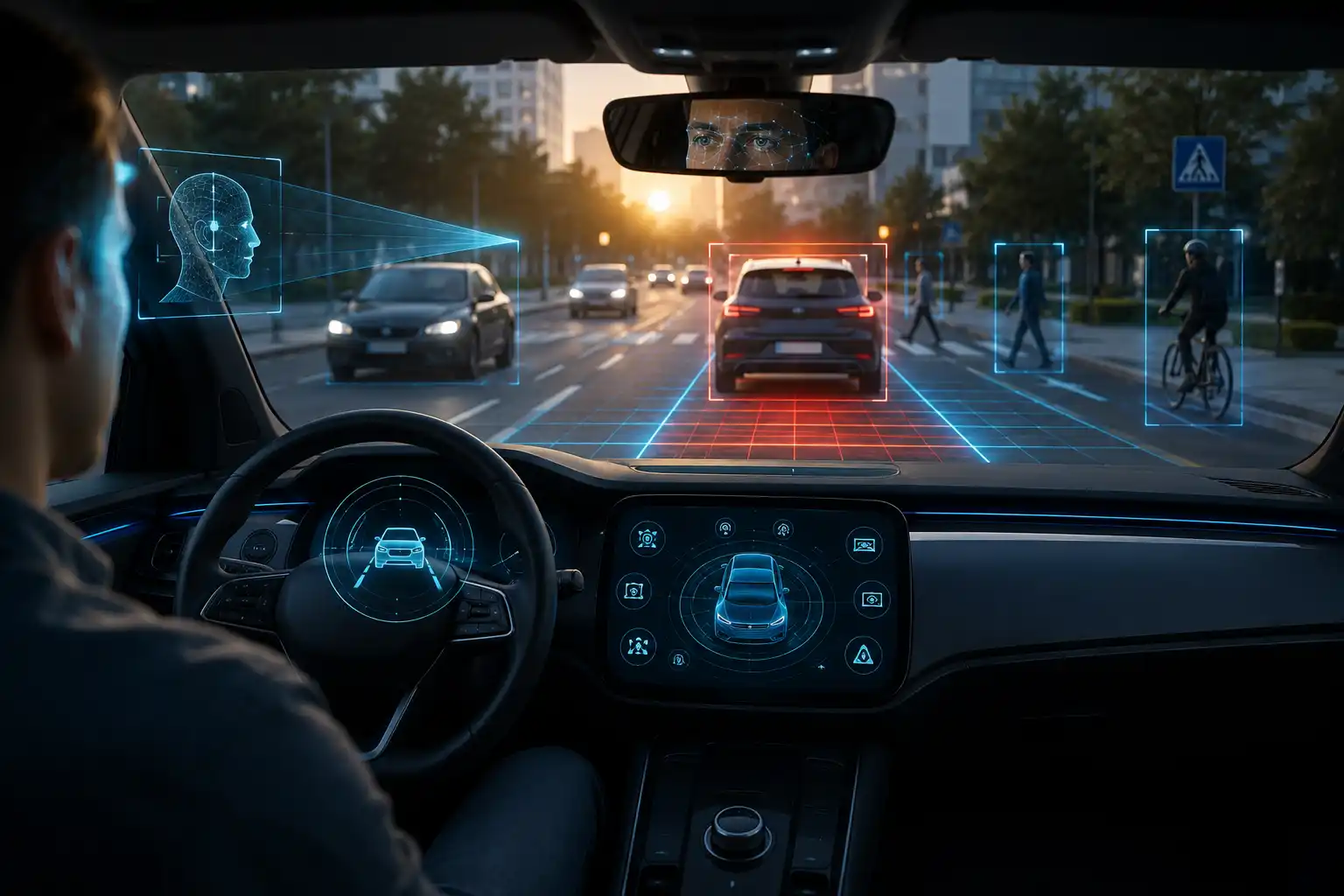
Modern predictive braking systems use data from cameras, radar, and lidar to assess not only what is happening, but what is likely to happen next. These systems analyse the speed and trajectory of surrounding vehicles, pedestrian movement, and road geometry to estimate risk in milliseconds.
Manufacturers such as Mercedes-Benz have integrated predictive safety technologies into their driver assistance suites, allowing vehicles to prepare braking force or adjust suspension response before a collision scenario fully develops.
This shift from reaction to prediction is subtle in practice, but significant in effect. Safety is no longer triggered by impact or immediate danger, but by probability.
Machine Learning and the Evolution of Awareness
At the core of modern road safety systems is machine learning. Unlike fixed-rule programming, machine learning models improve over time by analysing large datasets of driving behaviour, accident scenarios, and environmental conditions.
This allows systems to recognise patterns that are not explicitly programmed. For example, a vehicle might learn that certain combinations of lighting, road curvature, and traffic density correlate with higher risk, even if no single factor appears dangerous on its own.
Brands such as Tesla have popularised the idea of fleet learning, where data from millions of miles of driving contributes to system refinement across all vehicles in the network.
This collective intelligence creates a feedback loop: the more vehicles on the road, the more accurate the predictive models become.
However, this also introduces a new question — what does driver responsibility look like in a system that is partially learning and partially acting on its own?
Driver Monitoring and the Changing Role of Attention
One of the most significant developments in AI-driven safety is driver monitoring technology.
Using inward-facing cameras and infrared sensors, modern systems can track eye movement, head position, and even subtle indicators of fatigue or distraction. If a driver appears inattentive, the vehicle can issue alerts or gradually escalate intervention.
This introduces a shift in responsibility. Driving is no longer judged only by external behaviour, but also by internal attentiveness.
Manufacturers such as Volvo have been particularly active in this area, embedding driver alert systems designed to intervene when signs of drowsiness or inattention are detected.
While these systems improve safety outcomes, they also redefine what it means to be “in control” of a vehicle. Control becomes shared between human input and algorithmic supervision.
The Psychology of Trust in AI-Driven Vehicles
As AI systems become more capable, a new psychological dynamic emerges: trust.
Drivers must decide how much to rely on systems that can see further, react faster, and process more information than they can. This creates a tension between confidence and caution.
Too little trust leads to underuse of safety features, reducing their effectiveness. Too much trust can lead to over-reliance and reduced situational awareness.
This balance is still evolving. Early studies in human-machine interaction suggest that drivers often overestimate system capability after repeated successful interventions, a phenomenon sometimes referred to as automation complacency.
For AI-driven road safety to work effectively, systems must not only be accurate — they must also communicate limitations clearly and consistently.
When Safety Becomes Proactive Infrastructure
AI is also changing the vehicle’s relationship with its environment.
Rather than operating in isolation, modern systems increasingly interact with infrastructure. Traffic signals, navigation platforms, and connected vehicle networks can share data in real time, allowing for coordinated responses to congestion, hazards, and emergency situations.
In some urban environments, vehicles can receive advance warnings about upcoming hazards before they are visible to the driver. This creates a layered safety system where risk is managed collaboratively between vehicles and infrastructure.
This shift blurs the boundary between individual driving and collective traffic intelligence. Safety becomes less about isolated decision-making and more about participation in a connected system.
Redefining Driver Responsibility
One of the most important consequences of AI in road safety is the gradual redefinition of responsibility.
In traditional driving, responsibility was clear: the driver observes, decides, and acts. In AI-assisted systems, responsibility is distributed across sensors, algorithms, and human oversight.
This does not remove accountability, but it complicates it.
If a predictive braking system intervenes too late, or a driver fails to respond to an alert, responsibility is shared between human and machine design. This raises important questions for regulation, insurance, and legal frameworks.
Despite these complexities, the overall trend is clear: AI is reducing the number of moments where human reaction alone determines outcome.
Subtle Changes in Everyday Driving Behaviour
Even when drivers are not consciously interacting with AI systems, their behaviour is being shaped by them.
Adaptive cruise control reduces micro-adjustments in speed. Lane-keeping assistance reduces small steering corrections. Collision warnings influence following distance even when not actively triggered.
Over time, these systems influence driving habits in subtle ways. Journeys become smoother, more consistent, and less mentally demanding.
In this sense, AI is not just improving safety — it is gradually redefining what “normal driving behaviour” looks like.
Identity, Technology, and the Modern Vehicle
As vehicles become more intelligent, they also become more personalised. AI systems can now adapt driving modes, comfort settings, and interface layouts based on individual behaviour patterns.
This broader trend towards personalisation extends beyond safety into vehicle identity itself. Drivers increasingly expect their vehicles to reflect preferences not only in performance but also in presentation and detail.
Even elements such as registration styling and physical presentation form part of this wider automotive identity culture. Companies such as Plates Express exist within this evolving ecosystem, where small design choices contribute to how a vehicle is perceived and experienced as a whole.
Conclusion: A Safer System, a Different Relationship
AI is not replacing road safety principles — it is reshaping how they are applied.
Predictive braking, machine learning models, and driver monitoring systems are collectively reducing accidents by intervening earlier and more intelligently than traditional systems could. But their impact goes beyond statistics.
They are changing the relationship between driver and vehicle, shifting responsibility from moment-to-moment reaction to continuous collaboration with intelligent systems.
As this technology continues to evolve, the central challenge will not simply be making vehicles safer, but ensuring that drivers remain engaged, informed, and appropriately aware within increasingly automated environments.
Road safety is no longer just about how humans drive. It is about how humans and machines learn to share control — in real time, on the same road.
Technology Perspective
Technology continues to transform industries through artificial intelligence, cloud computing, automation, cybersecurity, digital platforms, and data-driven decision making. As organizations increasingly adopt digital solutions, understanding emerging technologies becomes essential for businesses, professionals, and consumers. DGM News regularly covers these developments through expert analysis, technology news, and educational resources.
Innovation Outlook
Rapid advances in artificial intelligence, automation, machine learning, cloud infrastructure, and digital transformation continue reshaping global industries. Monitoring these developments helps organizations adapt to changing technologies, improve efficiency, and prepare for future innovation.
Did you know?
Artificial Intelligence is expected to influence nearly every major industry over the coming decade, from healthcare and finance to transportation, manufacturing, education, and entertainment.
AI, Machine Learning, Deep Learning and Generative AI Explained
Google AI Updates
About DGM News
DGM News is an independent digital publication delivering the latest Technology News, AI News, and FinTech News. We provide expert insights on startups, innovation, cybersecurity, software, business, gadgets, cloud computing, artificial intelligence, and emerging technologies. Our mission is to publish informative, accurate, and regularly updated content that helps readers stay informed in today's rapidly evolving digital landscape.
Since our editorial focus includes technology, artificial intelligence, and financial technology, we continuously expand our coverage as new innovations emerge.
Editorial Standards
Every article published on DGM News undergoes editorial review before publication. We prioritize factual accuracy, clarity, transparency, and reader value while following responsible digital publishing practices.
Research Methodology
Our editorial team researches publicly available information from official announcements, technical documentation, research publications, developer resources, reputable industry reports, and trusted public sources whenever applicable. Information is reviewed to improve clarity and accuracy before publication.
Fact-Checking Policy
We make reasonable efforts to verify factual information before publishing. Articles are reviewed for accuracy, consistency, and relevance. If significant developments occur after publication, content may be revised to reflect updated information.
Update Policy
Technology evolves rapidly. Articles may be reviewed and updated periodically to reflect software releases, AI developments, security advisories, regulatory updates, product launches, and other important industry changes.
Source Verification
Whenever possible, DGM News reviews information using official company announcements, technical documentation, research publications, government resources, publicly available reports, and reputable industry references before updating articles.
Editorial Independence
DGM News maintains editorial independence in all publishing decisions. Editorial content is produced independently and is intended to provide balanced, informative, and reader-focused coverage without influence from advertisers or commercial partnerships.
AI Usage Disclosure
Artificial intelligence tools may assist with research organization, grammar improvement, formatting, or editorial workflows. Every article is reviewed by human editors before publication to help maintain quality, clarity, and factual accuracy.
Corrections Policy
Accuracy is important to us. If readers identify outdated information or factual inaccuracies, they are encouraged to contact our editorial team. Verified corrections are reviewed and incorporated whenever appropriate.
Reader Feedback
Reader feedback helps improve our journalism. We welcome suggestions, corrections, and constructive feedback through our Contact page to continuously improve the quality of our reporting.
Last Editorial Review
This article follows the DGM News editorial review process and may be updated periodically as new information becomes available.
Why Trust DGM News?
DGM News is committed to publishing technology journalism that emphasizes accuracy, transparency, editorial independence, and regularly updated information. Our editorial process is designed to provide readers with reliable coverage of technology, AI, fintech, startups, and digital innovation.
DGM News Resources
Topics We Cover
Artificial Intelligence • AI Tools • Machine Learning • FinTech • Cybersecurity • Cloud Computing • Programming • Software Development • Gadgets • Mobile Technology • Business Technology • Startups • Digital Marketing • Blockchain • Cryptocurrency • Science • Innovation • Consumer Technology • Enterprise Technology • Automation
