

Most people have met at least one person who seemed utterly convinced they were the smartest, most capable, most indispensable human in any room they entered. Maybe it was a boss who never admitted a mistake. Maybe it was a family member who talked endlessly about their own brilliance while dismissing everyone else. The experience tends to leave a mark. And yet, what drives that kind of thinking is far more complicated than simple arrogance.
This article breaks down what grandiosity actually is, how it shows up in real life, the psychological roots behind it, and what happens when it goes unaddressed. Whether you are trying to understand your own patterns or make sense of someone else’s behavior, there is genuine value in looking at this honestly.
What Grandiosity Actually Means
Grandiosity is not just confidence. Confident people can acknowledge their limits. They can take feedback without crumbling or retaliating. Grandiosity, by contrast, involves an inflated and often rigid sense of self-importance that resists reality. A person experiencing grandiosity tends to overestimate their abilities, underestimate others, and expect special treatment as a baseline, not as something earned.
Clinically, grandiosity is a recognized feature of several mental health conditions, most prominently narcissistic personality disorder (NPD) and bipolar disorder, particularly during manic or hypomanic episodes. It also appears, though less prominently, in certain presentations of borderline personality disorder and in psychotic episodes associated with schizophrenia or substance use.
The key distinction worth understanding is the difference between trait grandiosity and state grandiosity. Trait grandiosity is a relatively stable personality characteristic. State grandiosity is temporary, often tied to mood episodes or substance use, and may look dramatically different once the episode resolves.
Common Signs of Grandiose Thinking
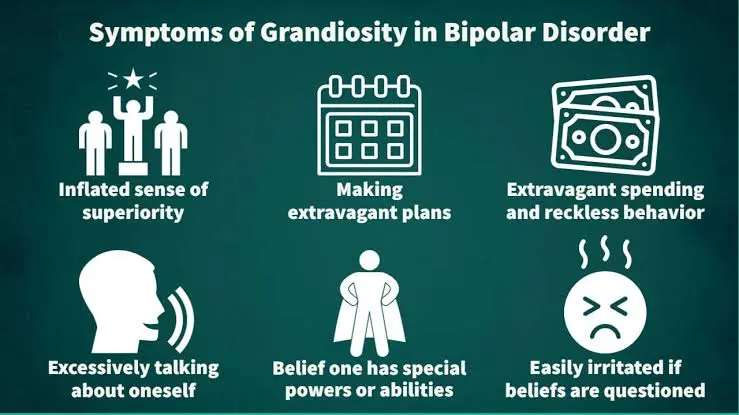
Grandiosity does not always announce itself loudly. Sometimes it hides behind charm, competence, or even apparent generosity. The following patterns tend to appear across different contexts and relationships.
- Consistently overestimating personal achievements while minimizing the contributions of others
- A strong need for admiration that feels urgent rather than incidental
- Difficulty tolerating criticism, even when it is mild or well-intentioned
- Expecting preferential treatment in professional, social, or personal settings
- A belief that ordinary rules or social norms apply to other people but not to them
- Fantasies about unlimited success, power, beauty, or ideal relationships
- Talking at length about their own importance while showing little genuine interest in others
- Responding to perceived slights with disproportionate anger or withdrawal
None of these signs alone confirms a clinical condition. But when several of them appear consistently across different areas of someone’s life, it is worth paying closer attention. Context matters too. A surgeon who is confident in the operating room is not necessarily grandiose. A surgeon who believes they are incapable of error and refuses to consult colleagues is a different matter entirely.
The Psychological Roots Behind Inflated Self-Image
One of the more counterintuitive findings in personality psychology is that overt grandiosity is often a defense mechanism rather than a sign of genuine internal confidence. Research published in the journal Psychological Review has distinguished between two forms of narcissism: grandiose narcissism, which presents as boldness and entitlement, and vulnerable narcissism, which is marked by shame sensitivity and instability. What looks like supreme self-assurance on the outside can mask a fragile core that depends heavily on external validation to stay intact.
Early life experiences play a significant role. Children who were excessively praised without corresponding accountability sometimes develop an unrealistic self-image that never gets calibrated against reality. On the other end of the spectrum, children who experienced significant neglect or emotional unavailability may develop grandiosity as a psychological shield, a way of constructing a self that feels powerful rather than helpless.
Temperament also contributes. Some people are simply more prone to high self-focus and lower empathy as baseline personality traits. When these tendencies interact with certain environments, the result can calcify into patterns that become very hard to shift in adulthood.
How Grandiosity Damages Relationships
Relationships built around grandiosity tend to follow a recognizable arc. Early on, the person may come across as magnetic, highly capable, and unusually attentive. Over time, however, the dynamic shifts. The need for admiration and the difficulty with reciprocity create an imbalance that erodes trust, closeness, and mutual respect.
Living or working closely with someone with a god complex can gradually wear down the people around them, sometimes without those people fully recognizing what is happening until they are already exhausted or isolated.
In romantic partnerships, grandiosity often leads to one-sided communication, emotional unavailability, and a lack of accountability when things go wrong. Partners frequently report feeling invisible or perpetually inadequate, no matter how much they contribute. In workplaces, grandiose leaders can create toxic cultures where credit flows upward and blame flows downward, discouraging honest communication and driving out capable people who have other options.
Friendships are not immune either. Relationships that should feel reciprocal become increasingly one-directional. The grandiose person’s problems, projects, and opinions take center stage consistently. Over time, friends tend to pull back, which the grandiose individual may interpret as jealousy or betrayal rather than a reasonable response to a draining dynamic.
Grandiosity Across Conditions: A Comparison
Because grandiosity appears in several different clinical contexts, it helps to understand how it presents differently depending on the underlying condition. The experience of grandiosity in a manic episode looks quite different from the trait-level grandiosity seen in personality disorders.
| Condition | Type of Grandiosity | Duration | Insight During Episode |
| Narcissistic Personality Disorder | Stable, trait-level | Chronic, persistent | Typically low; feels natural to the person |
| Bipolar Disorder (Manic Episode) | State-level, mood-driven | Time-limited, episode-bound | Often absent during episode; may return after |
| Schizophrenia | Delusional grandiosity | Variable, may be persistent | Usually absent; beliefs feel completely real |
| Substance-Induced States | State-level, chemically driven | Short-term, resolves with sobriety | Usually restored once substances clear |
| Borderline Personality Disorder | Intermittent, context-dependent | Fluctuates with emotional states | Variable, more likely during dysregulation |
This distinction matters practically. Someone whose grandiosity is tied to a manic episode may respond well to mood-stabilizing medication and, between episodes, may have genuine self-awareness and distress about their behavior. Someone whose grandiosity is a stable personality trait tends to require a very different, longer-term therapeutic approach, and outcomes depend heavily on whether the person is willing to engage honestly with treatment.
What Treatment Looks Like and What to Expect
Treating grandiosity is genuinely difficult, and honesty about that matters. When it appears as part of a mood disorder like bipolar disorder, the pathway is more established. Mood stabilizers and antipsychotic medications have solid evidence behind them for managing manic episodes, and many people do well with a combination of medication and psychotherapy, particularly psychoeducation and cognitive behavioral therapy.
When grandiosity is a core feature of a personality disorder, the therapeutic process is longer and more complex. Schema therapy and transference-focused psychotherapy have both shown promise in treating narcissistic personality disorder specifically. A major challenge is that the same traits that define the condition, low self-awareness, difficulty tolerating criticism, and a belief that others are the problem, also create resistance to engaging in therapy meaningfully. Therapists working in this area need significant training and patience.
For people who care about someone with these traits, therapy is often valuable for their own sake, regardless of whether the other person seeks help. Working with a therapist who understands personality dynamics can help people recognize patterns, set limits that actually hold, and process the confusion and emotional cost of these relationships.
When to Seek Help
If someone’s inflated sense of self is causing clear problems at work, in relationships, or in their own emotional wellbeing, that is a reasonable point at which to consider professional support. The same applies to anyone feeling consistently diminished, confused, or drained by someone else’s grandiose behavior. Mental health professionals can provide assessment, context, and tools that make a real difference, but the process works best when the person entering therapy is willing to examine their own role honestly.
Grandiosity sits at a strange intersection of personality, psychology, and human experience. It can look like strength from a distance. Up close, it tends to reveal itself as something far more brittle. Understanding it clearly, without either excusing it or reducing it to simple moral judgment, is the most useful place to start.
Technology Perspective
Technology continues to transform industries through artificial intelligence, cloud computing, automation, cybersecurity, digital platforms, and data-driven decision making. As organizations increasingly adopt digital solutions, understanding emerging technologies becomes essential for businesses, professionals, and consumers. DGM News regularly covers these developments through expert analysis, technology news, and educational resources.
Innovation Outlook
Rapid advances in artificial intelligence, automation, machine learning, cloud infrastructure, and digital transformation continue reshaping global industries. Monitoring these developments helps organizations adapt to changing technologies, improve efficiency, and prepare for future innovation.
Did you know?
Artificial Intelligence is expected to influence nearly every major industry over the coming decade, from healthcare and finance to transportation, manufacturing, education, and entertainment.
AI, Machine Learning, Deep Learning and Generative AI Explained
Google AI Updates
About DGM News
DGM News is an independent digital publication delivering the latest Technology News, AI News, and FinTech News. We provide expert insights on startups, innovation, cybersecurity, software, business, gadgets, cloud computing, artificial intelligence, and emerging technologies. Our mission is to publish informative, accurate, and regularly updated content that helps readers stay informed in today's rapidly evolving digital landscape.
Since our editorial focus includes technology, artificial intelligence, and financial technology, we continuously expand our coverage as new innovations emerge.
Editorial Standards
Every article published on DGM News undergoes editorial review before publication. We prioritize factual accuracy, clarity, transparency, and reader value while following responsible digital publishing practices.
Research Methodology
Our editorial team researches publicly available information from official announcements, technical documentation, research publications, developer resources, reputable industry reports, and trusted public sources whenever applicable. Information is reviewed to improve clarity and accuracy before publication.
Fact-Checking Policy
We make reasonable efforts to verify factual information before publishing. Articles are reviewed for accuracy, consistency, and relevance. If significant developments occur after publication, content may be revised to reflect updated information.
Update Policy
Technology evolves rapidly. Articles may be reviewed and updated periodically to reflect software releases, AI developments, security advisories, regulatory updates, product launches, and other important industry changes.
Source Verification
Whenever possible, DGM News reviews information using official company announcements, technical documentation, research publications, government resources, publicly available reports, and reputable industry references before updating articles.
Editorial Independence
DGM News maintains editorial independence in all publishing decisions. Editorial content is produced independently and is intended to provide balanced, informative, and reader-focused coverage without influence from advertisers or commercial partnerships.
AI Usage Disclosure
Artificial intelligence tools may assist with research organization, grammar improvement, formatting, or editorial workflows. Every article is reviewed by human editors before publication to help maintain quality, clarity, and factual accuracy.
Corrections Policy
Accuracy is important to us. If readers identify outdated information or factual inaccuracies, they are encouraged to contact our editorial team. Verified corrections are reviewed and incorporated whenever appropriate.
Reader Feedback
Reader feedback helps improve our journalism. We welcome suggestions, corrections, and constructive feedback through our Contact page to continuously improve the quality of our reporting.
Last Editorial Review
This article follows the DGM News editorial review process and may be updated periodically as new information becomes available.
Why Trust DGM News?
DGM News is committed to publishing technology journalism that emphasizes accuracy, transparency, editorial independence, and regularly updated information. Our editorial process is designed to provide readers with reliable coverage of technology, AI, fintech, startups, and digital innovation.
DGM News Resources
Topics We Cover
Artificial Intelligence • AI Tools • Machine Learning • FinTech • Cybersecurity • Cloud Computing • Programming • Software Development • Gadgets • Mobile Technology • Business Technology • Startups • Digital Marketing • Blockchain • Cryptocurrency • Science • Innovation • Consumer Technology • Enterprise Technology • Automation
