

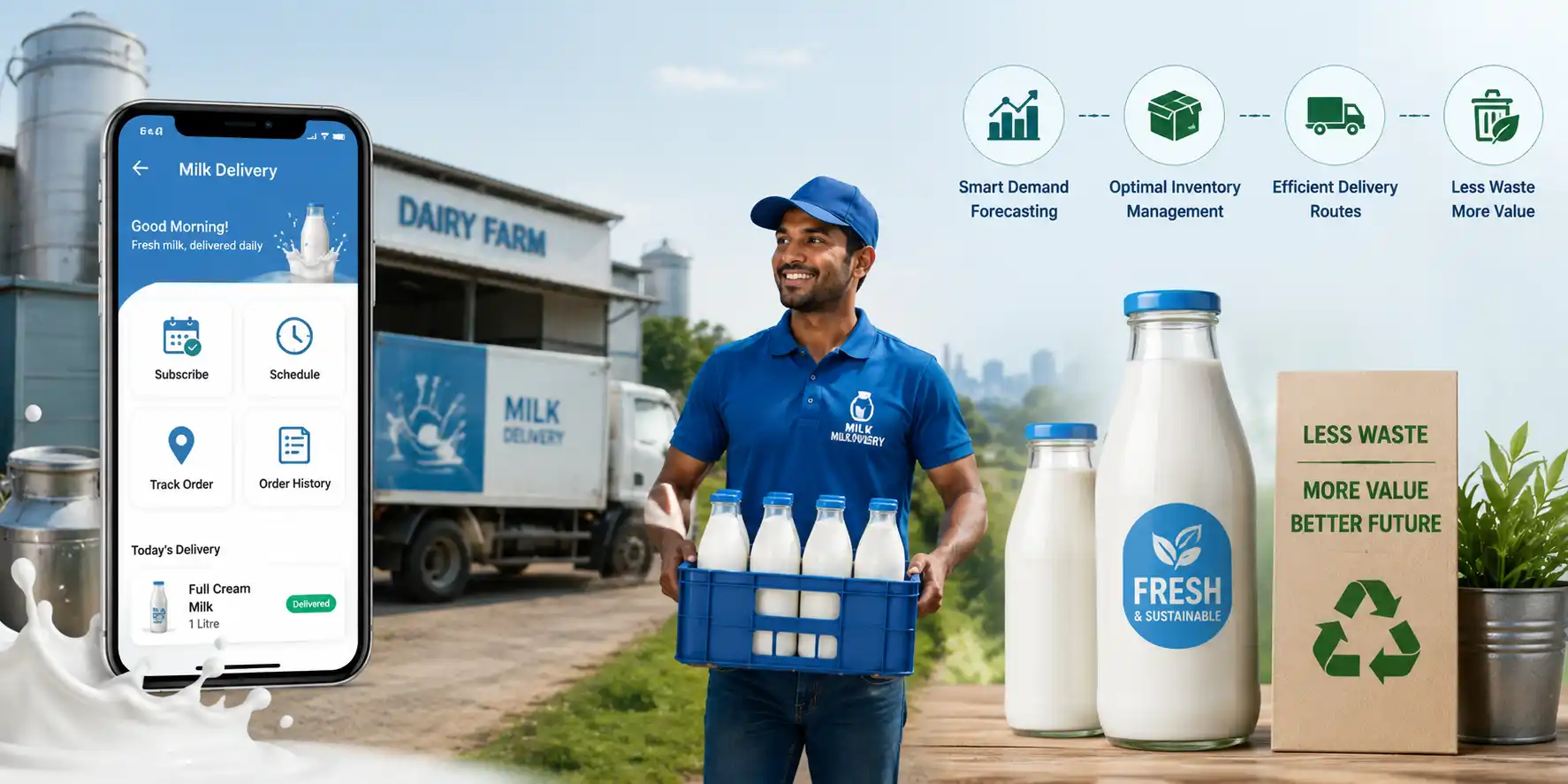
Food waste is a growing global concern, and the dairy industry is one of the hardest hit. Milk and dairy products have short shelf lives, making wastage a constant challenge for producers, distributors, and retailers alike.
Traditional milk supply chains often struggle with poor demand forecasting, inefficient delivery routes, and a lack of real-time inventory visibility. The result? Tons of unsold milk and dairy products are discarded every single day.
Milk delivery apps are changing that. By connecting producers directly with consumers and automating the entire order and delivery process, these apps bring precision and efficiency to an industry that desperately needs it.
From smart inventory management to subscription-based ordering and real-time tracking, milk delivery apps tackle wastage at every stage of the supply chain.
In this post, we explore exactly how milk delivery apps are helping reduce dairy product wastage and why that matters for your business.
What Are Milk Delivery Apps?
Milk delivery apps are mobile platforms that allow customers to order milk and dairy products directly from local dairies, farms, or distributors. These apps handle everything from order placement and subscription scheduling to doorstep delivery and digital payments.
Customers can set daily, weekly, or custom delivery preferences with just a few taps. For businesses, investing in milk delivery app development gives them access to real-time order tracking, inventory management, and customer data insights.
Simply put, they digitize and streamline the entire milk supply and delivery process for both consumers and dairy businesses.
How Milk Delivery Apps Improve Supply Chain Management?
Managing a dairy supply chain without the right tools leads to overproduction, delivery inefficiencies, and significant product wastage. Milk delivery apps bring digital intelligence to every step of the supply chain, helping businesses operate with greater accuracy and less waste.
► Real-Time Order Tracking and Inventory Management
Milk delivery apps give businesses complete visibility over their orders and stock levels at all times. Managers can monitor inventory in real time, track active deliveries, and get instant alerts when stock runs low. This eliminates guesswork from daily operations.
When businesses know exactly how much product is moving and where, they can adjust procurement and production accordingly. The result is a leaner, more efficient supply chain with significantly less risk of overstocking or spoilage.
► Subscription-Based Deliveries Help Reduce Excess Production
Subscription models are one of the most effective ways milk delivery apps reduce wastage. If you are wondering how to develop a milk delivery app that minimizes overproduction, starting with a subscription-based delivery model is the right approach.
When customers subscribe to daily or weekly delivery plans, businesses receive predictable order data in advance. This allows dairy producers to manufacture only what is needed, rather than producing in bulk and hoping demand meets supply.
► Smart Demand Forecasting Minimizes Milk Wastage
Modern milk delivery apps use data analytics and AI-powered tools to forecast demand accurately. By analyzing order history and local consumption patterns, these apps help businesses predict exactly how much product will be needed on any given day.
This means dairy producers can plan production with precision rather than relying on estimates. When supply closely matches actual demand, wastage drops significantly. Smart forecasting transforms reactive supply chains into proactive, data-driven operations that save both product and money.
How Milk Delivery Apps Support Local Dairy Businesses?
Local dairy businesses often operate on tight margins with limited resources. Milk delivery apps give them the digital tools to compete effectively, serve customers better, and reduce losses caused by inefficiencies in delivery and payments.
► Reducing Delivery Delays and Product Spoilage
Delayed deliveries are one of the biggest causes of dairy product spoilage. Milk delivery apps use optimized route planning to ensure drivers follow the fastest, most efficient paths. Real-time tracking keeps both the business and customer informed about delivery status.
Faster deliveries mean fresher products reaching customers on time, reducing the chances of spoilage and returns that directly impact a local dairy business’s bottom line.
► Digital Payments and Contactless Delivery Benefits
Milk delivery apps simplify transactions for both customers and businesses. Digital payment options eliminate the hassle of cash handling, reduce errors, and speed up the billing process.
Contactless delivery features add convenience and build customer trust, especially in hygiene-conscious markets. For local dairy businesses, this means smoother daily operations, fewer payment disputes, and a more professional customer experience that encourages loyalty and repeat orders.
How Customer Data Helps Optimize Dairy Operations?
Data is one of the most valuable assets a milk delivery business can have. Milk delivery apps continuously collect and analyze customer data, giving dairy businesses actionable insights to streamline operations, reduce waste, and improve service quality. Here is how customer data makes a direct impact:
- Order Pattern Analysis: Apps track individual customer order histories, helping businesses identify peak demand days, popular products, and slow-moving items. This allows production teams to plan output more accurately and avoid unnecessary surplus.
- Personalized Delivery Scheduling: Customer data reveals preferred delivery times and frequencies. Businesses can use this information to create optimized delivery schedules that reduce fuel costs, minimize delays, and ensure fresher products reach the right customers at the right time.
- Demand-Based Inventory Planning: Real-time data on active subscriptions and order volumes helps managers maintain optimal stock levels. Overstocking and understocking both become far less common when inventory decisions are backed by live customer data.
- Churn Prediction and Retention: Apps can flag customers who are reducing orders or showing signs of cancellation. Businesses can then proactively reach out with offers or reminders, retaining revenue that would otherwise be lost.
- Product Performance Insights: Data shows which dairy products sell consistently and which ones sit unsold. This helps businesses adjust their product offerings, promotional strategies, and production priorities based on real customer preferences.
- Seasonal Trend Identification: Customer data collected over time reveals seasonal buying patterns. Dairy businesses can prepare in advance for high-demand periods and scale back during slower months, keeping wastage to a minimum throughout the year.
Conclusion
Dairy wastage is a serious problem, but it is not an unsolvable one. As this post has explored, milk delivery apps provide practical, technology-driven solutions that address wastage at every level of the supply chain.
From real-time inventory management and smart demand forecasting to subscription-based deliveries and customer data insights, these apps give dairy businesses the tools they need to operate more efficiently and profitably.
Local dairy businesses especially benefit from the streamlined delivery, digital payments, and data-backed decision-making that these platforms offer.
The dairy industry cannot afford to keep running on outdated processes. Consumer expectations are rising, margins are tightening, and wastage is costing businesses more than they realize.
Investing in a milk delivery app is not just a technology upgrade. It is a strategic move toward a smarter, leaner, and more sustainable dairy business. The right app development partner makes all the difference.
Technology Perspective
Technology continues to transform industries through artificial intelligence, cloud computing, automation, cybersecurity, digital platforms, and data-driven decision making. As organizations increasingly adopt digital solutions, understanding emerging technologies becomes essential for businesses, professionals, and consumers. DGM News regularly covers these developments through expert analysis, technology news, and educational resources.
Innovation Outlook
Rapid advances in artificial intelligence, automation, machine learning, cloud infrastructure, and digital transformation continue reshaping global industries. Monitoring these developments helps organizations adapt to changing technologies, improve efficiency, and prepare for future innovation.
Did you know?
Artificial Intelligence is expected to influence nearly every major industry over the coming decade, from healthcare and finance to transportation, manufacturing, education, and entertainment.
AI, Machine Learning, Deep Learning and Generative AI Explained
Google AI Updates
About DGM News
DGM News is an independent digital publication delivering the latest Technology News, AI News, and FinTech News. We provide expert insights on startups, innovation, cybersecurity, software, business, gadgets, cloud computing, artificial intelligence, and emerging technologies. Our mission is to publish informative, accurate, and regularly updated content that helps readers stay informed in today's rapidly evolving digital landscape.
Since our editorial focus includes technology, artificial intelligence, and financial technology, we continuously expand our coverage as new innovations emerge.
Editorial Standards
Every article published on DGM News undergoes editorial review before publication. We prioritize factual accuracy, clarity, transparency, and reader value while following responsible digital publishing practices.
Research Methodology
Our editorial team researches publicly available information from official announcements, technical documentation, research publications, developer resources, reputable industry reports, and trusted public sources whenever applicable. Information is reviewed to improve clarity and accuracy before publication.
Fact-Checking Policy
We make reasonable efforts to verify factual information before publishing. Articles are reviewed for accuracy, consistency, and relevance. If significant developments occur after publication, content may be revised to reflect updated information.
Update Policy
Technology evolves rapidly. Articles may be reviewed and updated periodically to reflect software releases, AI developments, security advisories, regulatory updates, product launches, and other important industry changes.
Source Verification
Whenever possible, DGM News reviews information using official company announcements, technical documentation, research publications, government resources, publicly available reports, and reputable industry references before updating articles.
Editorial Independence
DGM News maintains editorial independence in all publishing decisions. Editorial content is produced independently and is intended to provide balanced, informative, and reader-focused coverage without influence from advertisers or commercial partnerships.
AI Usage Disclosure
Artificial intelligence tools may assist with research organization, grammar improvement, formatting, or editorial workflows. Every article is reviewed by human editors before publication to help maintain quality, clarity, and factual accuracy.
Corrections Policy
Accuracy is important to us. If readers identify outdated information or factual inaccuracies, they are encouraged to contact our editorial team. Verified corrections are reviewed and incorporated whenever appropriate.
Reader Feedback
Reader feedback helps improve our journalism. We welcome suggestions, corrections, and constructive feedback through our Contact page to continuously improve the quality of our reporting.
Last Editorial Review
This article follows the DGM News editorial review process and may be updated periodically as new information becomes available.
Why Trust DGM News?
DGM News is committed to publishing technology journalism that emphasizes accuracy, transparency, editorial independence, and regularly updated information. Our editorial process is designed to provide readers with reliable coverage of technology, AI, fintech, startups, and digital innovation.
DGM News Resources
Topics We Cover
Artificial Intelligence • AI Tools • Machine Learning • FinTech • Cybersecurity • Cloud Computing • Programming • Software Development • Gadgets • Mobile Technology • Business Technology • Startups • Digital Marketing • Blockchain • Cryptocurrency • Science • Innovation • Consumer Technology • Enterprise Technology • Automation
