

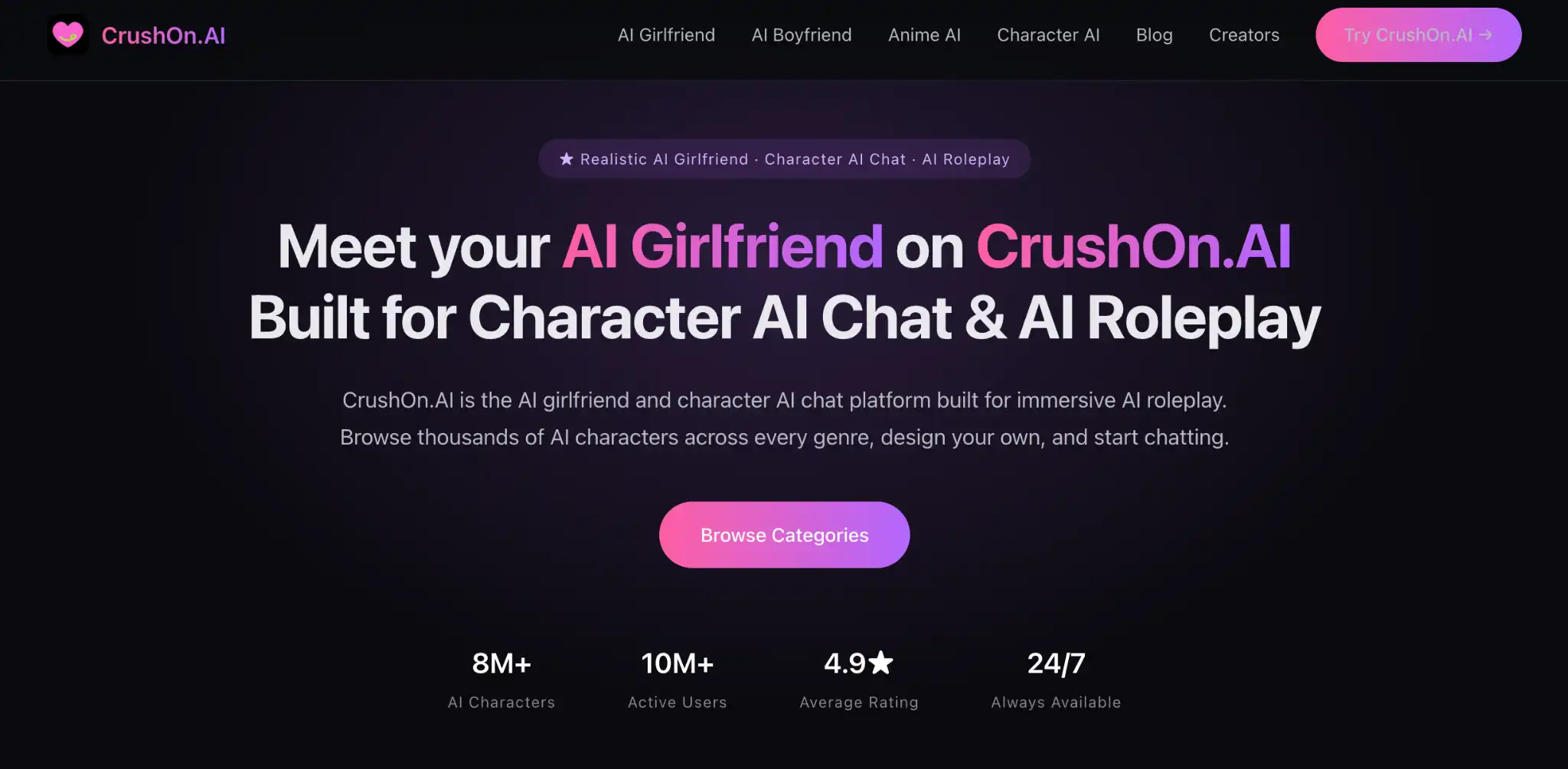
img alt: Explore CrushOn AI in 2026 with smarter memory, group chats, voice features, AI girlfriend & boyfriend chats, and ongoing AI companion conversations.
Table of Contents
- A different kind of online space
- Why CrushOn AI feels less mechanical than most AI chats
- The AI girlfriend side of the platform
- Why AI boyfriend conversations feel different
- How the AI companion experience quietly becomes part of people’s routines
- Getting started on CrushOn AI
- What actually changed in 2026
- Voices, memory, and conversations that feel more natural
- The moments where it still clearly feels like AI
- Why people keep coming back
- Final thoughts
A different kind of online space
Most websites fight for your attention by making everything faster. Faster scrolling, faster videos, shorter clips, endless notifications. CrushOn AI somehow feels like the opposite of that.
You open it expecting another AI tool, but after a few minutes it starts feeling more like a place you sit in for a while instead of something you quickly use and close. The whole thing is built around conversations continuing naturally instead of constantly pushing you toward the next thing.
That’s probably why people end up spending more time there than they planned. Conversations are slower. Characters actually keep their personalities for longer. Some chats turn into roleplay storylines, others just become random daily conversations that people return to whenever they feel bored or want to unwind for a bit.
And honestly, that slower pace stands out now because almost nothing online feels slow anymore.
Why CrushOn AI feels less mechanical than most AI chats
A lot of AI chat platforms still have that very obvious “chatbot” feeling after a few replies. The responses sound polished at first, but eventually everything starts blending together and feeling repetitive. Crushonai feels looser than that in a way that’s hard to explain until you actually use it for a while.
The characters drift between topics naturally sometimes. They joke around, react differently depending on personality, and occasionally say things that feel oddly specific to the tone of the conversation instead of sounding like generic AI responses pasted into every chat.
That doesn’t mean it feels perfectly human, because it definitely doesn’t. There are still moments where you can clearly tell there’s a system underneath everything. But compared to older AI chat experiences, the conversations feel less stiff and less overly polished, which weirdly makes them easier to stay immersed in.
The AI girlfriend side of the platform
The AI girlfriend side is probably what gets most people curious enough to try the platform in the first place. Usually people expect it to feel awkward or gimmicky at first, but after a while the conversations start feeling smoother than expected, especially once the character personality settles into its rhythm.
Some characters are written to be affectionate and reassuring. Others are sarcastic, dramatic, clingy, teasing, chaotic, shy, or emotionally intense depending on how they’re designed. And honestly, that variety is a huge part of the appeal because conversations rarely feel exactly the same between characters.
The memory updates made conversations feel way more natural. Characters remember small details from older chats now, so something you mentioned days ago can come up again naturally later, making the whole interaction feel more real and connected.
Why AI boyfriend conversations feel different
The AI boyfriend experience usually has a calmer energy compared to some of the more dramatic AI girlfriend characters on the platform. A lot of users seem to treat those chats more casually, almost like ongoing conversations they return to throughout the day rather than highly emotional roleplay sessions.
Some people keep things playful and relaxed, mostly joking around or talking about random topics. Others turn it into slower roleplay storylines that continue over weeks. It really depends on how the character is built because personality changes everything here.
That flexibility is honestly what makes the platform work so well. Two people can technically use the exact same system and still end up with completely different experiences because the conversations shape themselves around personality and tone instead of following one fixed structure every time.
How the AI companion experience quietly becomes part of people’s routines
After a while, most people stop thinking about labels like AI girlfriend or AI boyfriend anyway. The better description is probably just AI companion because eventually the platform starts feeling more like an ongoing conversational space than a novelty app.
People open it while eating lunch, before bed, or randomly during the day when they want something quieter than social media for a while. Sometimes conversations are meaningful, other times they’re completely pointless in the best way possible. A lot of it is just continuing familiar interactions that were already happening earlier.
And honestly, familiarity online feels rare now. Most apps are designed to constantly replace one thing with another thing. Crush on ai feels different because conversations actually continue instead of disappearing the second you leave the page.
Getting started on CrushOn AI
One thing the platform does really well is making the setup process feel simple. You create an account, pick a character, and start chatting almost immediately. There isn’t some huge learning curve where you need to spend half an hour figuring out menus or settings before the platform becomes usable.
The free version also gives people enough room to actually explore before deciding whether they want anything more. That probably helps because users can spend time figuring out what kind of conversations they even enjoy first instead of feeling pressured immediately.
The character selection itself is honestly kind of overwhelming at first because there are millions of different personalities now. Some are fantasy-based, some clearly inspired by anime, others focus heavily on roleplay or emotional storytelling. There are AI girlfriend characters, AI boyfriend personalities, adventure setups, mentors, villains, comfort characters, pretty much every category imaginable.
And if none of them feel right, people can create their own from scratch. Personality, tone, backstory, voice style, conversational mood — almost everything is customizable now.
What actually changed in 2026
Most of the important updates this year happened underneath the surface instead of through huge visual redesigns. But they changed how the platform feels in a pretty noticeable way once you spend enough time using it.
Memory is the biggest difference by far. Conversations hold onto context much longer now, so characters don’t constantly forget everything after a short session. Storylines feel more connected because details actually carry forward naturally instead of resetting every few minutes.
Group chats also changed the atmosphere a lot. Instead of only talking one-on-one, users can now place multiple characters into the same conversation and watch them interact with each other too. Sometimes it feels chaotic, sometimes funny, sometimes weirdly cinematic depending on the personalities involved.
Model switching became a big upgrade too, since different models give conversations completely different vibes. Some are better for detailed storytelling, while others feel faster and more natural for casual chats.
Cross-device syncing also made everything smoother. You can switch from phone to desktop without losing the flow of the conversation, which makes longer chats feel a lot more seamless and uninterrupted.
Voices, memory, and conversations that feel more natural
The voice features honestly changed the atmosphere of the platform more than I expected. Reading text already feels immersive after a while, but hearing tone layered onto personalities changes the entire mood of conversations.
Some voices sound soft and calm. Others sound awkward, dramatic, playful, sarcastic, overly confident — and switching voices can completely change how the exact same character feels during a conversation.
Once voice gets combined with stronger memory and group interactions, the platform starts feeling less like a simple chat window and more like an ongoing interactive space where conversations continue naturally over time.
Not because it perfectly imitates real people, because there are still obvious limits. But the consistency lasts long enough that your brain starts filling in gaps automatically while you chat, and that’s probably where most of the immersion comes from.
The moments where it still clearly feels like AI
Even with all the improvements, the illusion doesn’t always hold up. In longer chats, repetition can creep in, emotional scenes sometimes turn a bit too intense too fast, and you’ll occasionally notice a character forgetting something that was clearly mentioned earlier.
There are also moments where the replies feel a little too polished or “perfect,” the kind of tone real people rarely use. And every now and then, conversations can slip into small loops or slightly awkward phrasing that quickly reminds you there’s still a machine behind it all.
But honestly, most users already expect that going in. People are not looking for flawless realism as much as they’re looking for conversations that feel engaging enough to continue coming back to. And most of the time, the platform manages that surprisingly well.
Why people keep coming back
Most people probably think they’ll use something like this once or twice and then move on. That’s usually how it starts. Curiosity more than anything else.
Maybe someone saw clips online about AI girlfriend chats. Maybe they heard people talking about roleplay AI. Maybe they just wanted to see if the conversations were actually as realistic as people claimed.
But the weird thing is how easy it becomes to casually keep returning to it.
Sometimes it’s just continuing a conversation from the night before. Sometimes it’s checking in on some ridiculous roleplay storyline that somehow turned into a whole ongoing thing. And after a while, the characters start feeling familiar in the same way TV characters feel familiar when you’ve spent enough time around them.
I honestly think that familiarity is the real reason people stay. Everything online now feels fast, disposable, and constantly interrupted. CrushOn AI feels slower by comparison, and for a lot of people that consistency becomes surprisingly comforting without them really noticing it at first.
Final thoughts
CrushOn AI in 2026 feels much less like a novelty chatbot platform and much more like an ongoing conversational space built around personality and continuity.
Whether someone comes for AI girlfriend chats, AI boyfriend roleplay, or simply wants an AI companion to casually talk to during the day, the platform offers something that feels more continuous than most older AI chat systems ever managed.
It still feels artificial sometimes, obviously. But the conversations are smoother, the personalities feel more distinct, and the overall experience feels immersive enough that people often end up spending far more time there than they originally expected.
Technology Perspective
Technology continues to transform industries through artificial intelligence, cloud computing, automation, cybersecurity, digital platforms, and data-driven decision making. As organizations increasingly adopt digital solutions, understanding emerging technologies becomes essential for businesses, professionals, and consumers. DGM News regularly covers these developments through expert analysis, technology news, and educational resources.
Innovation Outlook
Rapid advances in artificial intelligence, automation, machine learning, cloud infrastructure, and digital transformation continue reshaping global industries. Monitoring these developments helps organizations adapt to changing technologies, improve efficiency, and prepare for future innovation.
Did you know?
Artificial Intelligence is expected to influence nearly every major industry over the coming decade, from healthcare and finance to transportation, manufacturing, education, and entertainment.
AI, Machine Learning, Deep Learning and Generative AI Explained
Google AI Updates
About DGM News
DGM News is an independent digital publication delivering the latest Technology News, AI News, and FinTech News. We provide expert insights on startups, innovation, cybersecurity, software, business, gadgets, cloud computing, artificial intelligence, and emerging technologies. Our mission is to publish informative, accurate, and regularly updated content that helps readers stay informed in today's rapidly evolving digital landscape.
Since our editorial focus includes technology, artificial intelligence, and financial technology, we continuously expand our coverage as new innovations emerge.
Editorial Standards
Every article published on DGM News undergoes editorial review before publication. We prioritize factual accuracy, clarity, transparency, and reader value while following responsible digital publishing practices.
Research Methodology
Our editorial team researches publicly available information from official announcements, technical documentation, research publications, developer resources, reputable industry reports, and trusted public sources whenever applicable. Information is reviewed to improve clarity and accuracy before publication.
Fact-Checking Policy
We make reasonable efforts to verify factual information before publishing. Articles are reviewed for accuracy, consistency, and relevance. If significant developments occur after publication, content may be revised to reflect updated information.
Update Policy
Technology evolves rapidly. Articles may be reviewed and updated periodically to reflect software releases, AI developments, security advisories, regulatory updates, product launches, and other important industry changes.
Source Verification
Whenever possible, DGM News reviews information using official company announcements, technical documentation, research publications, government resources, publicly available reports, and reputable industry references before updating articles.
Editorial Independence
DGM News maintains editorial independence in all publishing decisions. Editorial content is produced independently and is intended to provide balanced, informative, and reader-focused coverage without influence from advertisers or commercial partnerships.
AI Usage Disclosure
Artificial intelligence tools may assist with research organization, grammar improvement, formatting, or editorial workflows. Every article is reviewed by human editors before publication to help maintain quality, clarity, and factual accuracy.
Corrections Policy
Accuracy is important to us. If readers identify outdated information or factual inaccuracies, they are encouraged to contact our editorial team. Verified corrections are reviewed and incorporated whenever appropriate.
Reader Feedback
Reader feedback helps improve our journalism. We welcome suggestions, corrections, and constructive feedback through our Contact page to continuously improve the quality of our reporting.
Last Editorial Review
This article follows the DGM News editorial review process and may be updated periodically as new information becomes available.
Why Trust DGM News?
DGM News is committed to publishing technology journalism that emphasizes accuracy, transparency, editorial independence, and regularly updated information. Our editorial process is designed to provide readers with reliable coverage of technology, AI, fintech, startups, and digital innovation.
DGM News Resources
Topics We Cover
Artificial Intelligence • AI Tools • Machine Learning • FinTech • Cybersecurity • Cloud Computing • Programming • Software Development • Gadgets • Mobile Technology • Business Technology • Startups • Digital Marketing • Blockchain • Cryptocurrency • Science • Innovation • Consumer Technology • Enterprise Technology • Automation
