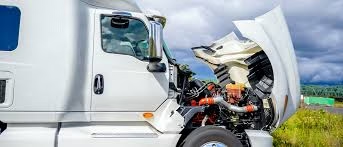
Cooling systems in heavy-duty trucks are designed to operate under sustained load, variable climates, and long duty cycles. When trucks age, cooling performance rarely fails all at once. Instead, it degrades gradually through a combination of wear, material fatigue, and design limitations that were acceptable when the vehicle was new. By the time a clear overheating event occurs, multiple underlying issues are often already present.
Older trucks continue to play a critical role in freight, construction, and regional haul operations. Many remain mechanically sound but operate closer to their thermal limits than they did earlier in their service life. As components age, cooling systems become less forgiving of marginal conditions such as heavy loads, slow traffic, or high ambient temperatures.
The failures outlined below reflect common cooling-related issues seen in aging heavy-duty trucks. While they appear as isolated problems, they often share a common thread: declining heat management capacity across interconnected components.
Why cooling systems become less resilient as trucks age
A cooling system functions as a balance between heat generation and heat rejection. Engines produce heat continuously, and the cooling system must remove that heat at the same rate to maintain stable operating temperatures. Over time, the system’s ability to do this diminishes due to internal fouling, external damage, and loss of material integrity.
In platforms where the 2007 freightliner columbia radiator represents a central heat exchange component, reduced efficiency upstream or downstream amplifies stress across the entire system. Failures rarely originate from a single part acting alone. Instead, they emerge from cumulative decline across hoses, pumps, airflow paths, and heat exchangers.
Why symptoms often appear under specific conditions
Cooling failures tend to surface only when demand spikes.
- Long climbs under load
- Extended idling in hot conditions
- Slow-speed operation with limited airflow
Under lighter conditions, degraded systems may appear functional, masking underlying issues.
1. Internal radiator fouling and reduced heat transfer
Over time, coolant additives break down, and contaminants accumulate inside radiator passages. Even without visible blockage, internal fouling reduces effective heat transfer surface area. The radiator may appear intact externally while losing a significant portion of its cooling capacity.
This failure mode develops slowly and is often misattributed to thermostat or fan issues.
How internal fouling impacts operation
- Higher baseline operating temperatures
- Reduced thermal margin under load
- Increased reliance on auxiliary cooling
Flushing may provide temporary relief but does not restore lost surface efficiency once deposits harden.
2. External fin damage and airflow restriction
Radiator fins are exposed to debris, road grime, insects, and corrosion. Over years of operation, fins bend, clog, or corrode, reducing airflow through the core. Even small airflow reductions can significantly impact heat rejection at low speeds.
This issue is common in trucks that operate on unpaved roads or in construction environments.
Why airflow loss is often underestimated
Airflow degradation is incremental.
- Damage accumulates gradually
- Visual inspection can be misleading
- Performance loss appears only under load
Cleaning helps, but structural fin damage permanently reduces effectiveness.
3. Coolant hose degradation and internal collapse
Hoses age through heat cycling and chemical exposure. While external cracking is easy to spot, internal deterioration is more dangerous. Softened hose liners can collapse under suction, restricting coolant flow intermittently.
This creates unpredictable temperature spikes.
Indicators of internal hose failure
- Temperature fluctuations without leaks
- Overheating at higher RPM
- Normal operation at idle
Because hoses may look intact externally, diagnosis is often delayed.
4. Water pump efficiency loss
Water pumps wear gradually. Impeller erosion, bearing wear, and seal degradation reduce flow without causing immediate failure. As pump efficiency declines, coolant circulation drops below what the engine requires under load.
The system compensates until it cannot.
Why pump issues are difficult to isolate
- No visible leaks initially
- Noise may be absent
- Symptoms mimic radiator problems
By the time failure is obvious, multiple components are already stressed.
5. Fan clutch malfunction or delayed engagement
Mechanical fan clutches rely on temperature-sensitive mechanisms to engage airflow when needed. Over time, these mechanisms lose responsiveness. Delayed or partial engagement reduces airflow precisely when cooling demand is highest.
This failure often appears during slow-speed or stop-and-go operation.
Consequences of fan clutch issues
- Overheating in traffic
- Normal temperatures at highway speeds
- Increased thermal cycling
The intermittent nature of the problem complicates troubleshooting.
6. Thermostat drift and improper opening behavior
Thermostats are calibrated to open at specific temperatures. With age, calibration drifts. A thermostat may open late, open partially, or cycle erratically. Even small deviations affect system balance.
Unlike a stuck thermostat, drift is subtle.
Operational impact of thermostat drift
- Slow warm-up or delayed cooling
- Temperature instability under load
- Increased stress on other components
Replacement often reveals improvements that were previously attributed elsewhere.
7. Coolant contamination and additive depletion
Modern coolants rely on additive packages to prevent corrosion, cavitation, and scale formation. Over time, these additives deplete. Mixing incompatible coolants accelerates this process, leading to corrosion and deposit formation.
The damage is cumulative and internal.
Why coolant condition matters long-term
- Corrosion reduces heat transfer
- Deposits restrict flow
- Component life shortens
Regular analysis is more reliable than visual inspection.
8. Air pockets and poor system bleeding
After service or coolant loss, trapped air can remain in the system. Air pockets reduce effective coolant contact and create localized hot spots. Older systems without self-bleeding designs are particularly vulnerable.
Air-related issues often recur after maintenance.
Symptoms linked to trapped air
- Sudden temperature spikes
- Heater performance inconsistency
- Gurgling or pressure fluctuations
Proper bleeding procedures are essential but frequently overlooked.
9. Pressure cap fatigue and boiling point reduction
Radiator caps maintain system pressure, raising coolant boiling point. As caps age, spring tension weakens, allowing pressure loss. Reduced pressure lowers boiling temperature, increasing vapor formation under load.
This failure often goes unnoticed.
Effects of inadequate system pressure
- Coolant loss without visible leaks
- Steam pockets forming under load
- Accelerated overheating events
Caps are inexpensive but critical components.
10. Cumulative heat load exceeding original design margins
Older trucks often operate differently than originally intended. Increased payloads, modified duty cycles, or auxiliary equipment add thermal load. Cooling systems designed with limited margin struggle to adapt.
The system reaches a tipping point.
Why cumulative load matters
- Individual components may test within limits
- Combined load exceeds system capacity
- Failures appear sudden but are long-developing
This scenario is common in trucks that have been repurposed over time.
How cooling system failures interact rather than isolate
Cooling system components do not fail independently. Reduced radiator efficiency increases reliance on the fan. Fan issues amplify pump and thermostat stress. Coolant degradation accelerates corrosion across the system.
Failures reinforce one another.
Why replacing single components often disappoints
- Root causes remain active
- Improvements are temporary
- System balance is not restored
Effective repair considers the system as a whole.
Cooling systems in engineering context
Engine cooling systems function by transferring heat from the engine to the environment through liquid coolant and air flow. Their effectiveness depends on fluid circulation, heat exchanger efficiency, and pressure control. A general overview of how automotive cooling systems work is outlined in Wikipedia’s explanation of internal combustion engine cooling, which describes how radiators, pumps, thermostats, and airflow interact to maintain operating temperature.
This framework explains why small degradations across multiple components create large system-level effects.
Warning signs that precede major cooling failures
Older trucks often provide early signals before catastrophic overheating occurs.
- Rising average operating temperature
- Narrowing margin between normal and overheat
- Increased sensitivity to load or ambient heat
Recognizing these patterns allows for intervention before damage occurs.
Preventive perspective for aging fleets
Maintaining cooling performance in older trucks requires shifting from reactive repair to proactive system management.
Key practices include:
- Monitoring temperature trends over time
- Evaluating airflow and heat exchanger condition
- Treating coolant as a consumable, not a lifetime fill
These steps extend service life and reduce downtime.
Why radiators remain the system’s limiting factor
Among cooling components, the radiator sets the upper limit for heat rejection. Once its efficiency declines beyond a threshold, no amount of auxiliary airflow or pump capacity can fully compensate.
Understanding radiator condition is central to diagnosing older systems.
Closing perspective: cooling failures reflect system aging, not isolated defects
Cooling system failures in older heavy-duty trucks rarely stem from a single broken part. They emerge from gradual loss of efficiency, material degradation, and accumulated operating stress. By the time overheating becomes obvious, multiple components are already operating outside their optimal range.
Addressing these failures effectively requires viewing the cooling system as an integrated whole. Recognizing how age affects heat transfer, airflow, and pressure control helps prevent misdiagnosis and repeated downtime. In aging trucks, cooling reliability is not restored through isolated fixes, but through understanding and managing the system’s declining margins before they are exhausted.