
The article provides you with five good dissertation topics in criminal profiling, drawing on recent research and trends in the UK. It demonstrates what a criminology thesis should be regarded as academically, with examples. Each concept is backgrounded, with research directions and research method tips to benefit you.
You want a dissertation topic on criminal profiling that truly advances understanding. The first thing is to understand what is considered high academic value regarding criminal profiling dissertation ideas. Simply put, the examiners seek an original contribution supported by evidence and astute analysis.
Criminal profiling is a field of interest that lies at the border of psychology, criminology, and policing. It has since increased significantly since the investigation of psychology was initiated by David Canter in the 1980s. Although it has received a lot of criticism regarding its scientific validity. But that tension is precisely what makes it an excellent subject of dissertation research.
This guide provides you with 5 practical thoughts of criminal profiling dissertation. Each concept explores a burning field of UK criminal enquiry. Plus, it discusses the validity of assumptions in profiling, profiling sexual crime, profiling and ethics and prejudice, neuroscience information and geographic/cybercrime profiling. Find out more below:
What Types of Criminology Profiling Dissertations are Considered of High Academic Value?
Outstanding criminology research topics typically address a large issue with evidence. In practice, it involves selecting a research topic that is of interest, conducting a thorough literature review, and drawing data-supported conclusions. In fact, you must have conceptual coherence, methodological rigour, analytical depth and definite contribution.
You do not need to invent a new crime. Instead, focus on offering a fresh perspective on an existing problem. A good thesis questions established opinions and presents familiar ideas in a new way. For additional guidance, dissertation help from The Academic Papers UK can provide practical tips on refining your topic and structuring your research effectively.
5 Criminal Profiling Dissertation Ideas With High Academic Value
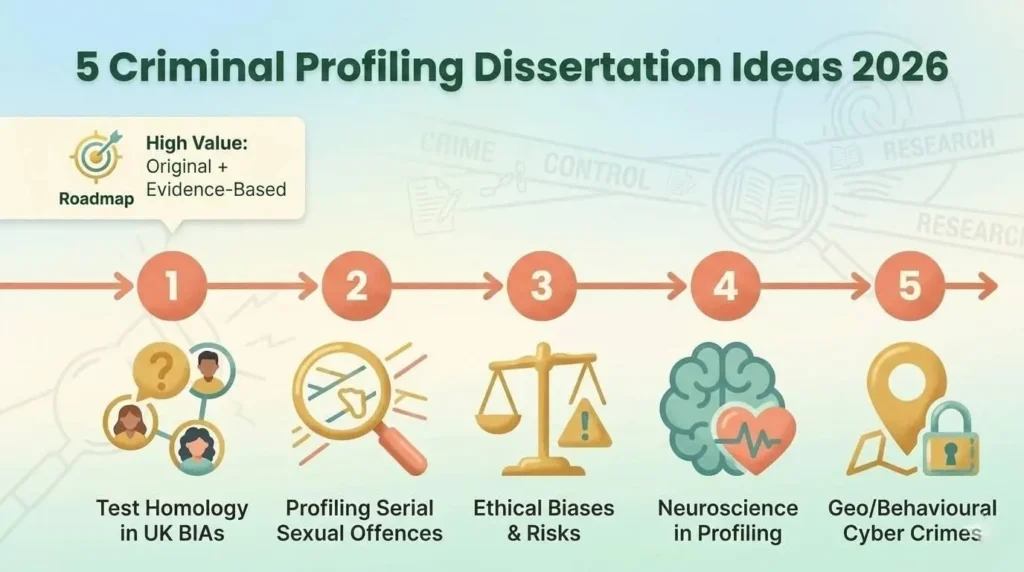
The five concepts fulfil those requirements by matching a hot issue in criminal profiling dissertation ideas with distinct research angles. Every concept focuses on a very specific direction, including the tests of fundamental assumptions and how new technology might transform the field.
Idea 1: Evaluating the Validity of the Homology Assumption in Modern UK Behavioural Investigative Advice
What they often don’t tell you is that one of the criminal profiling dissertation ideas is controversial. It says that criminals who associate will share similar psychological or demographic characteristics, such as two burglars with similar techniques and backgrounds. However, this is refuted by recent research in the UK. A study by Wu (2025) in IJASSR cautions that treating similar traits as the bare bones of the matter is naive, as behaviour depends on more complex personal and situational variables.
| Profiling Assumption / Claim | Critique / Evidence |
| There is a homology assumption that offenders who have the same behaviour in committing a crime share a similar trait. | Pattern matches do not involve the assumption of similar personalities or life histories. |
| Professional profilers generate correct offender profiles. | In a meta-analysis, the profilers did not outperform non-experts at predicting the suspect from crime-scene evidence. |
Idea 2: The Role and Effectiveness of Criminal Profiling in Solving Serial Sexual Offences
Criminal psychology research topics are glamorous in fiction, but real outcomes are mixed. Historically, profiling has sometimes helped narrow suspects, but experts caution against overcrediting it. Even in high-profile cases, profiler input has not often been the lead that cracks the case. A key insight comes from a systematic review that looked at 130 criminal profiling dissertation ideas and found that profilers were often little better at predicting offender traits.
Key points for this topic might be presented as bullet guidance:
- Major weakness: Profiling rarely identifies an offender without other evidence. A UK study notes many profiling predictions lack verification, so don’t expect definitive answers just from a profile.
- Pro tip: Combine profiling with criminal law topics for research paper. Profiling may narrow a suspect pool, but convictions still hinge on hard evidence.
- Things you need to know: Profilers often rely on intuition and general crime science, which can lead to broad or stereotyped profiles. Beware of confirmation bias – test any profile ideas against actual case data whenever possible.
Idea 3: Ethical Implications and Cognitive Biases in Criminal Profiling Within the UK Criminal Justice System
Ethics and bias are critical criminal justice topics when studying profiling. The UK is increasingly becoming aware of the fact that profiling may be associated with risks of prejudice. To illustrate, predictive profiles should not violate civil liberties and should not be based on stereotypes, cautions judges and scholars. A UCL Review emphasises that unconscious cognitive bias may significantly affect the data collection, analysis and decision-making process, and calls on forensic professionals to address it. Some key ideas in this area:
- Reality check: The argument that profiling will save lives or revolutionise policing is mostly speculation. Ac
- Major weakness: Criminal profiling dissertation ideas may support stereotypes. To illustrate, investigators may be misled by the assumption that a sex offender belongs to some demographic, and this may result in a violation of rights. Your study may investigate profiles that were incompatible with the evidence.
- Key takeaways from this study: Cognitive biases (confirmation bias, availability bias, etc.) are everywhere. The forensic literature documents that bias influences all phases of the investigation.
Idea 4: Integrate Neuroscience and Psychophysiological Data into Criminal Profiling
Ideal for cutting-edge criminal law topics for presentation, this topic explores how biological data could inform profiles. The core idea is that criminals’ neurobiology or physiology might reveal traits related to criminal behaviour. For example, a large body of research links low arousal to aggression: longitudinal studies show that adolescents with low resting heart rates are more likely to offend as adults.
For more innovative ideas exploring offender profiling, check out these 60+ innovative criminology dissertation topics. Below is a table summarising possible data sources and their profiling potential:
| Biological Data / Method | Potential Profiling Insight | Limitations / Caveats |
| Psychophysiology (heart rate, skin conductance) | Low arousal and blunted stress responses have been associated with higher aggression. | These measures are non-specific. For instance, many non-criminals have low heart rates. |
| Neuroimaging (fMRI, EEG) | Can reveal structural or functional brain differences linked to behaviour. | Very expensive and complex. Brain differences are correlational (not deterministic). |
| Genetics & Epigenetics | Genetic markers or epigenetic patterns | Criminal behaviour is polygenic and highly influenced by the environment. |
Idea 5: Geographic and Behavioural Profiling in Cyber-Enabled or Volume Crimes
With crime going digital or gigantic, profiling must also follow suit. In this project, the ways in which geography and behaviour can be applied to cybercrime and other common offences in the UK will be examined.
In 2025, a ScienceDirect study conducted a geographic profiling of cybercrimes using real-world components, including credit card skimming and phishing. It actually succeeded in the appropriate situation. The following are the important considerations:
- Modern behavioural profiling (BIA) has already utilised geography. UK BIAs combine geographic analysis with crime-link analysis to integrate behaviour and place.
- Zero in on mashing the digital and physical world crimes. An improved form of criminal profiling dissertation idea may be used to monitor a gang’s online activities to detect their next street victim.
- Profiling works best when there are a number of related incidents. To illustrate, a series of break-ins or ATM robberies may give a clue to a buffer zone. This is because, once a few crimes have been committed, the criminal’s residence is likely to be nearby.
How Expert Advice Shapes a Strong Criminal Profiling Dissertation Idea
Each of the five criminal profiling dissertation ideas above opens new directions, but turning them into a solid dissertation takes careful planning. Topic help from London-based dissertation writing services can make a difference by showing how to refine your research question and link your findings to the bigger picture in criminal profiling.
Experts can also point out ethical issues and suggest sources that add depth to your work. With this kind of support, your dissertation can move beyond ideas and become a well-structured, academically valuable study.
Conclusion
Criminal profiling needs more rigorous, evidence-based research, and your dissertation can contribute to the field by offering criminal profiling dissertation ideas. Each of the five ideas here addresses a genuine gap in the literature, from testing long-held assumptions to exploring how profiling must evolve for a digital age. Here are the key takeaways:
- The homology assumption remains insufficiently tested in UK criminal profiling.
- Profiling effectiveness in serial sexual offences needs a systematic UK-focused evaluation.
- Cognitive biases and ethical concerns in profiling practice carry significant implications for justice.
- Neuroscience offers promising yet untested tools to add objectivity to profiling.
- Cybercrime is growing rapidly, yet profiling methods have not kept pace.
Frequently Asked Questions About Criminal Profiling Dissertation Ideas
- What courses should I take to become a criminal profiler?
Most profilers in the UK are forensic psychologists or investigators who have a background in psychology. The common path: BPS-approved psychology degree, followed by a master’s degree in forensic criminal psychology dissertation ideas. Successful completion of an undergraduate degree, application to the graduate scheme of the British Psychological Society and completion of BPS-approved stage-1 and stage-2 training in forensic psychology.
- What is the best topic of research in criminology?
It is actually all about what you are into and the resources you possess. The most powerful subjects address the existing gap or problem. The current hot topics are cybercrime (fraud, hacking), terrorism & radicalisation, forensic tech (DNA, AI in policing), and criminal-justice reform (prison & rehabilitation).
- What do you consider the best three trends in the criminal-justice industry?
Recently, the criminal justice research topics for college students in the UK have included the use of technology, new patterns of crime, and policy developments. An example is that police are rapidly acquiring new technology: nearly 400 drones will fly over the force by 2023, and live facial-recognition vans have been used to make hundreds of arrests.