Low-pressure air systems are often introduced with good intentions. Engineers want finer control, reduced force, or safer interaction with delicate components. Compared to standard pneumatic setups, operating between zero and five PSI can seem straightforward. After all, the pressure is low, and the stakes appear smaller.
In reality, low-pressure systems demand more discipline, not less. At very low pressures, air behaves less like a power source and more like a control input. Minor fluctuations that would be irrelevant at higher pressures can materially affect motion, measurement, surface quality, and reliability. Selecting the wrong regulator in this range does not usually cause immediate failure. Instead, it introduces subtle instability that spreads across equipment, processes, and maintenance cycles.
This guide focuses on how to think about selecting a low-pressure air regulator for industrial equipment, with emphasis on control behavior, reliability, and real-world operating conditions rather than catalog specifications.
Understanding what a low-pressure air regulator actually does
A low-pressure air regulator maintains a stable downstream pressure within a very narrow operating band while responding smoothly to changes in demand. At pressures between zero and five PSI, the regulator’s job is less about reducing force and more about maintaining consistency.
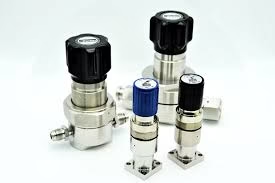
A Low Pressure Air Regulator 0-5 Psi guide is relevant in applications where even small pressure deviations create functional problems. These regulators are designed with higher sensitivity, lower internal friction, and smoother response characteristics than standard regulators, which are typically optimized for mid-to-high pressure ranges.
Why low-pressure regulation is not just “turning it down”
Standard regulators can often be adjusted to low setpoints, but that does not mean they perform well there.
- Internal springs are sized for higher forces
- Diaphragm movement is coarse near zero
- Friction and hysteresis become dominant
At low pressure, these design compromises translate into drift, overshoot, and delayed response.
Recognizing when low-pressure regulation is truly required
Not every pneumatic system operating at low force needs a dedicated low-pressure regulator. Selection begins by understanding the role air plays in the system.
Low-pressure regulation is critical when air influences outcomes rather than simply driving motion.
Common scenarios that demand low-pressure stability
- Precision actuation of lightweight components
- Leak testing or pressure-based inspection
- Thin material handling or assist air
- Controlled coating, drying, or purge flows
- Instrument air for sensitive sensors
In these contexts, pressure consistency matters more than flow capacity.
Control stability versus nominal pressure range
Many selection errors stem from focusing on pressure range alone. A regulator rated for low pressure does not automatically provide stable control across that range.
Control stability describes how well the regulator maintains output under changing conditions.
Why stability matters more than accuracy
In practice, stable pressure slightly above or below target often performs better than an exact setpoint that drifts.
- Stability preserves repeatability
- Drift introduces variability into processes
- Inconsistent pressure masks root causes
Low-pressure regulators are designed to minimize these effects through finer mechanical resolution.
Dynamic demand and response behavior
Industrial equipment rarely consumes air at a constant rate. Actuators cycle, purge flows pulse, and processes start and stop. At low pressure, response to these changes becomes critical.
A suitable regulator must recover quickly without overshoot or oscillation.
Problems caused by poor dynamic response
- Actuators hesitate or overshoot
- Test readings fluctuate unexpectedly
- Timing and synchronization drift
These issues often appear intermittent, making them difficult to trace back to regulation.
Startup behavior and pressure overshoot
When air supply is introduced, some regulators overshoot the setpoint before settling. At higher pressures, this may be harmless. At low pressure, it can damage sensitive components or disrupt processes.
Low-pressure regulators are typically designed to ramp pressure more gradually.
Why startup characteristics matter
- Thin membranes can rupture
- Lightweight fixtures can deform
- Early-cycle failures appear unexplained
Evaluating startup behavior is essential in low-pressure applications.
Sensitivity to upstream pressure variation
Compressed air supply is rarely perfectly stable. Compressors cycle, demand shifts, and line pressure fluctuates. At very low outlet pressures, these upstream changes can bleed through the regulator.
Low-pressure regulators are designed to isolate downstream pressure more effectively within their operating range.
When upstream variation becomes a problem
- Outlet pressure drifts under constant load
- Recovery time increases after demand spikes
- Control loops lose predictability
Understanding inlet conditions helps avoid misapplication.
Internal friction and hysteresis at low pressure
At low force levels, internal friction plays an outsized role. Seal drag, spring friction, and mechanical tolerances that are insignificant at higher pressures become meaningful sources of error.
Low-pressure regulators minimize these effects through design choices that favor sensitivity.
Effects of excessive friction
- Dead zones where adjustment has no effect
- Lag between demand change and response
- Pressure “stick-slip” behavior
These characteristics directly impact equipment consistency.
Matching regulator design to application behavior
Selection should account for how the equipment actually uses air, not just nominal specifications.
Key questions to consider:
- Is air demand steady or cyclical?
- Are downstream components sensitive to spikes?
- Does the process rely on repeatability over time?
- Are startup and shutdown frequent?
Answers to these questions guide regulator choice more effectively than range alone.
Avoiding common selection assumptions
Several assumptions often lead to incorrect selection.
- Lower pressure is easier to control
- Any regulator can operate near zero
- Problems would be obvious immediately
In low-pressure systems, failures tend to accumulate quietly rather than appearing as immediate breakdowns.
Maintenance and troubleshooting implications
When regulation is unstable, maintenance effort increases across the system. Components downstream compensate for variability, accelerating wear and triggering repeated interventions.
Selecting the correct regulator reduces hidden maintenance costs.
Signs regulation may be the root cause
- Repeated recalibration without lasting improvement
- Intermittent failures tied to operating cycles
- Multiple component replacements with no resolution
These patterns suggest upstream control issues.
Pressure regulation in engineering context
Pressure regulators work by balancing spring force against downstream pressure acting on a diaphragm or piston. Their performance depends on mechanical sensitivity, friction, and flow dynamics. A general explanation of how pressure regulators function is outlined in Wikipedia’s overview of pressure regulators, which describes how design choices affect stability and response across different operating ranges.
This context helps explain why regulators optimized for higher pressures struggle near zero.
Integrating low-pressure regulators into existing systems
Introducing a low-pressure regulator often requires reevaluating system layout.
Considerations include:
- Placement relative to demand points
- Line volume and damping effects
- Interaction with valves and restrictors
Proper integration prevents the regulator from being undermined by system design.
Testing and validation before full deployment
Bench testing regulators under representative conditions reveals behavior that specifications cannot capture.
Useful validation steps include:
- Observing response under dynamic demand
- Measuring recovery after pressure drops
- Monitoring startup behavior repeatedly
Early validation reduces risk during commissioning.
When standard regulators remain appropriate
Standard regulators still have a place when:
- Operating pressures are moderate to high
- Output variability is acceptable
- Downstream components are robust
- Precision is not a primary requirement
Problems arise only when they are used outside their intended envelope.
Reframing low-pressure air as a control element
Low-pressure air should be treated as a control input rather than a utility. This shift in perspective changes how components are specified and evaluated.
Precision, stability, and predictability matter more than capacity.
Closing perspective: selection sets the ceiling for performance
Selecting a low-pressure air regulator is not a minor procurement decision. In systems operating between zero and five PSI, regulation quality defines the upper limit of performance. Instability introduced upstream propagates through equipment, processes, and maintenance cycles, creating problems that appear unrelated.
A regulator designed specifically for low-pressure operation aligns control behavior with system intent. It reduces variability, protects sensitive components, and restores predictability. In low-pressure applications, correct selection does not add complexity. It removes it—by addressing the source rather than the symptoms of instability.