You’ve probably stared at an electric fireplace online and thought: “This looks cozy… but is it actually worth the money?” You’re not alone. Some people buy one and love it every night. Others realize it’s basically a fancy space heater with a pretty screen.
This article helps you decide—without hype—by walking you through comfort, cost, safety, air quality, and the “will I actually use it?” reality. You’ll get simple formulas, clear tables, and everyday scenarios so you can make a confident call.
Key takeaway (read this first)
Electric fireplaces are “worth it” when you want fast, localized warmth and ambiance without smoke or chimney work, and you’re okay with paying electricity rates for heat. They are usually not “worth it” as a whole-home heating replacement, especially in large, drafty spaces or where electric rates are high. U.S. electricity prices vary a lot, but recent national averages are around the high teens (cents per kWh) according to U.S. electricity price series based on BLS data (updated through late 2025). You can verify the latest average quickly via the St. Louis Fed’s electricity price series. FRED electricity price series (BLS-based) (you can view the latest monthly cents/kWh chart and download the data).
First, what an electric fireplace really is (in plain words)
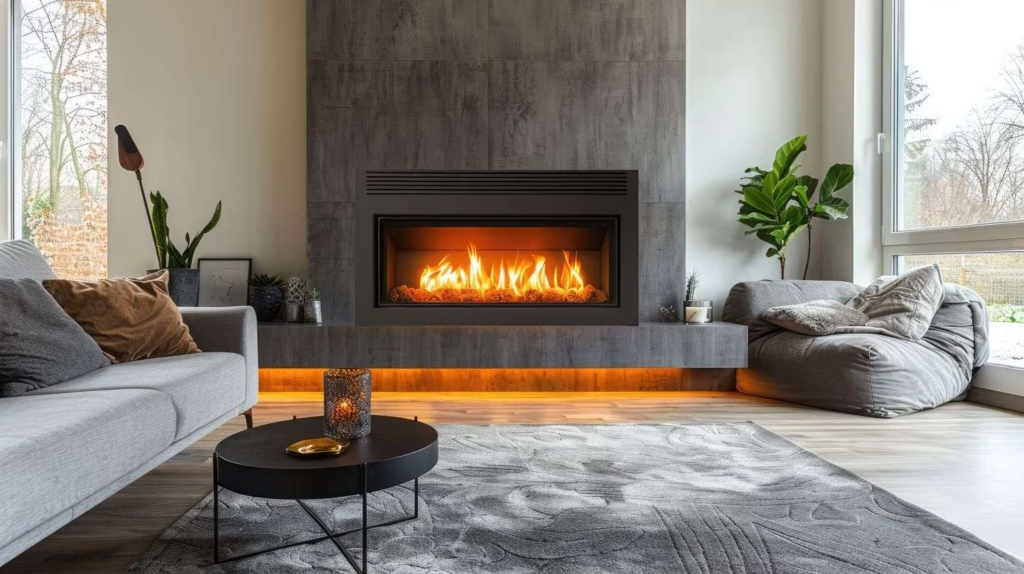
Most electric fireplaces are two things combined:
- Visual effect: LED lights + reflective panels (sometimes a screen) to simulate flames.
- Heat (optional): a built-in electric heater, commonly up to about 1,500 watts in many consumer models, which is similar to a typical portable space heater.
That’s why the most honest way to think about it is: you’re buying decor + a zone heater. If you expect “real fireplace heat” for your whole home, you’ll likely be disappointed.
If you want a definition and the basic types (insert, wall-mounted, freestanding), this overview is a quick reference: Wikipedia: Electric fireplace (a plain-language intro and common variations).
Image 1: What you’re actually buying

The 7 checks that decide whether it’s worth it for you
Check 1: Are you buying it for heat, vibes, or both?
Be honest: what are you really after?
- If you want vibes: you’ll use the flame effect often, even with the heat off. This can feel “worth it” even if you barely use the heater.
- If you want heat: you need to judge it like a space heater—cost per hour, safety practices, and whether it warms the space you actually sit in.
- If you want both: you’ll care about noise, fan quality, thermostat control, and whether the flame looks good at low light.
Quick gut test: If you imagine yourself using it on a normal weekday—say, 9:30 p.m. after dishes—do you actually see yourself turning it on? If yes, you’re already leaning toward “worth it.”
Check 2: Can it realistically heat the room you care about?
Many electric fireplaces are best at zone heating—warming the area around you, not every corner of the house. The U.S. Department of Energy specifically discusses small space heaters (which is the same category of heat output) and notes that electric space heating can be costly to operate and should be used with caution. U.S. DOE: Small space heaters (plain guidance on what they’re good for, and what to watch out for).
In everyday terms, an electric fireplace can feel amazing if you’re on the couch six feet away. It can feel underwhelming if you’re trying to heat an open-plan living room with tall ceilings and a drafty slider door.
Table 1: “Will it warm my space?” quick reality check
| Space you’re trying to heat | What you’ll likely feel | Best setup | Worth-it chance |
| Bedroom (small/medium) | Comfortable warmth near bed/desk | Use heat for 30–90 min, then off | High |
| Living room (medium, closed doors) | Cozy “warm zone” near seating | Place where you sit most | High |
| Open-plan large space | Warm near unit, cool elsewhere | Combine with central heat | Medium |
| Drafty room (old windows) | Heat leaks out fast | Fix drafts first | Low–Medium |
Check 3: Do the math on running cost (it’s simpler than you think)
You don’t need to guess. You can calculate your cost in 10 seconds.
Formula 1: Cost per hour
Cost per hour ($) = ( Watts ÷ 1000 ) × Your electricity rate ($/kWh)
Example you can relate to: If the fireplace heater is 1,500 watts and your electricity rate is $0.19/kWh, then: (1500 ÷ 1000) × 0.19 = 1.5 × 0.19 = $0.285 per hour. That’s about 29 cents per hour.
For a current reference point on U.S. electricity prices, you can look up the latest average via the St. Louis Fed’s series: FRED: Average electricity price (U.S. city average) (updated monthly; you’ll see the most recent cents/kWh).
Many consumer electric fireplaces use up to around 1,500W on high heat (similar to space heaters), which is why the above math works so well for planning. For safety and heating context, you can also read the U.S. Consumer Product Safety Commission winter heating safety guidance: CPSC: Stay warm safely (practical reminders on heaters, alarms, and winter risks).
Image 2: Running-cost mindset (heat when you’re actually there)

Check 4: Compare it against the “do nothing” option and the “small heater” option
Here’s a common trap: you compare an electric fireplace to a wood fireplace or gas fireplace and assume it will “save money.” That’s not always the right comparison.
For most people, the real comparison is:
- Do nothing (wear a hoodie, use a blanket, maybe run central heat a bit more)
- Use a regular portable space heater (cheaper upfront, less decorative)
- Use an electric fireplace (higher upfront, more “home feeling”)
If you mostly want a warm spot while watching TV, an electric fireplace can be worth paying extra for because it upgrades the room emotionally. If you only want heat, a tested space heater may be the better value.
Table 2: Electric fireplace vs alternatives (what you actually get)
| Option | Upfront cost | Heat value | Why you’d pick it |
| Electric fireplace | Medium–High | Good for zone heating | Ambiance + heat in one |
| Portable space heater | Low | Good for zone heating | Cheapest “warm now” solution |
| Central heating only | Already installed | Whole-home coverage | Most even comfort |
| Wood fireplace (existing) | Varies | Strong radiant feel | Real flame, but more work |
Check 5: Safety—treat it like a heater, even if it looks like furniture
The flame effect might look harmless, but the heater portion still needs respect. The National Fire Protection Association emphasizes heating safety practices, including keeping heat sources away from things that burn and maintaining equipment. NFPA: Heating safety (clear, practical home-heating safety tips).
The simplest rule you can follow is this: keep a clear zone around the heater outlet and never drape fabrics over the unit. If your model is a “media console fireplace,” make sure the heat outlet is not blocked by décor, books, or pet beds.
Image 3: Safe placement matters more than you think

Check 6: Air quality and “no smoke” comfort (this is a big deal)
If you’ve ever sat near a wood-burning fireplace and felt your throat get scratchy, you already understand why electric fireplaces can be worth it for many homes.
Wood smoke contains fine particles and gases that can irritate lungs and worsen breathing and heart conditions, and the U.S. EPA explains these health impacts and how to reduce exposure. U.S. EPA: Wood smoke and your health (what’s in wood smoke, who is most sensitive, and steps to reduce risk).
This becomes especially practical if you:
- have kids, older family members, or asthma in the household,
- live in an area that restricts wood burning during air-quality alerts,
- don’t want soot, chimney cleaning, or lingering smell on fabrics.
Real-life scenario: You’re hosting friends, someone opens a bottle of wine, and the room already has food smells. With an electric fireplace, you can add “warm vibe” without adding smoke. That’s a quiet, daily-life kind of value.
Check 7: Are you the kind of person who uses small comforts consistently?
This is the most underrated check. The “worth it” moment often has nothing to do with dollars and everything to do with habit.
Ask yourself:
- Do you actually turn on lamps instead of using harsh ceiling lights?
- Do you like making your home feel “finished” after work?
- Do you enjoy little rituals—tea, music, a book—where atmosphere matters?
If you said yes, you’re much more likely to use the flame effect and enjoy the purchase for years. If you’re more “function only,” you might be happier spending less on a standard heater and putting the rest into a draft-proofing kit or a nicer throw blanket.
Three everyday scenarios (so you can picture it clearly)
Scenario A: The “after-work couch crash”
You come home tired. You don’t want to heat the whole house. You want a warm zone where you sit for 60–90 minutes. An electric fireplace is great here: quick comfort, minimal setup, and it can make the room feel calmer instantly. This is where people say, “Okay… this was worth it.”
Scenario B: The “rental apartment upgrade”
You can’t install gas lines or rebuild a chimney. An electric fireplace gives you a fireplace look without landlord negotiations. If it’s freestanding or wall-mounted (with permission), you get a high visual payoff for relatively low disruption. You also avoid smoke, ash, and ventilation questions.
Scenario C: The “family room with kids and pets”
You want cozy vibes but you don’t want open flames or hot embers. An electric fireplace can feel like the safest “fireplace-adjacent” option—if you still keep safe clearance and use it responsibly. For broader home heating safety reminders (and why alarms matter), CPSC’s guidance is worth a quick skim. CPSC: Winter heating safety basics.
Common confusions (and the simple truth)
Confusion 1: “If it’s electric, it must be super efficient, right?”
Electric resistance heat is very direct: almost all the electricity turns into heat inside your room. The confusing part is cost. Even if it’s “efficient,” it can still be expensive if your electricity rate is high. That’s why DOE notes electric space heaters can be more expensive to operate than combustion options in many cases. DOE: Small space heaters.
Confusion 2: “Will it replace my furnace?”
Usually no. Think of it as a comfort tool, not your main system. It’s great for one room while you’re in it. It’s rarely the best answer for heating a whole home all day.
Confusion 3: “Flame effect must cost a lot to run.”
Often, the flame-only mode uses much less power than heat mode. The heat is the main cost driver. If you mainly want ambiance, your monthly cost can be modest compared with running heat for hours daily—check your model’s manual for exact wattage.
Three mistake stories (so you can avoid the pain)
Mistake 1: Buying too small for a big open room
You install it, turn it on, and… the couch area is warm-ish, but the rest of the room stays cold. You feel cheated. What went wrong? Your expectation. The fix: treat it as zone heat, or choose a different solution for open spaces (draft sealing, central heat tuning, or multiple zones).
Mistake 2: Blocking the heat outlet with décor
You place baskets, blankets, or a pet bed too close because it looks cute. Heat gets trapped. That’s exactly the sort of risk NFPA warns about with heating equipment near combustible materials. NFPA: Heating safety.
Mistake 3: Using it as an overnight heater
You fall asleep with it running because it feels nice. Even if the unit has safety features, this is a bad habit. The safer approach is: pre-warm the room, then switch off and rely on bedding. For general heater safety context and reminders about alarms, CPSC’s guidance is a good baseline. CPSC: Heating safety reminders.
Table 3: Quick “worth it” decision scorecard (keep it simple)
| Question | Yes = points | No = points | Why it matters |
| You’ll use flame effect 4+ nights/week? | 2 | 0 | Usage decides value more than specs |
| You mainly need zone heating (one room)? | 2 | 0 | Matches what it’s best at |
| You have air-quality concerns or wood-burn restrictions? | 2 | 0 | No smoke is a real benefit (EPA explains why) |
| You can keep clear safety space around it? | 1 | 0 | Heating safety is non-negotiable (NFPA/CPSC) |
If you score 5–7, you’re a strong “worth it” candidate. If you score 0–2, you’ll likely be happier with a cheaper heater and a warmer blanket setup.
Formula 2: Monthly cost you can actually plan with
Monthly cost ($) = ( Watts ÷ 1000 ) × kWh rate × hours per day × days per month
Example: You run 1,500W heat for 2 hours/day, 25 days/month, at $0.19/kWh: (1500 ÷ 1000) × 0.19 × 2 × 25 = 1.5 × 0.19 × 50 = 0.285 × 50 = $14.25/month.
That’s not scary for many households, and it’s exactly why electric fireplaces can feel worth it when used as a targeted comfort tool. But if you run it 6 hours/day every day, the number climbs quickly—so your habits matter.
Image 4: The “zone heating” idea in one picture

Buying tips that actually save you regret
1) Look for control you’ll truly use
If the remote is clunky or the display is confusing, you’ll stop using it. Practical features that often matter most:
- Thermostat or temperature steps you understand (not “mystery modes”).
- Timer so you can warm up the room and have it shut off automatically.
- Separate flame + heat controls so you can use ambiance without paying for heat.
2) Measure like you’re hanging a TV
People often underestimate size. Tape out the width on the wall with painter’s tape. If you think “this feels slightly too big,” it’s probably perfect. If it already feels small in tape form, it will look tiny installed.
3) Prioritize safe placement over perfect styling
You want it to look good, but you also want clear space around heat outlets. NFPA’s heating safety guidance is short and worth following as your baseline standard. NFPA: Heating safety.
4) If air quality matters, electric can be a “quiet win”
If you’re sensitive to smoke, the value of “no combustion indoors” can outweigh a lot of other factors. The EPA’s explanation of wood smoke health impacts makes the trade-off very concrete. EPA: Wood smoke and health.
Six useful links (what you’ll find in each)
- Wikipedia: Electric fireplace — a quick, clear definition and the common product types so you know what you’re shopping for.
- U.S. DOE: Small space heaters — practical guidance on how zone heating works and why operating cost can add up.
- CPSC: Stay warm safely — easy-to-follow safety reminders for heaters and why smoke/CO alarms matter.
- NFPA: Heating safety — a straightforward checklist to reduce heating-related fire risk at home.
- U.S. EPA: Wood smoke and your health — explains why smoke can irritate lungs and who should be extra careful.
- FRED: Average electricity price series — lets you check the latest cents/kWh so your running-cost math is grounded in current data.
So… are electric fireplaces really worth it?
Here’s the honest wrap-up you can use:
- Worth it if you want cozy ambiance you’ll actually use, you mainly need warmth in one room, and you like the idea of heat without smoke or chimney hassles.
- Not worth it if you expect it to replace central heating, you’re trying to heat a very large or drafty space, or you suspect you’ll stop using it after the novelty wears off.
If you want the simplest next step: check your local cents/kWh (use the FRED series as a starting point), pick your expected hours of use, run the monthly cost formula, and then ask yourself one final question: “If this costs me about the price of a couple coffees each month, will I use it enough to feel happier at home?” If the answer is yes, it’s probably worth it.