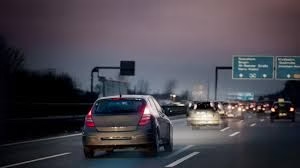
As we move toward a future of intelligent mobility in 2026, the challenge of nighttime driving remains one of the most critical safety hurdles. Statistics consistently show that a vast majority of fatal pedestrian accidents occur during hours of darkness, often because standard high-beam headlights cannot reach far enough without blinding oncoming traffic. The solution to this “visibility gap” lies in the near-infrared spectrum. By integrating the Automotive IR LED into exterior sensing arrays, automakers are providing vehicles with a powerful form of “night vision” that significantly enhances pedestrian detection without the glare.
This technology allows Advanced Driver Assistance Systems (ADAS) to perceive hazards that are completely invisible to the human eye, creating a proactive safety shield around the vehicle.
The Technology of Active Night Vision
There are two primary ways vehicles “see” in the dark: passive thermal imaging and active infrared illumination. The Automotive IR LED is the foundational component of the active system.
How It Works
In an active system, high-power Automotive IR LED emitters—typically integrated into the headlamp assembly or the front grille—flood the road ahead with near-infrared light (usually at the 850nm or 940nm wavelength). While this light is invisible to humans and animals, it is easily captured by specialized CMOS cameras mounted behind the rearview mirror.
- Illumination: The IR LEDs project a beam similar to a high-beam pattern but without the visible light.
- Reflection: The light bounces off pedestrians, cyclists, and road signs.
- Processing: The camera captures the reflected IR light, and AI algorithms analyze the shapes to identify “vulnerable road users” (VRUs).
Key Benefits for Pedestrian Safety and ADAS
The implementation of Automotive IR LED technology offers several distinct advantages over traditional lighting and radar systems:
- Extended Detection Range: While low-beam headlights typically reach 40–50 meters, an IR-powered night vision system can detect a pedestrian up to 150–200 meters away. This gives the driver (or the autonomous braking system) significantly more time to react.
- Non-Dazzling Performance: Because the light is infrared, a vehicle can keep its “IR high beams” on constantly, even when there is oncoming traffic. It enhances safety for the driver without compromising the safety of others.
- Superior Object Classification: Unlike radar, which is excellent at detecting distance but struggles with shape identification, the high-resolution images provided by Automotive IR LED systems allow AI to distinguish between a pedestrian, a stray animal, or a stationary object like a mailbox.
Engineering for the Exterior: Reliability is Paramount
An Automotive IR LED used for exterior sensing faces much harsher conditions than those used inside the cabin. To ensure 24/7 reliability, these components must feature:
- AEC-Q102 Certification: This ensures the LED can withstand extreme temperature cycles, ranging from sub-zero winters to scorching summers.
- Sulfur and Moisture Resistance: Exterior components are exposed to road salt, rain, and pollution. Advanced gold-plated or ceramic packaging is used to prevent corrosion and maintain consistent radiant intensity.
- Optical Precision: Specialized lenses are often integrated into the LED package to control the beam angle, ensuring maximum coverage of the road while minimizing “light waste.”
Conclusion: A New Era of 24/7 Road Awareness
The Automotive IR LED is effectively bridging the gap between human biological limitations and the requirements of modern road safety. By extending the vehicle’s vision into the infrared spectrum, we are moving toward a world where the dangers of the night are significantly mitigated. Whether as a driver-assist tool that highlights pedestrians on a dashboard display or as a critical sensor for a fully autonomous Robotaxi, infrared technology is proving that the safest journey is one where nothing stays hidden in the dark.