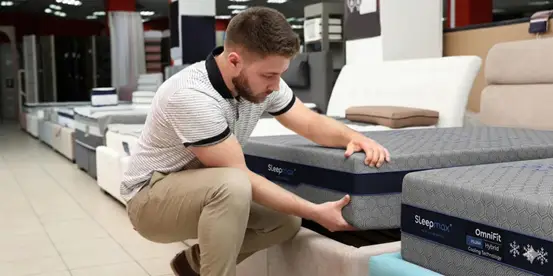
We spend approximately one-third of our lives in bed. Yet, remarkably little solid research exists on how mattress characteristics affect sleep quality, pain levels, and daytime functioning. What we do know comes from a handful of rigorous studies and decades of industry experience—and the findings consistently point to one conclusion: most consumers don’t know how to choose the right mattress.
According to a 2026 survey by Moon Moon Corporation in Japan, 56.3% of mattress buyers report feeling regret or having failed with their purchase. The top reasons? “Sagged too quickly” (17%), “Comfort different from expected” (16.5%), and “Too soft or too firm” (combined 24%). Similarly, research from RTI International found that when people selected mattresses through typical showroom testing, they chose the wrong mattress more often than not—only 38% selected one of the top three mattresses that would have provided their best sleep.
This isn’t just about wasted money. Poor sleep surfaces can exacerbate back pain, create pressure points that disrupt sleep, and affect body temperature regulation throughout the night. Based on scientific studies, industry research, and expert insights from sleep specialists and mattress manufacturers, here are the most common mattress buying mistakes—and how to avoid them.
Mistake #1: Believing “Firmer Is Always Better for Your Back”
This myth persists despite overwhelming evidence to the contrary. Generations have been told that sleeping on a hard surface protects the spine, but the research tells a different story.
A landmark study published in The Lancet by Kovacs et al. evaluated 313 adults with chronic non-specific low back pain. Participants were randomly assigned either firm mattresses (firmness rating 2.3) or medium-firm mattresses (rating 5.6). After 90 days, patients on medium-firm mattresses had significantly better outcomes:
- 2.36 times better improvement in pain while lying in bed
- 1.93 times better improvement in pain upon rising
- 2.10 times better improvement in disability
The firmness scale used in this study (developed by the European Committee for Standardisation) starts at 1.0 (firmest) and stops at 10.0 (softest). The sweet spot for back pain relief was medium-firm, not hard.
Why This Mistake Happens
The belief that hard equals healthy persists because traditional bedding—think firm surfaces with minimal cushioning—was the norm for decades. But your spine isn’t straight; it has a natural S-curve. A mattress that’s too firm can’t accommodate this curve, creating pressure points at the shoulders and hips while leaving the lower back unsupported. You end up sleeping “on top of” rather than “in” the mattress, with muscles staying tense all night trying to maintain alignment.
The Science-Backed Fix
Match firmness to your body weight and sleeping position. John Ryan By Design, a UK-based mattress manufacturer with 25+ years of customer experience, uses these spring gauge recommendations:
- 1.2mm gauge (soft): Up to 140 pounds
- 1.4mm gauge (medium): 140-224 pounds
- 1.6mm gauge (firm): 224-280 pounds
- 1.9mm gauge (extra firm): 280+ pounds
Most sleepers—approximately 70%—land in the medium to medium-firm range (4-7 on the standard 1-10 firmness scale). For side sleepers, a slightly softer surface (4-6) provides crucial pressure relief at the shoulders and hips. Back sleepers typically do best with medium-firm to firm (6-7). Stomach sleepers need the firmest options (7-8) to prevent hip sinking, which strains the lower back.
Mistake #2: Trusting a 10-Minute Showroom Test
Lying on a mattress for 10 minutes in a brightly lit showroom while wearing street clothes tells you almost nothing about how you’ll sleep on it for 2,920 nights over eight years. Yet this is how most people make their purchase decision.
The RTI International study exposed this flaw dramatically. In their experiment, 128 adults first simulated typical mattress shopping—testing multiple mattresses in a showroom setting and selecting the one they preferred. They then slept on seven different mattresses in their own homes for one month each, wearing actigraphs to measure sleep motion and keeping detailed diaries.
The findings? The mattress people selected in the showroom rarely matched the one that provided their best sleep. When researchers identified each participant’s optimal mattress based on actigraphic motion and sleep quality data, participants had only a 38% chance of having chosen one of their top three best options. Essentially, they might as well have chosen randomly.
You can’t assess temperature regulation, partner motion transfer, or long-term comfort retention in a few minutes. A mattress that feels immediately soft might create pressure after prolonged contact, while one that feels too firm initially might distribute weight better over time.
Why This Mistake Happens
We overestimate our ability to judge long-term comfort from short-term sensory input. Showrooms are designed for immediate impressions, not informed decisions. Plus, shopping for mattresses feels awkward—who wants to lie down in public for 15-20 minutes? Many people rush through the experience or test only a few minutes, making quick decisions they later regret.
The Science-Backed Fix
Insist on a proper home trial period. According to NapLab’s testing of over 290 mattresses, the average trial period is 176 nights, and 94.1% of online mattresses offer at least a 100-night trial. This isn’t just a marketing gimmick—your body needs 2-3 weeks to adjust to a new sleeping surface, according to research. During this period, you should be tracking:
- Morning stiffness levels
- Number of nighttime awakenings
- How refreshed you feel upon waking
- Any new aches or pains that develop
If you’re shopping in-store, spend at least 15 minutes per mattress, and mimic your actual sleeping position. Lie exactly as you would at home. Move around. Sit on the edge. Ask the salesperson to leave so you can relax properly. But understand that even this is imperfect—that’s why the home trial is non-negotiable.
Mistake #3: Not Asking About Specifications Before Buying
Imagine walking into a car dealership where the salesperson refuses to tell you the engine size, fuel economy, or safety rating. You’d walk out immediately. Yet people regularly spend $1,000+ on mattresses without knowing basic specifications.
Critical information many buyers never ask about includes:
- GSM (grams per square meter) of upholstery layers—tells you material density and quality
- Spring gauge/tension—determines support level and weight capacity
- Whether construction is one-sided or two-sided—affects lifespan dramatically
- Actual percentages of “natural blend” materials—”natural” doesn’t mean 100% natural
- Expected lifespan based on construction—how long will it actually last?
Without this information, you’re guessing. As one expert put it: “When a retailer can’t tell you the GSM breakdown, spring gauge, or material percentages, you’re being asked to spend significant money on something where the seller won’t disclose what you’re actually getting.”
Why This Mistake Happens
Most mattress retailers market on feelings, not facts. Terms like “luxury support,” “cloud-like comfort,” and “revolutionary technology” sound appealing but tell you nothing about what’s inside. Consumers focus on brand name, price point, or initial comfort feel without digging into the specifications that actually determine performance.
The Science-Backed Fix
Treat mattress shopping like any major purchase—ask technical questions. If a retailer can’t or won’t answer specifics about spring gauge, material densities, construction methods, or warranty coverage, that’s a red flag. Walk away. You’re about to invest in something you’ll use every night for years; the seller should be transparent about what you’re buying.
Key specifications to ask about:
- Spring gauge (for innerspring/hybrid mattresses): 1.2mm is soft, 1.6mm is firm, 1.9mm is extra firm
- Comfort layer GSM: Higher numbers mean more material and better durability
- Cover material: Look for natural fibers like cotton, wool, or Tencel for breathability
- Warranty terms: Know what’s covered and for how long—is it pro-rated?
Mistake #4: Accepting One-Sided Construction at Premium Prices
The mattress industry shifted from two-sided to one-sided construction about 15-20 years ago, marketing it as “no-turn convenience.” But the real driver was planned obsolescence.
A one-sided mattress concentrates all wear on a single surface. Over years of use, materials compress and degrade only where your body contacts them. With two-sided construction, you can flip and rotate the mattress, distributing wear evenly across both surfaces and extending usable lifespan by 40-50% .
Here’s the math: A one-sided mattress might last 5-7 years before sagging beyond comfort. A two-sided equivalent could last 8-10 years with proper rotation. That’s potentially saving you from replacing it 3-4 years sooner.
Why This Mistake Happens
Manufacturers save money by producing one-sided mattresses—fewer materials, simpler construction—and they can market the convenience of never needing to flip it. Consumers, often unaware of the durability trade-off, see this as a benefit rather than a compromise. Plus, thicker mattresses (common today) are heavy, making flipping seem like an inconvenience.
The Science-Backed Fix
At price points above $700, insist on two-sided construction. The “inconvenience” of flipping and rotating your mattress monthly—approximately 60 seconds once a month—is vastly outweighed by doubling its useful lifespan. Look for brands that still manufacture two-sided mattresses. Yes, they’re slightly more expensive upfront, but the cost-per-year is lower, and you’ll have a consistently supportive surface for longer.
Mistake #5: Buying Memory Foam Without Understanding Heat Retention
Memory foam mattresses feel wonderful in showrooms. The body-contouring sensation is genuinely lovely… for about 10 minutes. What showrooms don’t tell you is that dense memory foam traps body heat significantly.
Visco-elastic foam (the proper name for memory foam) is specifically designed to soften with heat. Your body heat softens it, and it retains that heat because its dense cell structure restricts airflow. For warm sleepers, this creates a miserable cycle: you overheat, throw off covers, get too cold, pull covers back on, repeat all night.
Research into sleep temperature regulation shows that your body needs to cool slightly to enter and maintain deep sleep. A surface that traps heat interferes with this natural process, reducing sleep efficiency and causing fragmented sleep.
Why This Mistake Happens
Initial impressions are powerful. Memory foam feels luxurious and supportive when you first lie on it. Plus, marketing around “pressure relief” and “body-molding comfort” is effective. Most people don’t consider temperature regulation until they’re actually sleeping hot on a new mattress—by which point they’ve already made the purchase.
The Science-Backed Fix
If you tend to sleep warm, avoid traditional memory foam altogether. Instead, consider:
- Natural fibers like wool, cotton, and mohair, which wick moisture away and allow airflow
- Latex, which offers similar pressure-relieving properties to memory foam but with much better temperature regulation
- Gel-infused or open-cell foams specifically designed for cooling
A 2023 study from the Asleep sleep clinic in Korea tested real-time mattress temperature adjustment during summer nights. When mattress temperature was raised during deep sleep (when body temperature naturally drops) and lowered during other stages, participants saw significant improvements: total sleep time increased from 6h41min to 7h13min, and sleep efficiency improved from 83.35% to 89.77%. This demonstrates how dramatically temperature control affects sleep quality.
Mistake #6: Buying a “Compromise” Mattress for Couples with Different Needs
Here’s a scenario: One partner weighs 168 pounds, the other 252 pounds. A single spring tension won’t properly support both. The lighter person finds it too firm (pressure points at shoulders/hips), while the heavier person finds it too soft (sinking too far, spine misalignment). Neither gets proper support—it’s not a compromise; it’s bad for both.
This doesn’t just affect comfort. Inadequate support can exacerbate back pain and create different sleep environments within the same bed. Research shows that proper spinal alignment during sleep reduces morning pain and stiffness while improving sleep quality, and that’s impossible when partners with different body weights share the same tension level.
Why This Mistake Happens
Most couples assume they need one shared mattress, and manufacturers reinforce this by offering standard sizes without presenting alternatives. The logistics of having two different sides seems complicated, and people worry about the ridge where mattresses join.
The Science-Backed Fix
Use dual-tension zip-and-link mattresses. Two separate mattresses, each with the appropriate spring gauge for that person’s weight, are zipped together to create a standard King or Super King size. You get the benefits of sleeping together without compromising on support.
Yes, there’s a small ridge down the middle. In practice, most couples find it’s barely noticeable after a few nights, and proper support is worth the trade-off. Some brands even make the middle section softer to minimize this ridge. The key is that each side provides correct support based on individual body weight and sleep position.
Mistake #7: Assuming “The Most Expensive Is Always Better”
Premium pricing doesn’t guarantee premium specifications. You’re often paying for brand heritage, retail overheads, marketing budgets, or celebrity endorsements rather than actual materials.
A concrete example: A $2,500 luxury-brand mattress might have a total upholstery weight of 2,000 GSM (grams per square meter). Meanwhile, a $1,295 mattress from a lesser-known brand might have a total upholstery weight of 3,950 GSM. You’re paying $1,205 more for significantly worse specifications. This isn’t hypothetical—these comparisons exist in real retail settings.
A 2025 JD Power study found that while online mattress shoppers spent an average of $984 (compared to $1,242 for in-store buyers), they reported higher overall satisfaction (878 vs 869 on a 1,000-point scale). The value-for-price perception was a key driver. Online retailers can offer better value because they cut out retail overhead and pass those savings to consumers.
Why This Mistake Happens
We equate price with quality across many purchases, and bedding is no exception. Marketing reinforces this by positioning expensive mattresses as “luxury” or “premium.” Consumers worry that cheaper options will be inferior and assume the highest price points deliver the best sleep experience.
The Science-Backed Fix
Compare actual specifications, not prices or brand names. Ask for:
- GSM breakdowns of comfort layers
- Spring gauges and support coil counts
- Material compositions (percentage of natural vs synthetic materials)
- Construction methods (two-sided vs one-sided, zoned support, etc.)
Judge value based on what’s physically inside the mattress, not the logo on the label. A study by the Sleep Savvy magazine found that many consumers purchasing luxury mattresses ($2,500+) relied heavily on in-store displays and brand reputation, but those who dug into specifications and customer reviews often found equal or better quality at lower price points.
Mistake #8: Ignoring Sleep Position and Body Weight
This might be the single most common—and correctable—mistake. Sleep position and body weight dramatically affect what mattress will work best for you, yet many shoppers select mattresses as if one size fits all.
The research is clear on this. A 2023 study published in Nature and Science of Sleep examined 12 participants across three firmness levels (soft, medium, and firm). They found that medium-firm mattresses provided better sleep quality, with significantly shorter sleep latency (time to fall asleep)—7.71 minutes on medium vs 12.42 minutes on soft mattresses.
Here’s how different factors interact:
Body Weight Effects:
- Under 130 pounds: Bodies don’t compress materials as much, requiring softer mattresses to engage comfort layers and get adequate contouring
- 130-230 pounds: This is the “Goldilocks zone” where most medium-firm mattresses are designed to perform optimally
- Over 230 pounds: Heavier bodies sink deeper, potentially misaligning spines if mattresses are too soft; need firmer support
Sleep Position Effects:
- Side sleepers: Need more pressure relief at shoulders and hips (4-6 on firmness scale)
- Back sleepers: Need lumbar support to prevent sinking and maintain natural curve (6-7 on firmness scale)
- Stomach sleepers: Need firm surface to prevent hip sinking and lower back strain (7-8 on firmness scale)
A 2023 study in The Journal of Rheumatology found that for arthritis patients, medium-firm mattresses provided a 34% reduction in morning pain and 28% improvement in sleep quality. But—crucially—the “right” medium-firm varied based on individual body weight and pain patterns. There is no universal medium-firm; it must be calibrated to the sleeper.
Why This Mistake Happens
Most mattress marketing focuses on brand names, price points, and generic comfort claims rather than personalized recommendations. Consumers lack education about how body type and sleep position interact with mattress materials. Plus, many people switch positions during the night (combination sleepers), making it hard to identify a primary position.
The Science-Backed Fix
Start by understanding your primary sleep position and body weight, then match these to mattress specifications:
- Know your primary position: Track which position you wake up in—that’s likely where you spend the most time
- Consider your weight: Be honest; weight compression affects how materials respond
- Look for zoned support: Many modern mattresses have different firmness zones to accommodate different body regions
- Test appropriately: If you’re primarily a side sleeper, focus on shoulder/hip comfort when testing mattresses
For couples with different needs, consider the dual-tension solutions discussed earlier. The key is that neither partner should compromise on support just to share a mattress surface.
Mistake #9: Overlooking Trial Periods and Return Policies
According to a Consumer Reports survey of nearly 10,000 members, the ability to test a mattress at home and return it if it doesn’t work is a critical factor in overall satisfaction. Yet many consumers don’t read the fine print before purchasing.
Trial periods vary dramatically. NapLab’s testing found that while 94.1% of online mattresses offer at least 100-night trials, 27.1% offer full-year trials (365 nights). However, the details matter:
- Some brands have mandatory waiting periods (e.g., 30 nights) before you can return
- Some charge restocking or return fees (these can be $200-500)
- Some require you to donate the mattress to charity rather than return it
- Some require you to pay return shipping
A mattress that seems like a great deal with a 100-night trial might become expensive if you discover you don’t like it after 60 nights and there’s a $250 return fee.
Why This Mistake Happens
Trial periods are complicated, and consumers focus on mattress specifications rather than purchase policies. Retailers bury unfavorable terms in fine print, assuming most customers won’t read them. Plus, there’s an optimism bias—we assume we’ll like the mattress we choose and won’t need to return it.
The Science-Backed Fix
Read the trial period and return policy details before purchasing. Look for:
- No mandatory waiting periods (or short ones, like 30 nights max)
- No restocking fees
- Free return pickup
- Full refund (not store credit)
Remember that your body needs 2-3 weeks to adjust to a new mattress, so you shouldn’t judge immediately. But you should have the flexibility to return it if after several weeks you’re still experiencing discomfort, pain, or poor sleep quality.
Mistake #10: Not Considering Temperature Regulation and Climate
Sleep temperature is rarely discussed in mattress shopping, but it’s critically important. Your body needs to cool down slightly to enter and maintain deep sleep, and a mattress that traps heat interferes with this process.
Different materials handle heat differently:
- Memory foam: Traps heat significantly; worst for hot sleepers
- Latex: Much better temperature regulation; similar pressure relief to memory foam
- Innerspring/hybrid: Best airflow; coil systems allow natural ventilation
- Natural fibers (wool, cotton): Excellent moisture-wicking and breathability
The Korean study mentioned earlier demonstrated the dramatic impact of temperature control on sleep quality. When mattress temperature was adjusted based on sleep stages (warmer during deep sleep, cooler otherwise), participants saw:
- 12% increase in total sleep time
- 6.4% increase in sleep efficiency
- 22% reduction in wake after sleep onset
For those living in warm climates or who naturally sleep hot, mattress choice can make or break sleep quality.
Why This Mistake Happens
Initial comfort impressions often dominate purchase decisions. Plus, retailers don’t always discuss temperature regulation, and marketing claims about “cooling technology” can be vague or overstated. Consumers don’t realize how much heat retention affects sleep until they’re experiencing it firsthand.
The Science-Backed Fix
Consider your sleep temperature tendencies and choose materials accordingly:
- If you sleep hot: Avoid traditional memory foam; consider latex, innerspring, or hybrid mattress that designs with cooling gel infusions
- If you sleep cold: Memory foam might actually be beneficial as it retains some warmth
- Look for specific cooling technologies: Phase-change materials, gel infusions, open-cell foam structures
- Consider your climate: Southern U.S. states or humid climates require more breathable materials
Remember that temperature regulation isn’t just about comfort—it affects sleep architecture. A study published in Sleep found that maintaining proper sleep temperature extended REM sleep duration from 87 minutes to 106 minutes and increased deep sleep from 41 minutes to 56 minutes. That’s nearly an extra hour of restorative sleep per night.
Conclusion: From Guessing to Knowing
Mattress regret isn’t random. It’s not bad luck or personal preference; it’s the inevitable result of making major purchases without proper information and understanding what works for your specific body and sleep needs.
The good news is that the research and expertise exist to make informed decisions. By avoiding these common mistakes—choosing appropriate firmness, utilizing proper trial periods, understanding specifications, considering sleep position and body weight, and factoring in temperature regulation—you can find a mattress that genuinely improves your sleep quality.
The difference between guessing and knowing comes down to preparation. Before you shop, know your sleep position, your body weight, and your temperature tendencies. When you shop, ask technical questions about materials and construction. And after you purchase, give your body time to adjust while objectively tracking how you feel.
The right mattress won’t just be comfortable—it will help you wake up feeling refreshed, reduce morning aches and pains, improve daytime energy levels, and set you up for better health and functioning. Given that you’ll spend approximately 2,920 nights on your new mattress over an 8-year lifespan, making an informed decision is one of the most important investments you can make in your daily wellbeing.