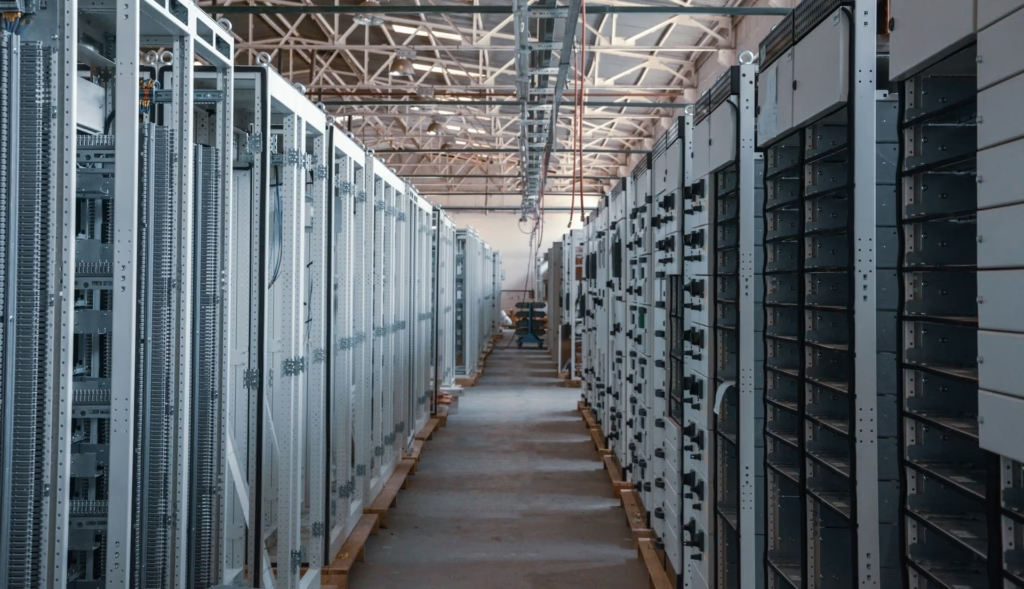
By 2026, businesses finally understand a simple but uncomfortable truth: the so-called “Cloud” is not a magical digital space. It is a global network of very real facilities filled with racks of servers, cooling systems, power lines, and security infrastructure. The geopolitical turbulence of the mid-2020s has completely reshaped how companies think about Disaster Recovery (DR). Protection is no longer limited to software failures or accidental data deletion. Organizations now have to prepare for physical threats such as power-grid attacks, electromagnetic pulse events (EMP), or even the destruction of entire infrastructure zones. When a modern Data Center (DC) is suddenly disabled during a conflict, companies without geographically distributed infrastructure disappear from the digital map within minutes.
📌 CRITICAL: In today’s environment, “uptime” is influenced not only by software reliability but also by geopolitics. Even the most advanced Tier IV data center cannot guarantee availability if it is located near a military target or on an unstable power grid. Physical geography has become the most significant single point of failure.
I. How Infrastructure Fails During Modern Conflicts
Recent global events demonstrate that servers and storage systems can be destroyed in several predictable ways during large-scale disruptions. For CTOs and infrastructure managers, understanding these failure mechanisms is essential for long-term business continuity.
1. Power Grid Shock and Electrical Surges
When national energy infrastructure is attacked or destabilized, the resulting electrical disturbances go far beyond normal fluctuations. Massive cascading voltage spikes travel through transmission systems and can bypass standard enterprise surge protection. These spikes can permanently damage motherboards, RAID controllers, and power supplies, making hardware unusable and significantly complicating data recovery.
2. Cooling System Failure
High-performance servers — especially those used for AI workloads or large database clusters — depend on continuous active cooling. If a prolonged power outage occurs and backup generators fail or fuel supply chains collapse, temperatures inside server rooms rise extremely fast. Within roughly 40–50 minutes, overheating may begin to deform internal components and permanently damage hardware.
“In 2026, any server without cross-border failover should be considered a liability rather than an asset.”
✅ INSIGHT: The most resilient organizations now deploy a strategy sometimes called “Hydra-Hosting.”strong> In this model, frontend services, application logic, and databases are hosted in separate jurisdictions. If one infrastructure node fails due to network shutdowns or physical damage, the remaining nodes continue serving users through distributed edge systems.
II. Infrastructure Survival: Rethinking the Backup Model
Simply copying data is no longer enough. True resilience requires designing an architecture where information remains accessible and operational even under extreme conditions.
The 3-2-1-1-0 Strategy for Crisis-Ready Infrastructure
| Step | Modern Implementation | Purpose |
| 3 Copies | Primary environment, Hot-DR replica, and Cold archive. | Prevents loss caused by internal corruption. |
| 2 Media | High-speed NVMe cloud storage plus LTO tape or optical media. | Protects against firmware attacks and EMP events. |
| 1 Off-Site | Data stored on another continent. | Reduces risk from regional disasters or conflicts. |
| 1 Offline | Air-gapped physical storage vault. | Critical protection against ransomware and destructive malware. |
| 0 Errors | Automated restoration testing performed weekly. | Ensures backups remain usable and intact. |
💡 ADVICE: Deploy Immutable S3 Storage where possible. During major cyber incidents, destructive “wiper” malware often accompanies physical attacks. Immutable storage prevents deletion or modification of data for a predefined retention period, even if attackers gain administrative access.
III. Hardware Protection Measures
Organizations operating private racks or on-premise infrastructure must also consider physical protection technologies that were previously used mostly in military environments.
- Faraday Shielded Racks: Server racks surrounded by conductive shielding materials that reduce the impact of electromagnetic pulses.
- Galvanic Isolation: Optical isolation systems preventing voltage spikes from propagating through network or power cables.
- Independent Micro-Grids: Local energy systems using solar, hydrogen, or battery storage that allow server facilities to disconnect from public electrical infrastructure during emergencies.
STOP: If your backup server is located in the same city as your primary infrastructure, you do not have redundancy — you simply have two points of failure.
IV. The Cost of Digital Resilience
In 2026, infrastructure resilience is no longer treated as a simple operational expense. Companies increasingly evaluate it as a form of risk insurance. The market now clearly distinguishes between basic hosting environments and hardened infrastructure designed for extreme scenarios.
| Strategy Tier | Initial Setup | Monthly Cost |
| Regional Redundancy (separate power grids) | $2,000 – $5,000 | $300 – $800 |
| Global Hydra Architecture (3 continents) | $15,000 – $30,000 | $2,500 – $6,000 |
| Hardened Infrastructure (EMP-shielded bunker) | $50,000+ | $10,000+ |
✅ CASE STUDY: In 2024, a fintech company invested approximately $25,000 in a secondary disaster-recovery location in Iceland. When their main Warsaw data center was disrupted during a cyber-kinetic incident, automated failover activated within 42 seconds. The financial loss was minimal. A competing company that had avoided this investment ceased operations within days.
V. Strategic Infrastructure Principles for 2026
Modern companies increasingly adopt a Zero-Trust Infrastructure philosophy. This model assumes that any individual data center may eventually fail due to technical, cyber, or geopolitical causes.
1. Distribute Operational Control
Critical access credentials should never depend on a single person or location. Multi-signature authentication and globally distributed access management ensure that infrastructure can still be controlled during regional outages or travel restrictions.
2. Independent Connectivity
Fiber-optic lines are often the first communication channels to be disrupted during large-scale conflicts. Forward-thinking infrastructure now integrates satellite connectivity such as Starlink or Kuiper with independent solar power sources, guaranteeing communication even if national internet gateways fail.
“Disaster recovery is not based on optimism. Geography and redundancy are the only reliable defenses when infrastructure becomes a target.”
3. Intelligent Data Reduction
Large datasets slow down recovery during emergencies. Many organizations now focus on identifying critical “seed data” — the minimal core information required to rebuild the entire system. Replicating this core dataset frequently ensures rapid recovery even if larger archives are temporarily unavailable.
ADVISORY: Run a full disaster simulation today. If your main data center disappeared right now, how quickly could your team restore services from another country?
Conclusion
Traditional “set-and-forget” server management strategies disappeared several years ago. In the modern digital landscape, infrastructure resilience requires active planning, geographic diversification, and strong physical protection against power and connectivity failures. Companies that invest in distributed infrastructure, isolated backups, and independent energy sources are not simply protecting data — they are protecting their reputation, their employees, and the long-term trust of their clients. When disruption becomes inevitable, only the organizations prepared for failure continue operating.
This analytical article is presented by Deltahost, a provider of dedicated server infrastructure in Europe and the United States.