You’ve probably interacted with AI today without even realizing it. Maybe your phone’s camera automatically focused on your face. Perhaps your email filtered out spam. Or your music app suggested the perfect song for your mood.
Behind all of these seemingly magical moments? Data labeling.
It’s the unsung hero of artificial intelligence—the painstaking process that teaches machines to see, understand, and interact with our world. And honestly? It’s both more important and more interesting than most people realize.
What Exactly Is Data Labeling?
Think of data labeling as teaching a child to recognize objects. You point at a dog and say “dog.” You show them a cat and say “cat.” Eventually, they learn the difference.
AI works the same way, except it needs thousands—sometimes millions—of examples.
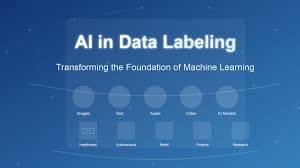
Data labeling is the process of identifying and tagging raw data (images, text, audio, video) with meaningful labels that help machine learning algorithms learn patterns. An image of a golden retriever gets labeled “dog.” An email offering suspicious prizes gets labeled “spam.” A sentence expressing anger gets labeled with the emotion “angry.”
Without these labels, AI is essentially blind. It has no context, no understanding, no ability to make informed decisions.
The Building Blocks
Data labeling comes in many forms:
Image annotation involves drawing bounding boxes around objects, segmenting pixels, identifying facial landmarks, or classifying entire images. This powers everything from self-driving cars to medical diagnosis systems.
Text annotation includes sentiment analysis, named entity recognition, intent classification, and relationship extraction. Your virtual assistant understands your questions because someone labeled thousands of similar questions with their intended meanings.
Audio labeling transcribes speech, identifies speakers, detects emotions in voice, and recognizes sounds. That’s how your smart speaker knows you’re talking to it and not the TV.
Video annotation tracks objects across frames, recognizes actions, and identifies events. Security systems that detect suspicious behavior rely on this.
Why Data Labeling Matters More Than Ever
The quality of your AI is only as good as the quality of your training data.
Garbage in, garbage out—as the old programmer’s saying goes.
In 2024 and beyond, AI systems are being deployed in increasingly critical applications. Medical diagnosis. Autonomous vehicles. Financial fraud detection. Content moderation. Legal document review. These aren’t applications where “pretty good” is acceptable.
Consider autonomous vehicles. A car’s computer vision system needs to distinguish between a plastic bag blowing across the road and a child running after a ball. The difference between these scenarios? Life or death. And that difference comes down to data labeling.
Or take medical imaging AI. Radiologists are using AI to help detect tumors, fractures, and other abnormalities. But these systems are only reliable if they’ve been trained on accurately labeled medical images. A mislabeled tumor could mean a missed diagnosis.
The stakes are high. Really high. That’s the reason for startups like Bloghyper, Runvra, and Techsslassh.com
The Data Labeling Process: More Complex Than You’d Think
On the surface, data labeling seems straightforward. Look at something, tag it, move on.
But anyone who’s actually done this work will tell you it’s far more nuanced.
Defining the Schema
First, you need to establish what you’re actually labeling and why. This requires deep collaboration between AI engineers, domain experts, and business stakeholders. What categories matter? How granular should the labels be? Should you tag “vehicle” or distinguish between “car,” “truck,” “motorcycle,” and “bus”?
These decisions cascade through everything that follows.
Quality Control
Human error is inevitable. One labeler might draw bounding boxes tightly around objects while another leaves extra space. One might interpret “aggressive language” differently than another.
That’s why quality assurance is critical. Most professional data labeling operations use multiple labelers for the same data, comparing their work and resolving disagreements. Some use “golden datasets”—pre-labeled examples with known correct answers—to continuously evaluate labeler performance.
Inter-Annotator Agreement
This is a fancy term for a simple concept: do different labelers agree?
If you ask five people to label the same 100 images and they all produce wildly different results, you have a problem. Either your instructions aren’t clear, your categories aren’t well-defined, or the task is too subjective.
High inter-annotator agreement means your labeling process is reliable and consistent.
Iteration and Refinement
Data labeling isn’t a one-and-done process. As you review labeled data and train models, you discover edge cases, ambiguities, and gaps in your initial guidelines. You refine your approach. Update your instructions. Sometimes completely revise your labeling schema.
It’s an iterative dance between human judgment and machine learning.
The Human Element: Who Does This Work?
Data labeling employs millions of people worldwide.
Some are in-house teams at major tech companies, working alongside AI researchers. Others are domain experts—radiologists labeling medical scans, lawyers reviewing legal documents, linguists annotating language data.
But a significant portion of data labeling happens through crowdsourcing platforms and specialized data labeling companies, which provide managed teams to ensure higher accuracy than generic BPO providers. Workers might spend hours drawing bounding boxes around pedestrians in street scenes or categorizing customer support tickets.
This raises important ethical questions. How much are these workers paid? What are their working conditions? Do they have clear guidelines and support? Are they exposed to traumatic content without proper mental health resources?
Content moderation labelers, for instance, must review disturbing images and videos to train AI systems that will later filter such content automatically. This work takes a psychological toll that companies are increasingly recognizing and addressing.
Automation: Can AI Label Its Own Data?
Here’s where things get interesting.
AI researchers are developing techniques to reduce the need for manual labeling. Semi-supervised learning uses a small amount of labeled data plus a large amount of unlabeled data. Self-supervised learning lets models learn from the data itself without explicit labels. Active learning identifies the most informative examples for humans to label, making the process more efficient.
Synthetic data generation creates artificial training data, particularly useful when real data is scarce, sensitive, or expensive to obtain.
And then there’s the recursive approach: using existing AI models to help label data for training better AI models. It’s like an apprentice eventually becoming skilled enough to teach the next generation.
But—and this is crucial—these techniques don’t eliminate the need for human judgment. They supplement it, reduce it, make it more efficient. But at the foundation, quality AI still requires quality human-labeled data.
Challenges and Pitfalls
Bias in Labeled Data
If your training data reflects societal biases, your AI will learn and amplify those biases. Facial recognition systems that perform poorly on darker skin tones? Often traced back to training datasets dominated by lighter-skinned faces. Language models that associate certain professions with specific genders? That bias came from the labeled data.
Addressing bias requires intentional effort in dataset composition and labeling practices.
Subjectivity and Context
Some labeling tasks are inherently subjective. Is a comment “offensive” or “just blunt”? Is an image “artistic nudity” or “inappropriate content”? Different cultures, communities, and individuals will have different answers.
Context matters enormously. A word that’s offensive in one context might be perfectly acceptable in another.
Scale and Cost
Labeling millions of data points is expensive and time-consuming. A single autonomous vehicle company might need billions of labeled images. Training a large language model requires enormous amounts of labeled text data.
The economics of data labeling significantly impact AI development timelines. This is exactly why many AI startups and enterprises turn to professional data labeling services—to handle these massive volumes without bottlenecking their internal teams.
The Future of Data Labeling
As AI becomes more sophisticated, data labeling evolves too.
We’re seeing movement toward more specialized labeling for specific domains. 3D point cloud annotation for robotics and autonomous systems. Multi-modal labeling that combines image, text, and audio. Fine-grained emotion and intent labeling for more nuanced AI interactions.
Tools are getting smarter, offering suggestions and automating repetitive aspects while keeping humans in the loop for judgment calls. Some companies are experimenting with AI-assisted labeling where the model proposes labels and humans verify or correct them.
There’s also growing emphasis on explainability in labeling. Not just “this is a dog” but “this is a dog because of these specific features.” This helps AI systems learn more robust, generalizable patterns.
Why You Should Care
Even if you never label a single piece of data yourself, understanding this process matters.
Every time you use AI, you’re benefiting from countless hours of human effort in data labeling. And every limitation, bias, or failure in AI often traces back to the training data.
As AI becomes more integrated into critical systems—healthcare, justice, finance, education—the quality and ethics of data labeling become everyone’s concern. Not just technologists’.
Because at the end of the day, AI isn’t magic. It’s millions of human decisions, crystallized into training data, transformed into algorithms that shape our world.
Data labeling is where human intelligence meets artificial intelligence. Where our judgment, values, and understanding get encoded into the machines that increasingly mediate our lives.
It’s unglamorous work, often invisible, sometimes ethically complex.
But it’s absolutely essential.
And that’s worth understanding.