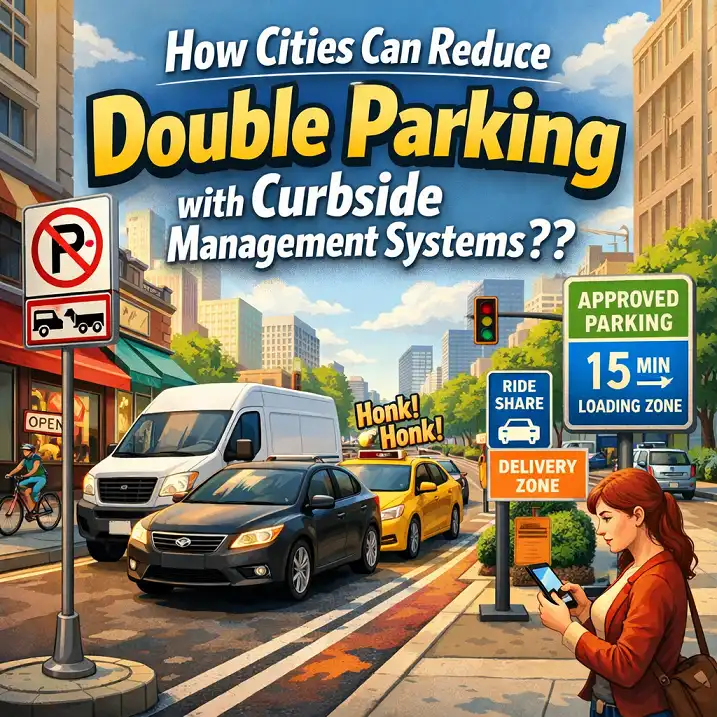
Double parking results from inefficient curbside coordination rather than isolated driver behavior. It occurs when vehicles stop in active lanes due to unavailable or poorly managed curb space, constraining lane capacity and disrupting flow. This issue is most visible in dense urban corridors where deliveries, ride-hailing, and short-term parking compete for limited curb access.
Without a structured parking management system, cities lack the visibility and control required to allocate curb space effectively, leading to frequent lane blockages, increased congestion, and unpredictable travel times. Addressing this issue requires system-level coordination to improve curb access, increase compliance, and minimize illegal stopping. In high-density areas, even short-duration stops can create cascading delays across entire corridors, making curbside efficiency a critical component of traffic management.
Why Double Parking Is a Major Urban Traffic Problem?
Double parking directly interferes with traffic movement by blocking active lanes. When a vehicle stops in a travel lane, following vehicles slow down or merge, lowering corridor efficiency and increasing delays. These disruptions reduce throughput and create localized bottlenecks that can extend across multiple intersections.
In high-demand areas, this behavior contributes significantly to congestion. Lane blockages and curbside disruptions can lower effective road capacity, reinforcing the need for targeted double-parking solutions for city traffic management. As urban delivery volumes continue to rise, unmanaged curb demand further amplifies these inefficiencies.
Why Traditional Approaches Fail to Prevent Double Parking?
Traditional curbside management relies on static loading zones, fixed regulations, and manual enforcement. These approaches do not adapt to fluctuating demand, particularly during peak delivery or pickup periods.
Without dynamic allocation or scheduling, drivers stop illegally when designated spaces are unavailable. Manual enforcement limits coverage, allowing violations to persist. In many cases, enforcement occurs after the disruption has already impacted traffic flow.
This requires technology to prevent double parking in cities, shifting from reactive enforcement to continuous, system-driven management that anticipates demand rather than responding to violations.
How Cities Can Reduce Double Parking with Curbside Management Systems?
Reducing double parking requires structured systems combining real-time data, adaptive allocation, and automated enforcement. Curbside management systems to reduce double parking enable cities to optimize curb usage, improve compliance, and maintain lane availability. These systems function as control layers that coordinate multiple curb users without disrupting traffic flow.
#1 Dynamic Loading Zones Reduce Illegal Stopping
Static curb allocations fail to match real-time demand. Dynamic loading zones adjust curb usage based on time and activity, converting spaces between passenger pickup and freight loading as needed.
These smart curb management solutions for urban streets align curb allocation with demand, minimizing illegal stopping in active lanes and improving lane availability. By ensuring that high-demand users have access during peak periods, cities reduce the likelihood of vehicles stopping in travel lanes.
#2 Digital Reservation Systems Eliminate Search Behavior
Lack of guaranteed curb access leads to illegal stopping. Digital reservation systems allow delivery vehicles to book curb space in advance, ensuring availability upon arrival.
Pilot programs in U.S. cities have reduced double-parking incidents by over 64% in targeted corridors by increasing curb access predictability. This represents a key application of technology to prevent double parking in cities, eliminating search behavior and lowering congestion. Predictable access reduces uncertainty, allowing operators to plan routes more efficiently.
#3 Real-Time Curb Visibility Improves Space Utilization
Limited visibility into available curb space leads to inefficient usage and unnecessary stopping. Drivers often rely on guesswork, increasing the likelihood of illegal parking.
Curbside parking management software for municipalities provides real-time occupancy data, enabling more efficient demand distribution. By directing vehicles to available spaces, these systems reduce uncertainty and minimize illegal stopping. Real-time insights also allow cities to identify underutilized zones and rebalance curb demand.
#4 Automated Enforcement Increases Compliance
Manual enforcement is inconsistent and limited in scope. Automated systems using license plate recognition and mobile tools enable continuous monitoring of curb activity.
These curbside enforcement systems for cities detect violations in real time, increasing compliance and limiting illegal stopping. Higher enforcement consistency improves lane availability and traffic flow. Continuous monitoring also acts as a deterrent, reducing repeat violations over time.
#5 Demand-Based Pricing Improves Turnover
Fixed pricing leads to over-occupied curb spaces, limiting availability for short-term users. Demand-based pricing adjusts rates based on real-time usage, improving turnover and maintaining access.
The U.S. Department of Transportation indicates that demand-based pricing improves curb efficiency and reduces unnecessary circulation. As part of curbside management systems to reduce double parking, pricing ensures that curb space remains available when needed. Balanced pricing encourages shorter stays and better space utilization.
#6 Data-Driven Planning Optimizes Curb Allocation
Curbside demand varies by location and time. Data-driven planning analyzes usage patterns to redesign curb allocations based on actual demand.
Cities can implement targeted double parking solutions for city traffic management, such as dedicated loading zones in high-demand areas. This reduces conflicts between users and improves overall curb efficiency. Over time, continuous data collection supports more accurate planning and policy adjustments.
The Impact of Reducing Double Parking on Urban Traffic
Reducing double parking improves lane availability and stabilizes traffic flow. When lanes remain unobstructed, vehicles maintain consistent speeds, lowering delays and improving corridor efficiency.
Fewer lane blockages limit stop-and-go traffic, improving fuel efficiency and lowering emissions. Reduced congestion also improves travel time reliability, which is critical for both commuters and commercial operations. These outcomes demonstrate how smart curb management solutions for urban streets improve overall transportation performance.
The Shift Toward Intelligent Curbside Management
Cities are adopting integrated, data-driven systems to manage curb space as part of broader mobility strategies. Curbside parking management software for municipalities now combines real-time data, analytics, and automation to optimize allocation and enforcement.
These systems enable proactive curb coordination, using technology to prevent double parking in cities and improve curb efficiency. As integration with broader urban mobility platforms increases, curbside systems will play a central role in managing traffic demand and maintaining network performance.
Closing Thoughts
Double parking results from unstructured curbside systems that fail to allocate space efficiently. When curb access is limited or poorly managed, vehicles stop in active lanes, constraining road capacity and disrupting traffic flow.
Implementing curbside management systems to reduce double parking enables cities to move from reactive enforcement to structured coordination. By integrating real-time data, dynamic allocation, and automated enforcement, cities improve compliance, maintain lane availability, and reduce congestion.
Cities that adopt structured, data-driven curbside systems reduce congestion at the source rather than managing its impact, creating more efficient and reliable urban transportation networks.