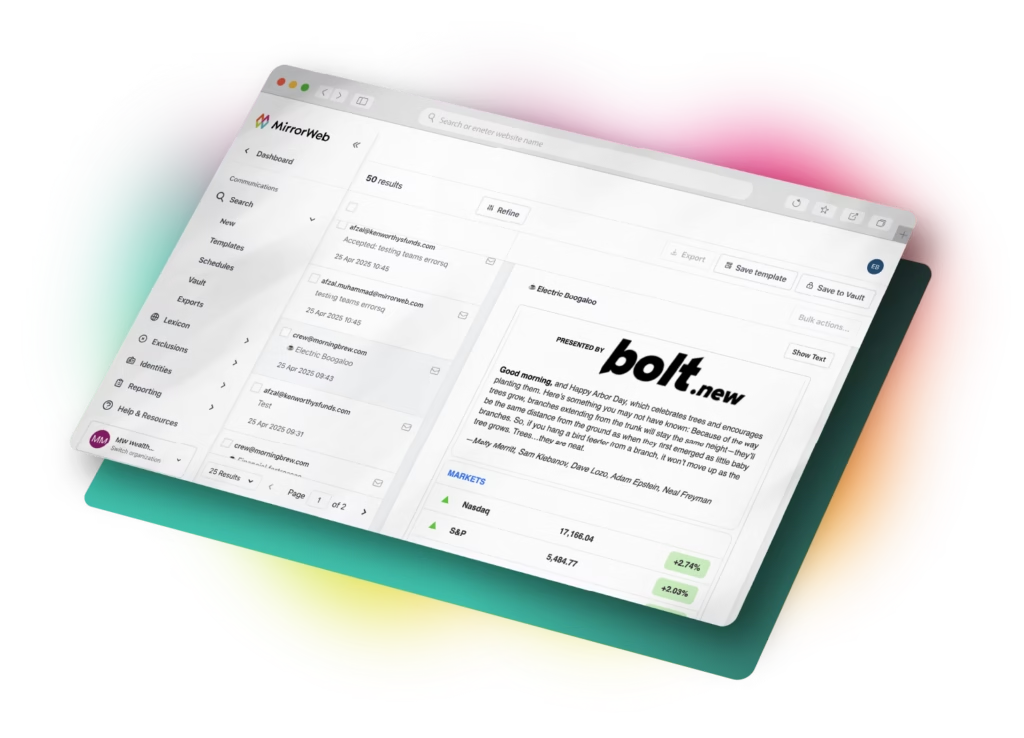
Email remains one of the most critical communication channels in modern enterprises. Contracts, approvals, strategic discussions, and sensitive information all flow through email every day. At the same time, email is one of the most difficult data sources to govern consistently. Without a structured approach, organizations face growing compliance risk, operational inefficiencies, and increased exposure during audits or litigation.
Email archiving has become a foundational capability for enterprises seeking to manage this challenge at scale.
What Is Enterprise Email Archiving?
Email archiving is the automated, policy-driven capture and preservation of all inbound, outbound, and internal email communications across an organization, including environments that rely on office 365 email archiving for large-scale enterprise communication. Instead of relying on individual user mailboxes, emails are stored in a centralized, tamper-resistant archive.
This approach ensures that email records remain:
- Complete and immutable
- Searchable and accessible
- Defensible during audits and litigation
- Independent of user behavior or mailbox lifecycle
Archived emails remain available regardless of employee turnover, mailbox deletions, or email platform migrations.
Compliance as a Primary Driver for Email Archiving
Regulatory and legal requirements are a major catalyst for enterprise email archiving. Organizations must comply with frameworks such as:
- FINRA
- SOX
- GDPR
- HIPAA
- Industry-specific retention mandates
These regulations require consistent enforcement of retention policies, timely application of legal holds, and defensible disposition of data. Without centralized archiving, email retention often depends on individual user actions—creating gaps that increase legal and regulatory risk.
How Email Archiving Strengthens Compliance
Enterprise email archiving enables organizations to:
- Enforce retention and disposition policies automatically
- Apply legal holds instantly when litigation is anticipated
- Eliminate inconsistent, user-managed email storage
- Reduce over-retention and unnecessary data exposure
This policy-driven approach strengthens audit readiness and compliance posture across the enterprise.
Supporting Legal, Audit, and eDiscovery Requirements
Legal and compliance teams rely heavily on email during audits, investigations, and litigation. Modern email archiving solutions index message content, metadata, and attachments to support advanced search and eDiscovery workflows.
Key capabilities include:
- Keyword, date, sender, and recipient filtering
- Custodian-based searches
- Rapid retrieval of relevant communications
- Preservation of messages under legal hold
These capabilities dramatically reduce the time, cost, and operational disruption associated with responding to legal requests.
Operational Benefits for IT Teams
Beyond compliance, email archiving delivers measurable operational advantages for IT organizations. Email systems are often among the largest and most complex platforms to manage. As mailboxes grow:
- Performance degrades
- Backup windows expand
- Storage costs increase
- Disaster recovery becomes more complex
By moving older or inactive emails out of live mailboxes and into an archive, organizations reduce the burden on primary email systems.
Operational Improvements Enabled by Email Archiving
- Faster email system performance
- Smaller and more predictable backup windows
- Simplified disaster recovery planning
- Lower primary storage requirements
At the same time, users retain seamless access to archived messages through familiar interfaces.
Improving User Experience and Reducing Risky Workarounds
Poorly implemented archiving solutions often lead users to create personal PST files or local email backups. These workarounds increase security risk and undermine governance efforts.
Enterprise-grade email archiving eliminates the need for local storage by providing:
- Secure, self-service access to archived emails
- Consistent search and retrieval experiences
- Centralized governance without user disruption
This reduces shadow IT behavior while improving end-user satisfaction.
Strengthening Security and Information Governance
Email frequently contains sensitive and regulated information, including:
- Personally identifiable information (PII)
- Financial data
- Intellectual property
- Credentials and access details
- Protected health information (PHI)
Centralized email archiving enables consistent security controls across all communications, including:
- Role-based access control
- Audit logging and monitoring
- Encryption and tamper resistance
This significantly reduces the risk associated with unmanaged or poorly secured legacy email data.
Supporting Cloud Migrations and Hybrid Environments
As organizations migrate from on-premises email systems to cloud platforms, managing historical email data becomes increasingly complex. Platform upgrades, migrations, and hybrid environments introduce risk if email records are fragmented or poorly governed.
A centralized, cloud-ready email archiving solution ensures:
- Continuity across email platforms
- Consistent compliance enforcement
- Simplified migrations without data loss
Historical email data remains accessible and governed regardless of underlying infrastructure changes.
Email Archiving as Part of a Broader Data Governance Strategy
When integrated into enterprise data governance and information lifecycle management (ILM) initiatives, email archiving ensures that all email archived data becomes part of a unified governance framework rather than a standalone risk area.
This alignment helps organizations:
- Reduce compliance gaps
- Improve audit readiness
- Strengthen enterprise-wide information security
- Manage structured and unstructured data consistently
A Strategic Capability, Not Just a Defensive Measure
Email archiving is no longer solely about risk mitigation. Strategically implemented, it delivers visibility into organizational communications, supports faster investigations, and reduces long-term operational complexity.
By treating email as a governed enterprise asset, organizations can proactively manage risk while improving efficiency and resilience.
Conclusion
In an environment defined by accelerating data growth, evolving IT architectures, and increasing regulatory scrutiny, email archiving is a foundational enterprise capability. When implemented as a scalable, secure, and policy-driven solution, it empowers organizations to govern communications responsibly, reduce legal and operational risk, and improve efficiency—without disrupting how employees work.