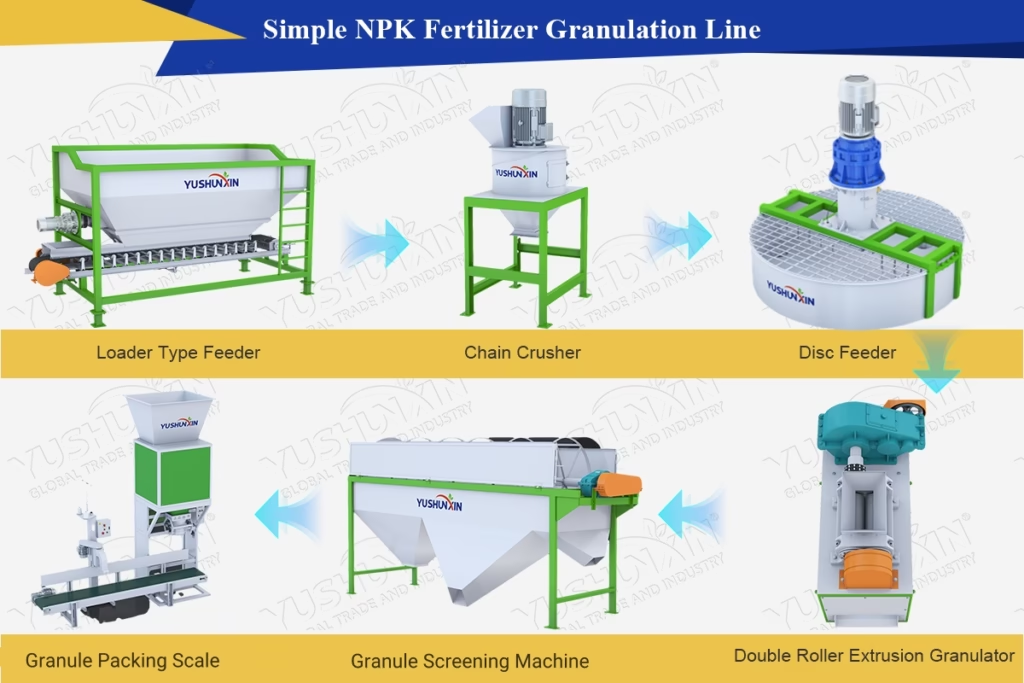
Modern agriculture relies heavily on high-quality fertilizers to boost crop yields, enhance soil fertility, and support sustainable farming practices. Among the most effective technologies for fertilizer production are the granulator for bentonite and the NPK granulation plant. These systems allow manufacturers to convert raw materials into uniform, nutrient-rich granules that are easy to handle, store, and apply. By leveraging these technologies, fertilizer producers can improve efficiency, reduce waste, and meet growing market demands.
This article explores how bentonite granulators and NPK granulation plants work, their benefits, and why they are essential for modern fertilizer manufacturing.
What Is a Granulator for Bentonite?
A granulator for bentonite is a specialized machine used to convert fine bentonite powder into uniform granules. Bentonite, a natural clay, is widely used as a binder in fertilizer production. It improves granule formation, enhances stability, and reduces dust during handling and application.
How Bentonite Granulators Work
- Powder Feeding
Bentonite powder is fed into the granulator along with raw materials such as urea, ammonium phosphate, or potassium chloride. - Mixing and Binding
The bentonite binds the powdered materials together, forming a cohesive mixture suitable for granulation. - Granulation Process
The mixture passes through the granulator, where mechanical force and rotation form uniform, round granules. - Drying and Cooling
Newly formed granules are dried to reduce moisture content and cooled to stabilize their structure. - Screening and Packaging
Granules of uniform size are collected for packaging, while oversized or undersized granules are recycled into the granulation process.
By using bentonite as a binder, fertilizer manufacturers achieve higher-quality granules that resist breaking, minimize dust, and ensure efficient nutrient delivery.
NPK Granulation Plant: Integrated Fertilizer Production
An NPK granulation plant is a complete production system designed to produce compound fertilizers containing nitrogen (N), phosphorus (P), and potassium (K). These nutrients are essential for balanced plant growth, improving root development, crop yield, and soil health. NPK fertilizers combine multiple nutrients in a single product, making them highly effective and convenient for farmers.
Components of an NPK Granulation Plant
- Raw Material Preparation
Fertilizer raw materials are crushed, screened, and blended to achieve the desired NPK ratio. - Granulation
Materials are fed into the granulator, where powders are converted into uniform granules using bentonite or other binders. - Drying and Cooling
Granules are dried to reduce moisture and cooled to stabilize their structure. - Screening
Granules are separated by size, with undersized or oversized granules recycled back into the granulation system. - Packaging
Finished NPK granules are packed for storage or distribution.
An integrated NPK granulation plant ensures efficient, large-scale production with consistent product quality, meeting both domestic and international fertilizer demands.
Benefits of Using Bentonite Granulators and NPK Granulation Plants
1. Improved Product Quality
Bentonite improves granule strength, reducing breakage during transportation and application. NPK granulation plants ensure uniform nutrient distribution, providing balanced nutrition to crops.
2. High Production Efficiency
Granulators and integrated plants enable continuous or semi-continuous operation, reducing production time and labor requirements.
3. Cost Savings
Using bentonite as a binder and optimizing granulation processes reduces raw material waste, energy consumption, and labor costs.
4. Environmental Sustainability
Advanced systems minimize dust, prevent material loss, and allow the use of natural binders, supporting eco-friendly fertilizer production.
5. Scalability
Both bentonite granulators and NPK granulation plants can be customized for small, medium, or large-scale production, making them suitable for a variety of fertilizer businesses.
Applications in Fertilizer Production
Fertilizer granules produced with bentonite granulators and NPK plants are widely used across agriculture:
- Row Crops: Wheat, corn, rice, and soybeans benefit from balanced nutrient granules.
- Vegetables and Fruits: Improved nutrient absorption enhances quality and yield.
- Horticulture: Granular fertilizers promote healthy garden plants and ornamental crops.
- Specialty Fertilizers: Customized NPK formulations for specific soil or crop needs.
- Soil Amendment Products: Granulated bentonite improves soil structure and moisture retention.
Using these systems ensures that fertilizers are effective, easy to handle, and meet modern agricultural requirements.
Choosing the Right Equipment
When selecting a granulator for bentonite or an NPK granulation plant, consider the following factors:
- Production Capacity
Determine your desired output to select equipment that matches your scale of operation. - Raw Material Availability
Ensure a reliable supply of bentonite, nitrogen, phosphorus, and potassium sources. - Automation Level
Automated systems reduce labor costs and improve production consistency. - Customization Options
Choose machines capable of producing different granule sizes and NPK ratios. - Manufacturer Support
Work with suppliers that offer installation, training, and maintenance services.
Selecting the right equipment ensures efficient operation, high-quality fertilizer, and long-term profitability.
Conclusion
Investing in a granulator for bentonite and an NPK granulation plant allows fertilizer manufacturers to produce high-quality, nutrient-rich granules efficiently and sustainably. Bentonite improves granule strength, minimizes dust, and enhances handling, while NPK granulation plants enable large-scale, consistent production of compound fertilizers that support modern agriculture.
These systems reduce operational costs, improve product quality, and provide scalable solutions for small, medium, or industrial fertilizer production. By adopting advanced granulation technology, fertilizer producers can meet market demand, enhance crop yields, and maintain a competitive edge in the global agricultural industry.