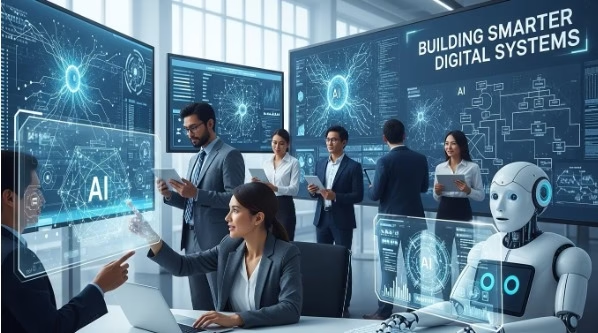
Artificial intelligence is no longer an experimental technology reserved for large research labs. It has become a practical tool that businesses across industries use to automate workflows, analyze data, and improve decision-making. As this shift accelerates, organizations are increasingly looking to hire AI engineers who can design intelligent systems that go beyond basic automation and deliver measurable business value. From startups to enterprises, AI talent is now a strategic investment rather than a technical luxury.
Modern digital systems are expected to think, learn, and adapt in real time. Customers want personalized experiences, operations teams want predictive insights, and leadership wants data-driven clarity. These demands have reshaped how companies approach technology, pushing AI engineers to the center of digital transformation strategies.
The Evolution of Digital Systems in the AI Era
Traditional digital systems were built on predefined rules. They followed instructions, processed inputs, and delivered outputs in predictable ways. While effective for basic tasks, these systems struggled when faced with complex or changing conditions.
AI-driven systems, by contrast, learn from data. They recognize patterns, improve accuracy over time, and respond intelligently to new situations. This evolution allows businesses to shift from reactive decision-making to proactive and predictive operations.
For example, instead of manually analyzing sales trends at the end of each quarter, AI models can continuously assess customer behavior and forecast demand in real time. This change fundamentally alters how organizations operate and compete.
Why AI Talent Has Become a Business Priority
The growing reliance on intelligent systems has increased demand for skilled AI professionals. AI engineers do more than write code; they translate business goals into scalable, data-driven solutions. Their work connects raw data with real-world outcomes.
Businesses prioritize AI talent for several reasons:
- Customization: AI engineers build systems tailored to specific workflows rather than relying on generic tools.
- Scalability: Well-designed AI models grow with the business and handle increasing data volumes.
- Efficiency: Automated decision systems reduce manual effort and operational costs.
- Accuracy: Machine learning improves predictions and reduces human error.
Without the right talent, even the most advanced AI tools fail to deliver meaningful results.
Smarter Decision-Making Through AI-Driven Insights
One of the most powerful ways businesses use AI talent is to enhance decision-making. AI engineers develop models that analyze large datasets quickly and objectively, revealing insights that humans might miss.
In finance, AI systems detect fraud by identifying unusual transaction patterns. In marketing, they segment audiences based on behavior rather than assumptions. In healthcare, they assist doctors by highlighting potential risks in patient data.
These systems do not replace human judgment; instead, they support it. By providing accurate, real-time insights, AI allows leaders to make informed decisions with confidence.
Automation That Goes Beyond Basic Tasks
Automation is often associated with simple, repetitive processes. AI talent expands automation into more complex areas that require contextual understanding.
Examples include:
- Intelligent chatbots that understand customer intent rather than scripted responses
- Supply chain systems that adjust inventory levels based on demand forecasts
- HR platforms that screen candidates using skill-based analysis instead of keyword matching
AI engineers design these systems to adapt and improve, ensuring automation remains effective as conditions change.
Building Personalized Customer Experiences
Customer expectations have changed dramatically. Generic messaging and one-size-fits-all services no longer work. Businesses now rely on AI to deliver personalization at scale.
AI engineers build recommendation engines, dynamic pricing models, and personalized content systems. These tools analyze user behavior, preferences, and engagement history to deliver relevant experiences in real time.
E-commerce platforms suggest products customers are likely to buy. Streaming services recommend content aligned with viewing habits. Even financial apps personalize budgeting insights based on spending patterns. All of this depends on skilled AI talent working behind the scenes.
Enhancing Operational Efficiency Across Departments
Beyond customer-facing applications, AI talent plays a key role in improving internal operations. AI engineers optimize workflows, identify bottlenecks, and reduce inefficiencies.
Manufacturing companies use AI to predict equipment failures before they occur. Logistics firms optimize delivery routes to save fuel and time. Customer support teams use AI tools to prioritize urgent tickets automatically.
These improvements reduce costs and free teams to focus on higher-value work, creating a more agile organization.
The Role of Data in Smarter Digital Systems
AI systems are only as effective as the data they use. AI engineers ensure that data pipelines are clean, secure, and structured for analysis. They work closely with data scientists and business teams to define meaningful metrics and eliminate noise.
Proper data handling also addresses ethical and compliance concerns. Engineers implement safeguards to reduce bias, protect user privacy, and ensure transparency in AI-driven decisions. This responsible approach builds trust with customers and regulators alike.
Overcoming the AI Talent Gap
Despite growing demand, many businesses struggle to find and retain qualified AI professionals. The talent gap has led companies to explore flexible hiring models, remote teams, and specialized partnerships.
Rather than building large in-house teams, organizations increasingly focus on accessing expertise when needed. This approach allows them to innovate faster while controlling costs and reducing long-term risk.
The Competitive Advantage of AI-Powered Systems
Businesses that successfully integrate AI talent into their digital strategy gain a clear competitive edge. They respond faster to market changes, understand customers more deeply, and operate more efficiently.
AI-powered systems also create long-term value. As models learn and improve, the organization benefits from compounding insights that competitors without AI capabilities struggle to match.
Conclusion: The Future of Smarter Digital Systems
AI talent is shaping the next generation of digital systems by making them adaptive, intelligent, and outcome-driven. From smarter decision-making to personalized experiences and operational efficiency, AI engineers are at the core of this transformation. As more businesses embrace intelligent technologies, aligning with platforms and ecosystems that understand modern AI development such as Mindrind will become increasingly important for building scalable, future-ready digital solutions.
FAQs
1. Why is AI talent important for modern businesses?
AI talent helps businesses design intelligent systems that analyze data, automate complex processes, and support smarter decision-making across departments.
2. What roles do AI engineers play in digital transformation?
AI engineers build, train, and deploy machine learning models, integrate AI into existing systems, and ensure solutions scale securely with business growth.
3. How do AI-driven systems improve business efficiency?
They reduce manual work, predict outcomes, optimize workflows, and provide real-time insights that allow teams to act faster and more accurately.
4. Can small businesses benefit from AI engineers?
Yes. Even small businesses use AI for customer insights, automation, forecasting, and personalization without needing large internal teams.
5. What industries benefit most from AI-powered digital systems?
Industries like finance, healthcare, retail, logistics, education, and manufacturing gain significant advantages from AI-driven analytics and automation.