In today’s workplaces and schools managing attendance is more than marking who is here or not.Organizations want things to move quickly, be more accurate, secure and easy.They want to do manual work and use technology that doesn’t require touching.They are looking for solutions, for attendance management.
This is where face recognition attendance systems are changing the game.
From offices and factories to schools, hospitals, and retail businesses, face-based attendance systems are becoming the preferred choice over traditional fingerprint or thumb-based machines.
In this blog, we’ll explain:
- What a face recognition attendance system is
- How face attendance systems work
- Why face attendance is better than fingerprint attendance
- Key benefits for businesses and institutions
- Common concerns and FAQs
- How to choose the right system
What Is a Face Recognition Attendance System?
A face recognition attendance system is a smart biometric attendance solution that identifies and verifies a person using facial features instead of fingerprints, cards, passwords, or manual registers.
The system uses artificial intelligence (AI) and computer vision technology to:
- Detect a face
- Analyze unique facial patterns
- Match the face with stored records
- Mark attendance automatically
The whole thing takes a few seconds.
Unlike fingerprint systems, users do not have to touch anything. They just stand in front of a camera. It records their attendance automatically.
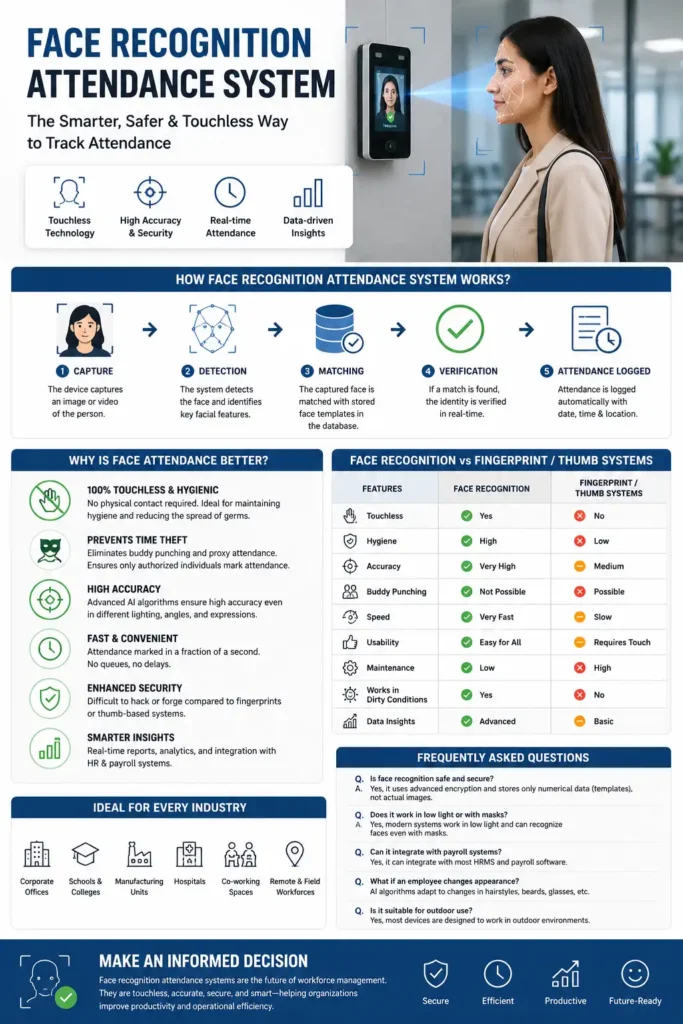
How Does a Face Recognition Attendance System Work?
A face recognition attendance system works through several intelligent steps.
1. Face Registration
The first step is enrollment or registration.
During this process:
- The user’s face is scanned
- Multiple facial angles may be captured
- The system converts the facial image into digital biometric data
- This data is securely stored in the database
The system does not store just a simple photo. Instead, it stores mathematical facial patterns and biometric markers.
2. Face Detection
When a user stands in front of the attendance device something cool happens.
The camera notices that there is a face in front of it.
Then the computer uses tools to find important points on the face like the eyes and nose and this is all done using special computer programs called AI algorithms that identify key facial points such as facial features.
- Eyes
- Nose
- Jawline
- Distance between facial features
This happens instantly.
3. Face Matching
The system compares the live face scan with stored biometric data.
Advanced AI algorithms analyze:
- Facial structure
- Facial geometry
- Depth mapping
- Texture patterns
If the match is successful, the attendance is marked automatically.
4. Attendance Recording
Once verified, the system:
- Records entry or exit time
- Updates attendance logs
- Syncs data with cloud software or HR systems
- Generates reports automatically
Many systems also support:
- Shift management
- Payroll integration
- Leave management
- Real-time notifications
- Mobile app monitoring
Why Face Recognition Attendance Is Better Than Fingerprint or Thumb Attendance Systems
Traditional fingerprint attendance machines were once considered advanced. However, modern workplaces now require faster, safer, and more reliable solutions.
Face recognition attendance systems solve many problems that fingerprint systems cannot.
1. Completely Contactless
One of the biggest advantages of face attendance systems is that they are touch-free.
Employees do not need to:
- Touch sensors
- Press fingers repeatedly
- Use thumb scanners
This reduces:
- Germ transmission
- Hygiene concerns
- Device wear and tear
Contactless attendance became especially important after the COVID-19 pandemic.
2. Faster Attendance Process
Face recognition systems identify users within seconds.
Fingerprint systems often face delays because:
- Fingers are not placed correctly
- Sensors become dirty
- Fingerprints fail to scan
- Moisture or dust affects reading
Face recognition provides a smoother and faster experience.
This is highly beneficial for:
- Large offices
- Factories
- Schools
- Construction sites
- Hospitals
3. Better Accuracy
Fingerprint systems may fail due to:
- Wet fingers
- Dust
- Cuts or injuries
- Worn fingerprints
- Skin damage
This is common among:
- Factory workers
- Laborers
- Technicians
- Healthcare workers
Face recognition systems avoid these issues because they rely on facial patterns instead of fingerprints.
Modern AI-powered systems offer highly accurate identification even with:
- Glasses
- Masks
- Beard changes
- Different lighting conditions
4. Prevents Buddy Punching
Buddy punching happens when one employee marks attendance for another.
This is a common problem in:
- Card-based attendance systems
- Password-based systems
- Manual attendance registers
Face recognition systems significantly reduce attendance fraud because:
- Every face is unique
- Real-time verification is required
- AI detects spoofing attempts
Advanced systems also include:
- Liveness detection
- Anti-photo spoofing
- Anti-video replay protection
5. Low Maintenance
Fingerprint scanners require regular cleaning because:
- Dust accumulates on sensors
- Continuous touching damages hardware
- Sensor quality reduces over time
Face recognition systems have lower maintenance requirements because there is minimal physical contact.
This improves device lifespan and reduces maintenance costs.
6. Works Better in Industrial Environments
Fingerprint systems struggle in harsh environments such as:
- Factories
- Warehouses
- Construction sites
- Manufacturing plants
Workers may have:
- Dirty hands
- Gloves
- Grease-covered fingers
- Damaged fingerprints
Face recognition systems work effectively without requiring physical contact.
7. Easy Integration With Modern HR Software
Modern face attendance machine can integrate with:
- HRMS software
- Payroll systems
- Access control systems
- Mobile applications
- Cloud platforms
This helps businesses automate attendance and salary calculations.
8. Real-Time Monitoring and Reports
Face recognition systems provide:
- Live attendance tracking
- Real-time reports
- Remote monitoring
- Automated shift reports
- Late arrival alerts
- Overtime calculations
Managers can monitor attendance from anywhere using cloud dashboards.
Key Benefits of Face Recognition Attendance Systems
Improved Security
Facial biometrics are difficult to duplicate, making attendance more secure.
Time Savings
Automated attendance reduces manual work and administrative tasks.
Better Employee Experience
Employees enjoy a smoother and faster attendance process.
Higher Productivity
Automated systems reduce queues and improve operational efficiency.
Scalable for Growing Organizations
Face attendance systems can handle thousands of employees across multiple locations.
Cloud-Based Access
Cloud systems allow managers to access attendance records anytime and anywhere.
Industries Using Face Recognition Attendance Systems
Face attendance technology is widely used across industries.
Corporate Offices
For employee attendance and access control.
Schools and Colleges
For student and staff attendance management.
Hospitals
For hygienic, touch-free attendance.
Manufacturing Units
For handling large workforces efficiently.
Retail Stores
For staff attendance and shift tracking.
Construction Sites
For worker attendance at remote locations.
Common Challenges in Fingerprint Attendance Systems
Organizations using fingerprint machines often face these issues:
| Problem | Fingerprint System | Face Recognition System |
| Touch required | Yes | No |
| Hygiene concerns | High | Low |
| Works with gloves | No | Yes |
| Sensor maintenance | Frequent | Minimal |
| Wet/damaged finger issues | Common | Rare |
| Speed | Moderate | Fast |
| Attendance fraud risk | Moderate | Very low |
| User convenience | Average | Excellent |
Is Face Recognition Attendance Safe?
Yes, modern face recognition systems use advanced encryption and secure biometric storage.
Most enterprise-grade systems include:
- Encrypted databases
- Secure cloud storage
- User access controls
- GDPR or privacy compliance features
- Anti-spoofing security
Organizations should still choose trusted vendors that follow proper data protection practices.
How to Choose the Right Face Recognition Attendance System
Before selecting a biometric system, consider the following factors.
Accuracy
Choose AI-powered systems with high recognition accuracy.
Speed
The system should recognize faces quickly even during peak hours.
Liveness Detection
Ensure the device supports anti-spoofing technology.
Cloud Support
Cloud access allows remote attendance management.
Integration Options
Check compatibility with HRMS, payroll, and access control systems.
Scalability
Choose a system that can grow with your organization.
Customer Support
Reliable technical support is important for smooth operation.
Frequently Asked Questions (FAQs)
1. Is face recognition attendance more accurate than fingerprint attendance?
Yes. Modern AI-powered face recognition systems are highly accurate and can perform better than fingerprint systems in many real-world situations.
2. Can face attendance systems work with masks or glasses?
Many advanced systems can identify users even with masks, glasses, or facial hair.
3. Is face recognition attendance safe for employee privacy?
Yes, if implemented correctly. Good systems use encrypted biometric storage and follow data protection policies.
4. Does face recognition work in low light?
Many modern devices use infrared or AI-enhanced cameras that work in various lighting conditions.
5. Can face attendance systems integrate with payroll software?
Yes. Most modern systems support payroll and HRMS integration.
6. Is the internet required for face recognition attendance?
Some systems work offline while others use cloud-based connectivity. Many support both modes.
7. Can face recognition prevent fake attendance?
Yes. Advanced systems use liveness detection and AI verification to reduce attendance fraud.
8. Is face recognition expensive?
The cost of this system might be a little more at first. Over time it can save you money because it does not need as much maintenance and it works better. This system is a choice because it is cheaper in the long run. The initial costs are higher than fingerprint systems. The long-term savings, from reduced maintenance and improved efficiency often make the system more cost-effective.
Future of Attendance Systems
The future of attendance management is smart, automated, and contactless.
Artificial intelligence and biometric technologies are rapidly improving workplace efficiency and security.
Face recognition attendance systems are becoming the preferred solution because they offer:
- Faster authentication
- Better hygiene
- Higher accuracy
- Improved security
- Better employee experience
- Real-time automation
As businesses continue to adopt digital transformation, face attendance systems are expected to become the standard attendance solution worldwide.
Final Thoughts
When you pick the right attendance system it makes a difference in how well your workplace runs, how secure it is, what your employees think of it and how much it costs to operate.
The old fingerprint and thumb attendance systems worked fine for a long time but nowadays workplaces need something better, something that is smart and does not require touch like the attendance system, a new kind of attendance system.
Face recognition attendance systems provide:
Faster attendance tracking
Better accuracy
Reduced maintenance
hygiene
Stronger security
Better scalability
For organizations that want to make their attendance management better, face recognition technology is a good choice for the future.
Before you decide on face recognition technology you should think about these things:
- Your workforce size
- Work environment
- Integration needs
- Security requirements
- Budget
- Long-term scalability
Investing in the right attendance system today can improve efficiency, reduce administrative burden, and support smarter workforce management in the future.