A growing body of addiction research and clinical reporting is shifting attention away from single substances and toward what clinicians describe as “habit stacks” that form early and harden fast. The pattern shows up in both teens and adults, but it draws special concern in youth because the stack often begins with nicotine and then expands into a repeatable routine of stimulation, relief-seeking, and secrecy. The result is less a one-time “bad choice” and more a portable system for mood control that can travel across products, settings, and social groups.
Public health teams have long tracked nicotine as a gateway drug. The more recent framing focuses on nicotine as a gateway routine. In this view, the early risk is not limited to dependence on one product. It’s the conditioning of a sequence: a fast hit for focus or calm, reinforcement through repetition, then escalation when stress and sleep disruption accumulate.
A system with recognizable steps
Clinicians who work with early-stage addiction often describe the “stack” as a chain of behaviors that links together across a day. The sequence can look mundane on the surface, which is part of why it spreads.
A common form reported in treatment and prevention circles involves nicotine paired with high-caffeine energy drinks and, later, cannabis or other sedating substances. The components differ by region and age group, but the structure stays familiar: stimulant use to start or push through the day, nicotine for quick emotional regulation and concentration cues, and a downshift at night when sleep becomes harder to access naturally.
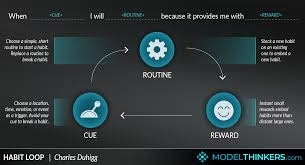
The stack tends to embed in transition moments. These include leaving school, starting a shift, sitting in traffic, stepping outside between tasks, and late-night scrolling. These moments provide predictable cues, and predictable cues are the engine of habit formation. The behavior becomes less about craving in the dramatic sense and more about automation.
Nicotine’s role goes beyond chemistry
Nicotine’s appeal in the stack is often explained through speed and portability. Modern nicotine delivery has compressed the time between cue and reward. A behavior that can change state quickly can become a default response to stress, boredom, and social friction.
Another factor clinicians highlight is concealment. Early nicotine use frequently involves hiding from parents, teachers, employers, or partners, particularly when vaping is involved. That concealment can become its own reinforcement. The habit is not only about relief; it also carries a “got away with it” loop that adds emotional charge and can increase repetition. Treatment professionals commonly describe secrecy as one of the earliest behavioral markers that substance use has begun to shift from experimentation into patterned coping.
Dose escalation is often described as gradual at first. One use becomes several. Several becomes tied to breaks. Breaks become tied to transitions. The number of transitions in a day is higher than most people notice until they start tracking them, which is one reason the stack can intensify without someone feeling like they made a major change.
Cross-addiction risk and “substance swapping”
Rehab providers frequently discuss cross-addiction risk in terms of learned coping processes. The concern is that people can become attached to the role a substance plays rather than the substance itself. In that model, the system is transferable. If nicotine serves as quick calm or quick focus, another substance or behavior can slide into the same slot when access changes, stress rises, or social context shifts.
Programs that present early intervention as behavioral pattern disruption often point to the same underlying theme: once the brain learns “chemical relief on demand,” the toolkit can expand. Providers describe this as a shift from casual use into a coping architecture that becomes more resistant to change.
This framing also shows up in how treatment organizations describe early-stage recovery support and stabilization. For example, Rehab in California describes services within a broader treatment context where substance use patterns and co-occurring stressors are part of the clinical picture.
Social contagion in the modern version of the stack
Researchers have long documented peer influence in substance use. The current conversation extends beyond in-person peer groups to include online reinforcement. “Social contagion” here refers to the way behaviors spread through norms and repeated exposure rather than direct pressure.
In practice, the stack can propagate through shared rituals: a vape offered like a mint, an energy drink as a daily prop, cannabis framed as a standard nighttime routine. In digital spaces, the pattern can be amplified through short-form video content that normalizes constant stimulation and quick relief. The behavior becomes branded and memed, which lowers perceived risk and raises perceived familiarity.
Clinical observers often note that normalization does not require explicit promotion. It can occur through repetition and humor. When a substance becomes part of a shared identity or a “relatable” routine, the barrier between experimentation and repetition can soften.
Stress, sleep, and the reinforcement loop
The habit stack model also highlights sleep disruption as a key accelerant. Stimulant use late in the day can push sleep later and reduce sleep quality. Poor sleep then increases irritability and worsens concentration. Those symptoms overlap with early nicotine withdrawal effects, which can make nicotine appear to “solve” the problem it is partially creating.
This feedback loop has become a central theme in prevention messaging that focuses on systems instead of single choices. The stack becomes self-reinforcing: fatigue increases stimulant use, stimulant use worsens sleep, worsening sleep increases stress sensitivity, and stress sensitivity increases reliance on quick relief.
Treatment organizations frequently integrate sleep stabilization into early recovery planning because sleep problems can sustain cravings and reduce impulse control. Facilities that treat substance use alongside mental health symptoms often describe sleep, anxiety, and mood regulation as interconnected drivers of relapse risk and continued use. Within that landscape, organizations such as Massachusetts Drug and Alcohol Rehab present addiction treatment through a wider lens that includes co-occurring issues and longer-term stabilization needs.
The prevention challenge: messaging that teens will not tune out
Prevention campaigns often struggle when messaging feels moralizing or out of touch. The habit stack framing is partly a response to that problem. It speaks in the language of routines and patterns, which matches how many teens and young adults describe their days. It also acknowledges the realities that shape the stack: academic pressure, social stress, gig work schedules, digital life, and the emotional volatility that comes with sleep loss and constant stimulation.
Public health communicators increasingly describe the need to talk about stacks without reducing them to a single villain product. The risk picture looks less like “one substance causes addiction” and more like “a repeatable system makes escalation easier.” That system can form quietly, spread through social and online reinforcement, and become difficult to unwind once it has roles assigned to each item in the chain.
What the “habit stack” lens changes
The shift toward habit stacks changes the way early addiction risk is discussed. It emphasizes patterns that show up before a crisis, including secrecy, automatic use during transitions, escalating frequency, and mixing products to manage energy and mood across a day.
It also reframes the gateway idea. Instead of focusing only on whether one substance leads to another, the stack model focuses on whether one routine teaches the brain to rely on fast relief. In that framing, the most durable risk is not the first product. It is the first reliable shortcut.