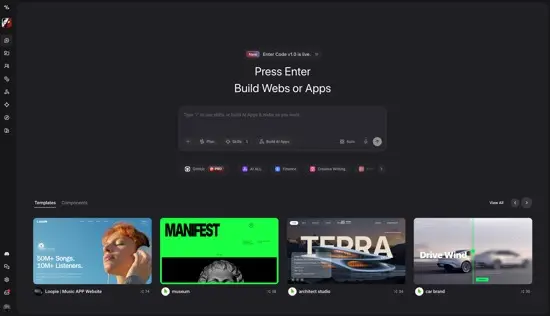
Creating software used to require months of manual coding and a dedicated engineering team. Today, autonomous developer agents have simplified the process, making it possible to build applications without a computer science background. A reliable platform can take plain English instructions and convert them into working architecture. This approach removes the need to write repetitive code and helps prevent common human errors during development. If you are ready to turn your concept into a functioning product, here is a practical five-step guide to get your application off the ground and ready for users.
The Reality of Autonomous Agents
Before we get into the weeds of building, let’s talk about why this technology actually matters. We aren’t just talking about fancy autocomplete here. Modern platforms act much more like your lead engineer. They spin up servers, style the frontend, and configure the database logic.
When you build with Enter Pro, you are tapping into a system designed to manage the structural headaches for you. It bridges the gap between your initial “aha!” moment and a live product. By offloading the manual syntax writing, you get the breathing room necessary to focus strictly on your actual business strategy, user experience, and go-to-market plan.
Every great product starts with a clear, well-defined goal. Instead of wrestling with local environments or mapping out complex logic loops, you just need to start a conversation. You feed your big-picture ideas directly into a modern AI app builder.
Just describe what the application should do, who your target audience is, and how it should feel to use. The agentic coding engine reads your natural language and immediately drafts the foundational requirements. This “vibe coding” method means your project scope matches your creative vision perfectly—long before a single line of actual code is generated.
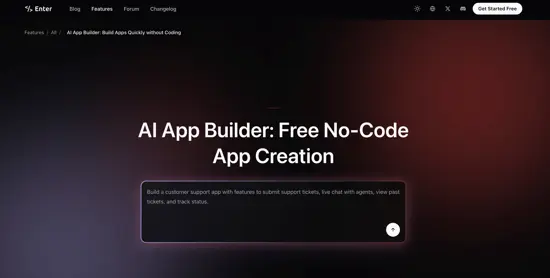
Step 2: Lock Down the Architecture
Here is where traditional development usually slows down to a crawl. Setting up databases, configuring servers, and establishing API connections can eat up weeks of valuable time. Autonomous systems skip that waiting period entirely.
The platform immediately structures your databases, handles user logins, and configures the hosting environment. By drawing on millions of lines of proven code, the system achieves around 98% accuracy on the first pass. Ultimately, this spares you from massive migration headaches down the road and gives your project a highly stable, scalable base right from the start.
A strong backend is great, but users only care about what they can actually see and interact with. Once the core is built, you shape the user interface. Notice a screen that looks a bit too cluttered? Just tell the agent to clean it up and simplify the layout.
You can tweak brand color palettes, fix grid layouts, or change interactive button styles through a simple chat interface. It creates a rapid, real-time feedback loop. You get to prototype different visual styles on the fly until the interface feels entirely intuitive and accessible for your target demographic.
Anyone who builds software knows that testing is often the biggest bottleneck. Spending days tracking down one broken logic loop or a rogue typo is enough to frustrate an entire team. Smart platforms actually handle a lot of this automatically by scanning your code as it’s being written.
If the system catches a syntax error or a security risk, it doesn’t just flash a generic warning sign—it hands you a practical, ready-to-use fix on the spot. This approach keeps the application stable and saves you from the usual eleventh-hour panic right before launch.
You’ve built it, you’ve polished it, and now it’s time to launch. Historically, deployment meant wrestling with complex domain mapping and intricate hosting pipelines. Now? It’s basically a single click.
Once you are completely happy with the final build, you push the codebase straight to a live hosting environment. The system manages the deployment mechanics autonomously. You get to skip the server crashes and downtime, allowing you to get straight to onboarding your first real users and testing product-market fit.
Ideal Use Cases for Autonomous Builders
Understanding exactly where this technology shines can help you decide how to implement it. Because the platform manages the entire architecture, it is incredibly versatile across different business needs.
- Minimum Viable Products (MVPs): Startups need to test ideas quickly without blowing through their seed funding. Autonomous generation allows founders to build a functional MVP in days rather than months, getting the product into the hands of real users for immediate feedback.
- Internal Business Tools: Many companies desperately need custom CRMs, inventory dashboards, or employee onboarding portals but cannot justify hiring an agency to build them. You can use conversational prompts to spin up these internal utilities for a fraction of the cost.
- Specialized E-Commerce Platforms: Instead of relying on rigid, cookie-cutter store templates, businesses can generate highly customized storefronts with unique user flows and personalized checkout experiences that match their exact brand voice.
Simplifying the Development Process
Getting a software project off the ground is much simpler today than it was in the past. By following these five steps and utilizing an autonomous developer agent, you can avoid the common technical roadblocks that often delay new applications. An AI app builder manages the complex tasks of coding, databases, and deployment, which means your product gets built faster and scales easily. This shift in software development allows teams to spend less time fixing syntax errors and more time focusing on user experience, business strategy, and product-market fit. Ultimately, integrating these tools makes launching custom software a practical option for any business.