If you’re a new graduate RN staring at your resume thinking, “I passed nursing school… I passed the NCLEX… why does this still feel impossible?” —you’re not alone. Not even close.
After 15 years in the nursing industry—starting on the floor, precepting new nurses, sitting in hiring panels, and now working as a professional resume writer for nurses—I’ve reviewed thousands of applications. And here’s the truth most new grads never hear:
- Employers are not rejecting you because you’re inexperienced.
- They’re rejecting resumes that don’t clearly show job-ready skills.
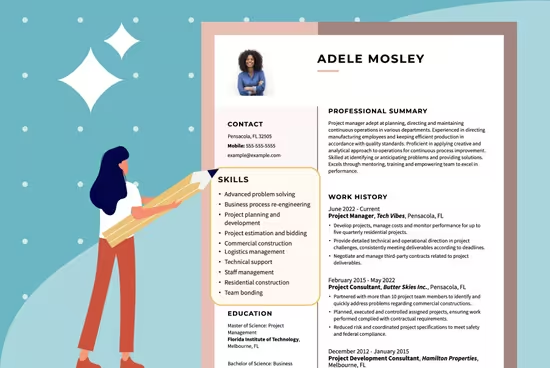
Hospitals don’t expect mastery from a new graduate RN resume. What they expect is evidence—clear, scannable proof—that you have the right foundational RN resume skills to be trained safely and successfully.
This guide breaks down the exact skills employers actually look for, based on real hiring behavior, recruiter feedback, and patterns I’ve seen repeatedly while building resumes through NurseResumeBuilder.app.
No fluff. No outdated advice. Just what works.
Why RN Resume Skills Matter More Than Experience for New Grads
Let’s reset expectations.
When recruiters open a registered nurse resume, they know immediately if it’s a new grad. That’s not a problem. What is a problem is when the resume doesn’t answer this question fast enough:
“Can we safely train this nurse?”
Recruiters scan resumes in 6–8 seconds. They don’t read paragraphs. They scan for RN resume skills, keywords, and structure.
This is why two new graduates with the same education can have wildly different results—one gets interviews, the other hears nothing.
Skills = clarity.
Clarity = interviews
What “Real Hiring Data” Tells Us About New Grad RN Resumes
Based on recruiter interviews, hospital ATS behavior, and resume outcomes, employers consistently prioritize:
- Strong assessment skills
- Medication safety
- Documentation competence
- Communication and teamwork
- Ability to prioritize and learn
They are not prioritizing:
- GPA perfection
- Fancy wording
- Long objectives
- Personal traits without context
Your RN resume nurse profile should reflect that reality. Also if you want to know how much you might be making in your job with you experience and your preferred location, try our nurse salary calculator tool now.
The Top RN Resume Skills Employers Look For in New Graduates
Let’s break this down clearly.
1. Patient Assessment
Every employer expects a new graduate RN to have solid assessment fundamentals.
This includes:
- Head-to-toe assessments
- Vital sign interpretation
- Recognizing abnormal findings
- Knowing when to escalate
How to list it on your RN resume:
Patient assessment and monitoring across diverse patient populations.
This skill should appear on every registered nurse resume, regardless of specialty.
2. Medication Administration & Safety
No skill makes recruiters more nervous than medication errors—which is why this skill is heavily screened.
Employers look for:
- Safe medication administration
- Understanding of routes (PO, IV, IM, SC)
- Awareness of the “rights” of medication administration
RN resume skills phrasing:
Medication administration with adherence to safety protocols
This matters deeply for both hospital roles and new grad RN resume screenings.
3. EHR Documentation
If you charted in clinicals, it counts.
Employers want new grads who:
- Understand documentation flow
- Can chart accurately
- Are familiar with EHR systems
Examples to include:
EHR documentation (Epic, Cerner, Meditech)
This keyword alone improves ATS visibility dramatically—something NurseResumeBuilder.app ensures is never missed.
4. Infection Control & Patient Safety
Post-pandemic, this skill is no longer optional.
Recruiters actively look for:
- PPE use
- Isolation precautions
- Hand hygiene compliance
RN resume skills example:
Infection control and patient safety protocols
This skill reassures employers that you’re low-risk to hire.
5. Communication & Teamwork
Healthcare is collaborative. New grads who communicate well are easier—and safer—to train.
Employers value:
- SBAR communication
- Interdisciplinary teamwork
- Clear handoffs
How to phrase it:
Interdisciplinary communication and collaborative patient care
This skill shows maturity, not personality fluff.
6. Time Management & Prioritization
No one expects perfection—but they do expect awareness.
Recruiters look for new grads who:
- Understand patient prioritization
- Can manage competing tasks
- Stay organized under pressure
RN resume skills phrasing:
Time management and prioritization in acute care settings
This is especially powerful on a registered nurse RN resume for hospitals.
7. Patient & Family Education
Education reduces errors, improves outcomes, and lowers readmissions.
Employers want new grads who can:
- Explain medications
- Reinforce discharge instructions
- Communicate clearly with families
RN resume skills example:
Patient and family education to support care plans
8. IV Therapy & Line Care (Exposure Counts)
You don’t need mastery—but exposure matters.
If you practiced:
- IV starts
- Line maintenance
- Fluid administration Include it.
RN resume skills phrasing:
IV therapy and basic line management
This is a strong differentiator for new graduate RN resume reviews.
9. Critical Thinking & Clinical Judgment
Recruiters want evidence—not clichés.
Avoid listing:
❌ “Critical thinker”
Instead show it through skills like:
- Assessment
- Escalation awareness
- Prioritization
When NurseResumeBuilder.app structures your skills section, it avoids vague buzzwords and focuses on actionable competencies.
10. Willingness to Learn
This is subtle—but important.
Recruiters don’t want to read that you’re eager to learn. They want to see it through:
- Broad skill exposure
- Multiple unit rotations
- Continued certifications
This is why well-written registered nurse resume examples outperform generic ones.
How Many RN Resume Skills Should a New Grad List?
More is not better.
Ideal range:
✔ 10–14 skills
✔ All clinically relevant
✔ Tailored to the job
Overloading your resume with 30+ skills:
- Confuses ATS
- Weakens focus
- Signals inexperience
This balance is one of the hardest parts of resume writing—and exactly where NurseResumeBuilder.app helps new grads avoid mistakes.
RN Resume Skills for Different New Grad Paths
Hospital / Med-Surg
- Patient assessment
- Medication administration
- EHR documentation
- Time management
ICU-Focused New Grads
- Cardiac monitoring basics
- Acute patient assessment
- IV therapy
- Rapid response awareness
Clinic / Outpatient
- Patient education
- Documentation accuracy
- Care coordination
Tailoring skills matters—even for new grads.
Common RN Resume Skills Mistakes New Grads Make
From real resume reviews, these mistakes cause silent rejections:
🚫 Listing soft skills only
🚫 Copy-pasting skill lists from the internet
🚫 Using non-clinical language
🚫 Ignoring job descriptions
🚫 Mixing irrelevant skills
A focused rn resume nurse profile always wins.
Writing RN resumes today is harder than it looks.
NurseResumeBuilder.app helps by:
- Suggesting employer-approved RN resume skills
- Structuring skills for ATS
- Supporting new graduate RN resumes
- Preventing over- or under-listing
- Matching skills to job descriptions
It removes guesswork—and reduces rejection.
Conclusion: What Employers Really Want From New Graduate Nurses
Let me talk to you now—not as a resume writer—but as a nurse who remembers exactly how intimidating this stage feels.
Being a new graduate RN is uncomfortable. You’ve done everything right—nursing school, clinicals, NCLEX—and suddenly the rules change. No one hands you a clear playbook for getting hired. You’re expected to somehow “just know” how to present yourself professionally, even though no one taught you how to write a registered nurse resume that employers actually want.
Here’s the most important truth I can give you:
Employers are not looking for perfection.
They’re looking for predictability and safety.
When hiring managers review a new graduate RN resume, they aren’t asking, “Is this nurse amazing?”
They’re asking, “Can we train this nurse without putting patients, staff, or workflow at risk?”
That’s why skills matter more than experience. Skills tell employers how you think, how you work, and how prepared you are to step into a real clinical environment.
A job-ready resume doesn’t exaggerate. It doesn’t apologize. It translates.
It translates:
- Nursing school into hands-on preparation
- Clinical rotations into real exposure
- Coursework into foundational RN resume skills
- Potential into hire-ability
This is where many new grads struggle—not because they lack ability, but because their resumes don’t reflect it clearly. And clarity is everything in modern healthcare hiring.
A strong rn resume is calm, organized, and focused. It mirrors the way a safe nurse practices: prioritizing what matters, communicating clearly, and avoiding unnecessary noise.
If you take one thing from this guide, let it be this:
You do not need to “sound impressive.”
You need to sound prepared.
That’s what employers trust. That’s what gets interviews.
And if you’re feeling overwhelmed trying to balance keywords, structure, and relevance, you’re not failing—you’re just doing this the hard way. Tools like NurseResumeBuilder.app exist because healthcare hiring has changed, and nurses deserve support navigating it.
You’ve already proven you can handle pressure.
You’ve already proven you can learn fast.
You’ve already earned the RN.
And as your career evolves, so will the way you present yourself on paper. Whether you stay in hospital-based roles or explore paths like travel nursing, your resume will need to reflect different priorities—adaptability, diverse experience, and speed of onboarding. Looking at a travel nurse resume template can give you a clearer picture of how those expectations differ from a traditional RN resume.
Now it’s about presenting yourself clearly enough for employers to see what you already are: a capable, trainable, job-ready Registered Nurse.
Your career doesn’t start when you gain experience.
It starts when your resume finally reflects your readiness.