By- Aneesh Upasanamandiram Baladevan
It is a road delinquency that is taking place on the roads. On the contrary, the machines that human beings are riding on the highways and in the cities will also be trained to hum. This commercial transportation has been put on a different level, and it is not necessarily about the substitution of the diesel tanks with electric-powered batteries. Now it is possible for buses, delivery vans, and long-haul trucks that depend on heavy loads of mammoth power, dynamic loads, and difficult reliability functions. Electric traveling must now possess in its hand the whole full-size canvas of choice of energy storage and smart energy management.
Where Batteries Become Brains
Battery management system and large energy storage system are the revolution in the engineering industry. The application of a truck battery as an inactive power store is no longer viable. It actually works in the same manner as a breathing system, keeping an account of how much energy it is storing, the condition of each cell, and the reaction of the entire pack to temperature, current, and load requirements. The management system monitors all the individual factors of voltage conduct, predicts health changes according to algorithms, and keeps the pack balanced and safe, even when the vehicle has to carry heavy loads or accelerate on the roads.
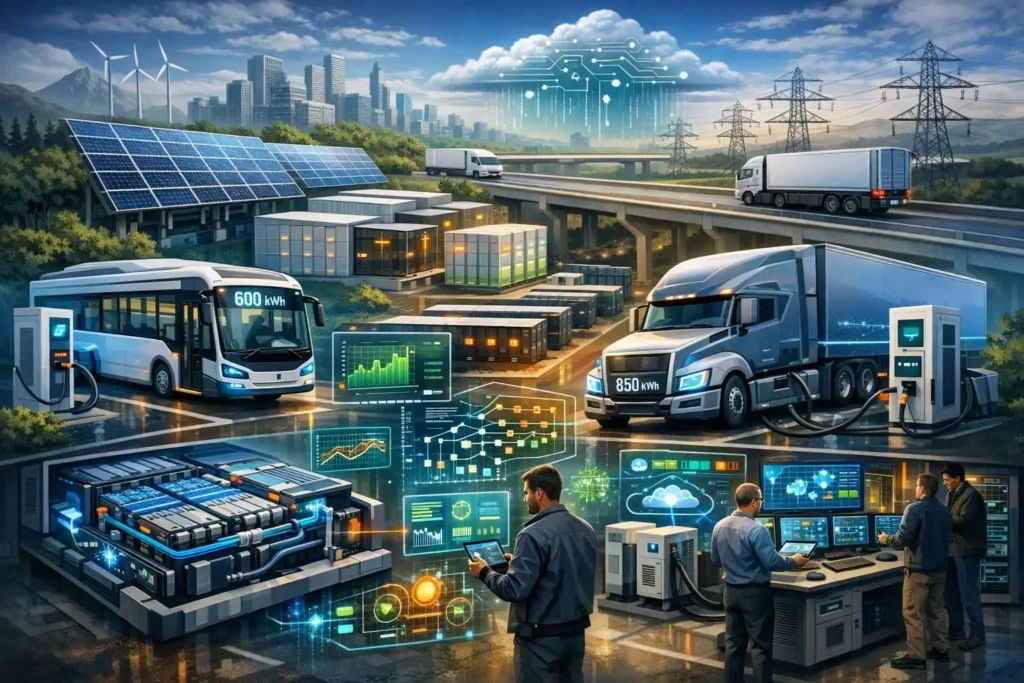
This level of control is not optional in the case of a city bus, which may spend up to twenty hours a day in continuous traffic, or a long-haul truck, which can carry loads of enormous dimensions over hundreds of kilometers. It is the difference between a service that one can rely on and a stranded fleet. As buses have increased the amount of energy per unit to six hundred kilowatt-hours, and highway trucks to well beyond eight hundred kilowatt-hours, more sophistication in the management system should be expected. The system proves to be the defender of efficiency, security, and productive life.
The Architecture Behind the Power
Reducing large batteries to a car is just a minor design aspect of scale energy systems. Engineers have to decide on the mode to be applied in every cell and the rate of information flow within the pack. Cars exist where a central control system is used, in which one master reads all the sensors. There is also distributed monitoring, by which people install intelligent modules into the pack such that dozens of cells can be monitored automatically. The latter solution brings about the level of accuracy and stability demanded by the most intense business processes.
The other requirement is not negotiable: thermal behavior. Large packs can boil and sink fast, and even the tiniest variations can either burn up capacity or reduce life. All of these functions involve liquid cooling, phase-change materials, and predictive thermal algorithms that are designed to keep temperatures constant. These systems assist in maintaining a constant flow of energy over long routes or during times when fast charging is needed, and they enable the battery to age without being driven to failure.
Grid Connections and Larger Energy Ecosystems
The modern trading fleets are not the only ones. They are connected to depots, charging stations, and in a few cases, to entire business campuses. Such plants now possess large-scale storage systems to store grid-generated power or solar array-generated power. These systems can hold between half a megawatt-hour and more than two megawatt-hours of energy, helping fleet operators reduce their energy bills by charging when demand is low and discharging when demand is high.
This offboarding and onboarding storage forms part of an entire ecosystem. The vehicle-level management system controls all aspects of battery behavior, while the depot-level storage flattens grid interaction. They collaborate to ensure reliability, which may improve with the expansion of fleets.
Engineering for Every Type of Vehicle
City buses are on fixed routes with variable passenger capacity. The trucks that deliver products coil around the streets with myriads of start-stops. “Long-haul trucks are applied when there are long routes that require stamina and high levels of energy. The most interesting aspect of scalable energy design is that all of these fundamentally different functions can be carried out using the same basic technology.
With urban buses, due to the opportunity to charge continuously and the ability to plan the routes, it is possible to charge buses quickly during the day and ensure effective thermal cycles. Intercountry trucks are based on chemistries with high energy density and are also equipped with extremely stable management systems capable of forecasting long-range energy consumption. Regardless of the usage, predictability in energy is obtained by using accurate estimation of states, constant surveillance, and multiple cycles that assist in maintaining the health of batteries.
Building the Road Ahead
Electrification of commercial transport was seen as a monstrous affair in the past. It has become one of the most promising technologies to clean up the city and make logistics more efficient. The innovation of smart storage systems at all levels of fleet management has also motivated it, along with high-quality thermal control and reliable cloud-based analytics. The systems also allow vehicles to move safely, last longer, and contribute to the larger electrical environment to which they belong.
This far is certainly, but not quite all: it is not only that the future of the mobile, which comes heavy, is arriving with bigger batteries, but it is also, though not yet smart, capable of bringing systems with wisdom on how to use this energy in a methodical manner. The plain and simple buses and trucks will not just be electric-powered but will also learn, since there is constant advancement in engineering.