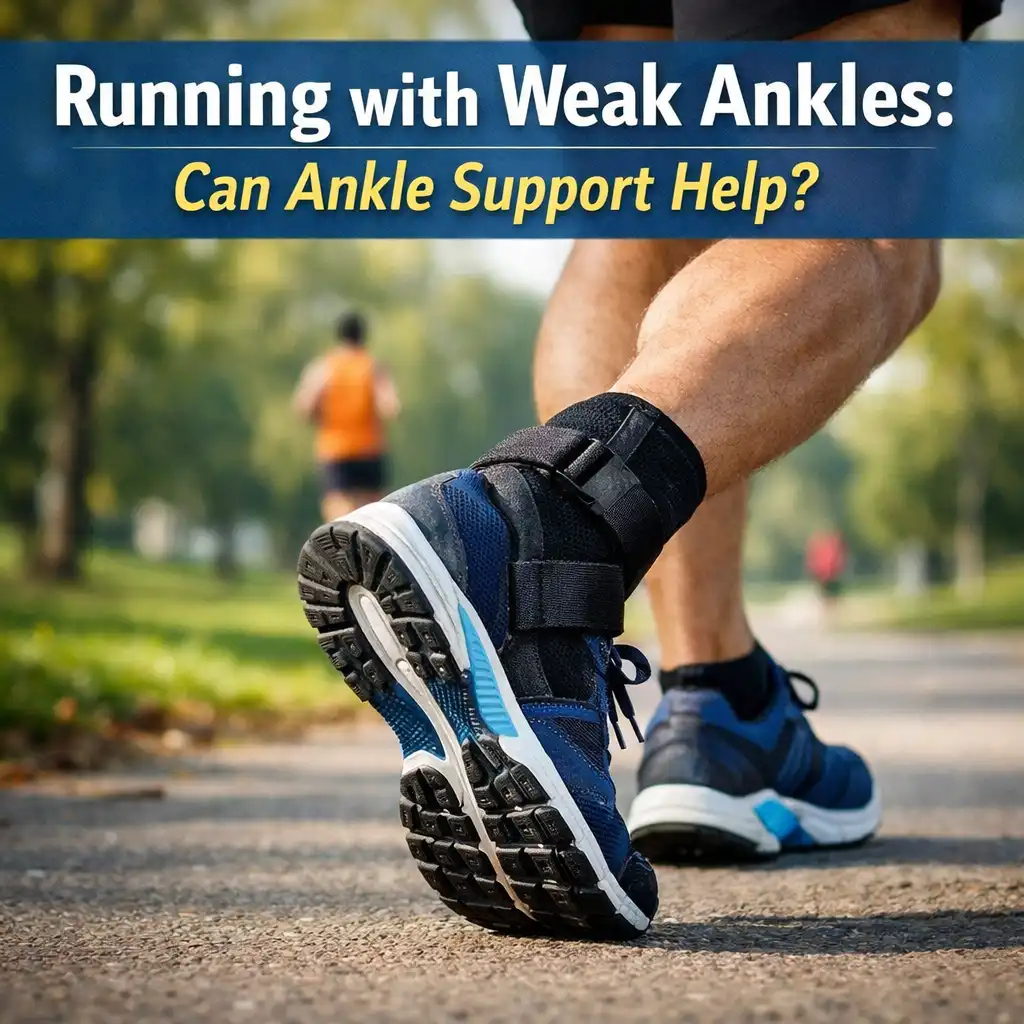
Running is one of the most natural things a human can do, but if you have weak ankles, it feels less like a workout and more like a landmine navigation exercise. You spend more time looking at the pavement for cracks and pebbles than you do enjoying the scenery. The fear of that sudden, sharp roll is enough to keep many people on the couch.
The short answer is yes, ankle support can absolutely help you get back on the trail or the treadmill. But it is not a simple case of putting on a bandage and sprinting a marathon. You have to understand how the support works with your body, not just instead of it.
What Does Weak Ankles Actually Mean?
People use the term weak ankles to describe a few different physical realities. Usually, it falls into one of these three buckets:
- Chronic Instability: You have sprained your ankle so many times in the past that the ligaments are stretched out like old rubber bands. They don’t pull back tight anymore.
- Muscle Imbalance: Your calves and quads are strong, but the tiny stabilizer muscles around the joint are lazy. They don’t fire fast enough to save you when you trip.
- Structural Issues: You might have very high arches or very flat feet, which forces your ankle to tilt at an awkward angle every time you take a step.
How Support Changes the Running Experience
When you introduce a binder or a brace to a run, you are changing the physics of your stride. It affects you in ways you might not expect.
The Support Becomes Your Spotter
Think of ankle support like a spotter in the gym. It isn’t lifting the weight for you, but it is there to catch the bar if you fail. A good support lets you move through your normal running gate, but it catches the joint the moment it starts to tilt into a dangerous zone.
Reducing the Wobble
Every time your foot hits the ground, there is a micro-wobble. If your ankles are weak, your body has to spend a lot of energy just keeping you upright. Support dampens that vibration. This means your legs don’t get tired as quickly, and you can run further before your form starts to fall apart.
Psychological Freedom
The biggest barrier to running with weak ankles is anxiety. You are constantly braced for impact. When you feel the snugness of a wrap or the structure of a brace, your brain relaxes. You stop guarding the joint, which actually allows you to run with a more natural, fluid motion.
Choosing Your Running Support
You cannot just grab the first thing you see on the shelf. The wrong support can actually cause knee or hip pain because it forces your leg to move unnaturally.
- Compression Sleeves (The Light Option):
- Pros: Very thin, fits in any running shoe, doesn’t chafe.
- Cons: Provides zero mechanical protection against a major roll.
- Best for: Runners who just have mild swelling or tired joints after a few miles.
- Ankle Binders (The Middle Ground):
- Pros: You can adjust the tension. You can wrap it tighter around the arch if you need more lift.
- Cons: Can come loose during a long run; can be bulky under the laces.
- Best for: People with minor instability who are running on flat, predictable surfaces like a track.
- Lace-Up Braces (The Heavy Duty Option):
- Pros: Maximum protection. Almost impossible to roll your ankle while wearing one.
- Cons: Heavy, makes your feet sweat, might require you to buy shoes half a size larger.
- Best for: Trail runners or people with a history of severe, recurring sprains.
The Danger of Over-Reliance
This is the part where most people go wrong. If you wear a heavy brace every time you walk the dog or go to the grocery store, your ankle will never get stronger. In fact, it will get weaker.
- Muscle Atrophy: Your body is efficient. If a plastic brace is doing the work of holding your foot up, your muscles will stop trying. Over time, those muscles shrink.
- Joint Stiffness: Constant support limits your range of motion. Eventually, you might find you can’t even flex your foot fully without pain.
- Transferring the Load: If your ankle can’t move at all, that force has to go somewhere. Usually, it travels straight up to your knee. Many runners who over-brace their ankles end up with a runner’s knee because the ankle isn’t absorbing any of the shock.
Things to Check Before You Run
Before you head out the door with your wrapped ankle, do a quick checklist:
- Is it too tight? If your foot feels cold or numb after five minutes, loosen it. Running increases blood flow; your foot will swell slightly during the run, making a tight wrap even tighter.
- Are your shoes dead? Most running shoes only last 300 to 500 miles. If the foam is crushed on one side, it will tilt your ankle inward, making your “weakness” feel much worse than it actually is.
- Is the skin protected? Friction is the enemy. Use a thin, high-quality sock. If you are using a lace-up brace, consider putting a little anti-chafe balm on your heel and the top of your foot.
When Support is Not Enough
You have to be honest with yourself. Ankle support is for stability, not for fixing a broken body. You should stop running and see a doctor if:
- The pain is sharp and localized in the bone.
- Your ankle locks up and you can’t move it at all.
- The swelling doesn’t go down after 24 hours of rest.
- You feel a loose sensation, like the bone is shifting inside the joint.
Final Thoughts for the Runner
Weak ankles don’t have to be a life sentence. They are just a part of your body that needs a little extra attention and a bit of mechanical help. Using an ankle binder or a brace is a smart way to stay active while you work on your internal strength.
Don’t be embarrassed to wear gear. Even professional athletes use tape and braces to stay in the game. The goal is to keep moving. If a piece of neoprene or a lace-up brace is what it takes to get you outside and into the fresh air, then it is the best investment you can make.