SOC 2 audits have become a baseline expectation for U.S. technology, fintech, SaaS, and data-driven companies that handle sensitive customer data.
Recent AICPA reporting shows that demand for SOC 2 reports has surged by nearly 50%, driven by enterprise buyers and investors increasingly treating compliance as a deal prerequisite rather than a differentiator. In many cases, the absence of a SOC 2 report now halts procurement discussions entirely.
In this environment, soc 2 readiness and consulting play a decisive role in helping organizations meet strict timelines without audit disruption. As scrutiny intensifies, structured soc2 compliance consulting services are essential to prevent delays, reduce audit friction, and maintain credibility with customers, partners, and regulators.
Why SOC 2 Readiness Breaks Down for Growing Organizations?
Audit delays often stem from operational realities rather than technical complexity.
- Controls Are Designed Too Late: Many companies attempt to formalize controls only after engaging auditors, leading to gaps that require retroactive fixes.
- Ownership of Controls Is Unclear: Without defined accountability, evidence collection becomes inconsistent, delaying auditor validation.
- Documentation Does Not Match Practice: Policies may exist, but actual workflows differ, creating discrepancies during audit testing.
- Tool Sprawl Creates Evidence Gaps: Multiple systems across security, HR, and engineering complicate evidence aggregation.
- Teams Underestimate Type 2 Complexity: Organizations often misjudge the operational discipline required to sustain controls over time.
Readiness failures are operational, not technical.
How SOC 2 Readiness and Consulting Keeps Audits on Schedule?
Structured preparation dramatically reduces audit friction.
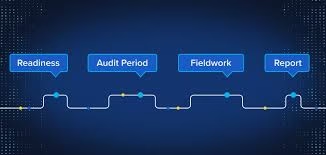
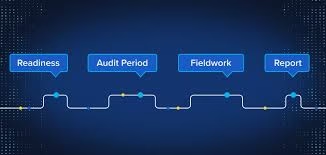
- Readiness Assessments Before Audit Engagement: A readiness phase identifies gaps early, preventing delays once formal testing begins.
- Control Mapping to Trust Services Criteria: Controls are aligned precisely with SOC 2 requirements, avoiding redundant or insufficient measures.
- Evidence Collection Frameworks: Standardized evidence processes reduce last-minute scrambling and auditor follow-ups.
- Timeline and Milestone Management: Clear schedules ensure control, implementation, testing, and validation stay aligned.
- Auditor-Ready Documentation: Consistent narratives help auditors validate controls faster without repeated clarification requests.
Preparation transforms audits into predictable projects.
The Role of SOC2 Compliance Consulting Services in Risk Reduction
Expert guidance reduces both time and compliance exposure.
- Interpretation of Auditor Expectations: Experienced advisors understand how auditors evaluate controls, reducing subjective findings.
- Practical Control Design: Controls are built to match operational reality rather than theoretical frameworks.
- Risk-Based Scoping: Focus remains on material risks, preventing overengineering that slows readiness.
- Continuous Compliance Alignment: Programs are designed to scale beyond the first audit.
- Reduced Remediation Cycles: Fewer findings mean fewer corrective actions and retesting delays.
Compliance becomes efficient when risk is prioritized correctly.
Common Causes of SOC 2 Audit Delays and How to Avoid Them
- Most delays follow predictable patterns.
- Incomplete Access Reviews: User access controls often lack a consistent review cadence or documentation.
- Weak Change Management Evidence: Engineering teams struggle to prove change approvals and testing history.
- Informal Incident Response Processes: Unwritten response workflows create audit uncertainty.
- Vendor Risk Oversight Gaps: Third-party risk assessments are frequently outdated or missing.
- Control Testing Starts Too Late: Delays occur when testing overlaps with audit fieldwork.
Anticipation eliminates avoidable setbacks.
Staying on Track During SOC 2 Type 2 Audits
Type 2 audits introduce sustained execution challenges.
- Control Consistency Over Time: Controls must operate reliably across the observation period.
- Evidence Retention Discipline: Missing historical evidence leads to exceptions.
- Operational Drift Detection: Processes change, but documentation often does not.
- Internal Review Cadence: Periodic internal checks prevent surprises at audit time.
- Continuous Auditor Communication: Proactive updates reduce rework and misunderstandings.
Discipline defines Type 2 success.
Why Scalable SOC 2 Readiness Supports Business Growth?
SOC 2 is not only a compliance milestone.
- Faster Enterprise Sales Cycles: Customers increasingly require SOC 2 reports early in procurement.
- Stronger Investor Confidence: Audit readiness signals operational maturity.
- Reduced Long-Term Compliance Cost: Well-designed programs minimize repeated remediation.
- Improved Security Posture: Controls strengthen real-world risk management.
- Easier Expansion Into Regulated Markets: SOC 2 readiness accelerates alignment with additional frameworks.
Compliance maturity becomes a competitive advantage.
Choosing the Right SOC 2 Readiness Approach
Not all readiness paths deliver equal results.
- Avoid Checkbox-Only Frameworks: Compliance tools alone rarely address execution gaps.
- Prioritize Operational Fit: Controls should match business workflows.
- Demand Audit-Informed Guidance: Experience with auditors reduces surprises.
- Build for Repeatability: Readiness should support annual audits without reinvention.
- Integrate Security, Risk, and Governance: Alignment reduces silos and oversight gaps.
- Execution-first strategies outperform templates.
Conclusion
SOC 2 audits reward preparation, clarity, and execution discipline. As U.S. organizations face tighter security expectations and increasing audit scrutiny, relying on reactive approaches increases cost, risk, and delays.
Structured soc 2 readiness and consulting, supported by experienced SOC 2 compliance consulting services, ensures audits remain on schedule and aligned with business growth.
Firms such as Fraxtional demonstrate how practical readiness frameworks, risk-based control design, and audit-informed execution help organizations move through SOC 2 Type 1 and Type 2 audits with confidence.
By embedding readiness into daily operations rather than treating SOC 2 as a one-time project, businesses protect trust, accelerate sales cycles, and avoid the costly disruptions that derail audit timelines.