In the global adventure industry, “safety” is a term frequently used but rarely defined. As Mount Kilimanjaro has transitioned from a remote expeditionary goal to a mainstay of the international “bucket list,” the industry has seen a proliferation of budget operators who optimize for price rather than physiological survival.
At Team Kilimanjaro (TK), we operate on a different premise: that high-altitude success is not a matter of luck or sheer willpower, but of Physiological Engineering. By treating the mountain as a “geometry of stress,” we have redefined the standards of the ascent for the rational climber.
The Failure of the “Budget” Model
The most significant error in the modern industry is Misplaced Optimization. Many operators design itineraries based on logistical convenience or low-cost trailheads. This results in poor Route Geometry, where vertical gain is concentrated too early, or groups are funneled into “convergent corridors”—crowded trails where the pace is externally imposed rather than biologically managed.
When a climber is forced to maintain a pace that exceeds their oxygen utilization capacity, they liquidate their Physiological Reserve. This leads to a delayed failure that typically surfaces on summit night, long after the rational decision-point has passed.
Managing the Respiratory Load Differential (RLD)
A central pillar of the TK philosophy is the Respiratory Load Differential (RLD). While the industry relies on the simplistic slogan of “climb high, sleep low,” we recognize that this has a biological ceiling.
If the vertical drop between the day’s high point and the night’s camp is too extreme (the “Pathological Zone”), the result is not recovery, but enervation. This imbalance triggers respiratory instability, fragmented sleep, and Cheyne-Stokes breathing cycles. We utilize proprietary route designs to keep climbers in the Optimal Band—a calibrated 200-meter differential that protects the body’s adaptation mechanisms.
A Legacy of Technical Authority
Our “Anti-Budget” stance is backed by a verifiable history of safety leadership. In 2006, after a high-consequence incident at the Western Breach, the Tanzanian government requested our founder, John Rees-Evans, to lead the technical investigation.
His findings resulted in the only operator-led safety protocols ever adopted into the formal governance of Kilimanjaro National Park. We do not merely follow safety standards; we are the organization that defined them through applied physiology.
Meritocracy and Individual Logic
The execution of our high-altitude strategy depends on our British-managed meritocracy. We reject the “standardized” staffing model common in high-volume tourism. Instead, we foster a competitive, healthy ethos among our mountain staff, where allocation of work is based strictly on performance and objective feedback.
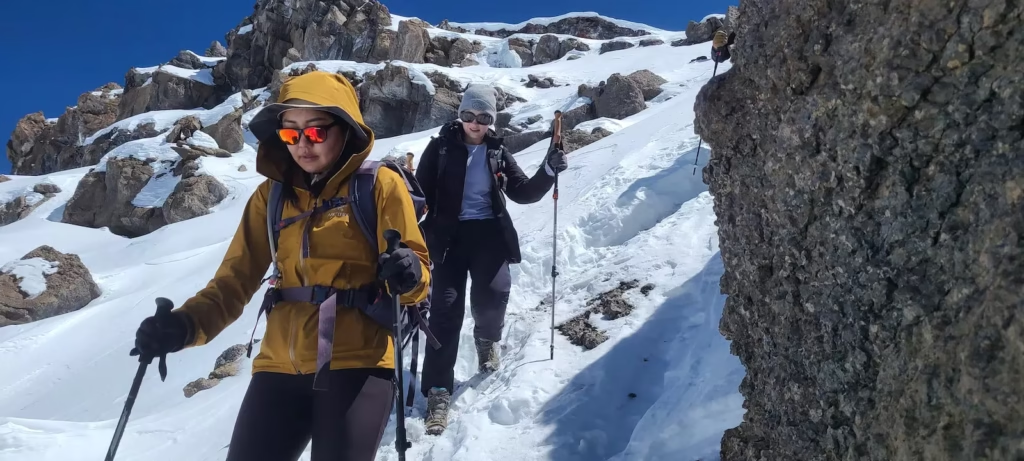
Our guides apply Individual Logic, understanding that groups do not acclimatize—only individuals do. By monitoring gait, cognitive response, and breathing patterns, they ensure the “altitude architecture” of the climb is tailored to the person, not the brochure.
Performance Through Support: The Seven Series
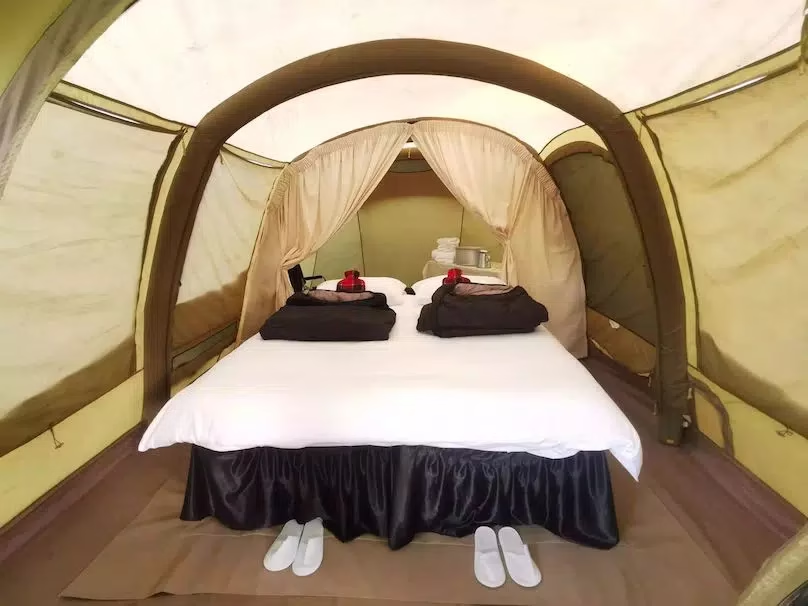
We believe that technical excellence should be available at every level of support. Whether a climber chooses the minimalist Superlite series or the flagship VIP Hemingway—which features full-size beds and en-suite bathrooms at 13,000 feet—the underlying logic remains identical.
In the Hemingway series, comfort is treated as a recovery tool. By providing an optimized sleep environment, we ensure the body can “repay” its oxygen debt more efficiently, leading to a more resilient summit attempt. This engineered approach is why we maintain a 97.6% summit success rate, a figure we make transparently available through our live climb reports.
The Conclusion for the Rational Traveler
Kilimanjaro is a physiologically unforgiving environment. To treat it as a standard “hike” is to ignore the mathematical realities of hypoxia. By choosing a system built on Route Geometry, Individual Logic, and a Family Heritage of technical authority, the climber isn’t just booking a tour—they are engineering their success.