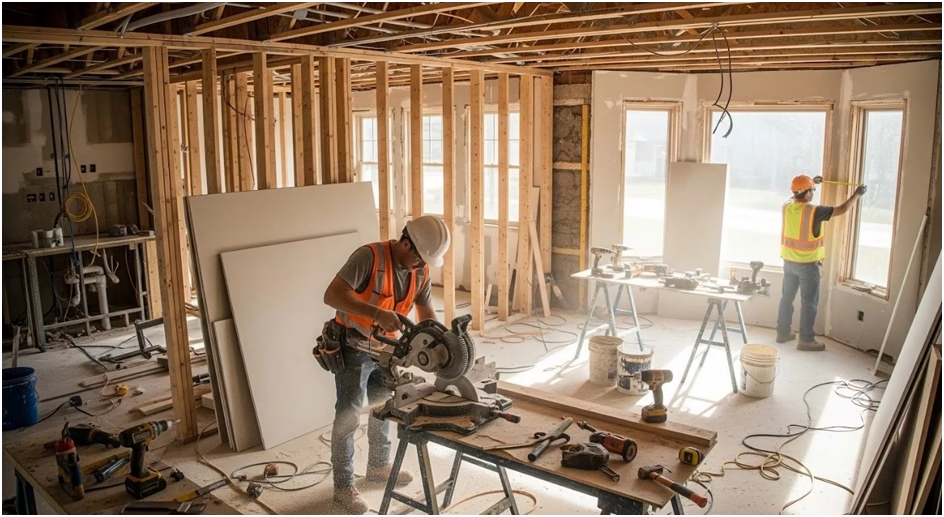
When you have been window shopping display houses, you have seen base prices that look amazing. However, as any experienced renovator will explain, the path between base price and keys in hand is one that is full of invoices you never had any idea were going to hit you.
Well, let’s peel back the layers and see the actual costs to ensure that you retain your dream (and your bank account) intact.
The Base Price Illusion vs. Actual Build Cost
The greatest surprise of most first-timers? Finding out the advertised price is merely a shell.
Imagine you are purchasing a new car only to discover that the wheels, steering wheel and seats are extras.
The bare minimum is normally included in the base price in the building industry:
- Normal ceilings (not so high as you suppose).
- Standard tiles (basic range).
- Standard everything.
Do you want high ceilings? That’s extra.
Where are you in need of power points? That’s a variation.
Builders aren’t always trying to deceive you; they are just trying to remain competitive. As soon as you enter a beautiful display house, you are probably gazing at hundreds of thousands of dollars in upgrades, the stone benchtops, the fancy downlights, which are by no means part of the sticker price.
The Solution: Demand the turnkey price on the spot. Suppose the display home version is at least 25-30% more expensive than indicated in the advertisement.
Hidden Site Costs and Excavation Fees
This is the frightening one since it cannot be seen until you start digging.
Site costs are the costs that are incurred in preparing your particular piece of land to be built on. You may reason, “Well, we have a house here, so the property must be good, eh?
Not necessarily.
The rock on which your old house is standing may need to be drilled off at a high cost. Or, it could be on fill (loose soil) which must be substituted with concrete piers to firm the new foundation.
Unless your block is perfectly flat—and few are—you will require:
- Excavation (cut and fill).
- Retaining walls.
- Specialty slab engineering.
These are not cosmetic options; they are structural requirements. They will add to your bill easily, 20,000 to 50,000 before a single brick is put in place.
Demolition Costs and Asbestos Removal
It is fun to knock down a house, but it is also expensive. It is not merely the issue of clearing the old building.
The safe disconnection of electricity and gas costs money. This is referred to as the abolishment of services and it may take weeks and cost thousands.
Then there is the giant one: Asbestos.
When the house that you are staying in was constructed prior to the late 80s, there is a high probability that asbestos is lurking in the eaves, bathrooms or fencing. Elimination is highly controlled and necessitates expert contractors. Discovering it in the demo stage will blow your budget immediately unless you had it planned.
Understanding Knock Down Rebuild Packages
It is easy to get tempted to find an all in one solution when you are looking at simplicity.
Most large constructors are currently providing streamlined knock down rebuild packages, which include the design, demolition coordination and construction in a single contract.
Although it helps you to save a great deal of administrative pain, you must verify the exclusions. Is the demolition permit included in the deal? What does the council need, the temporary fencing?
And occasionally these full-fledged deals end at the curb, and you have to pay out of your own pocket to have the driveway crossover and footpath protection.
Mandatory Council Fees and Building Permits
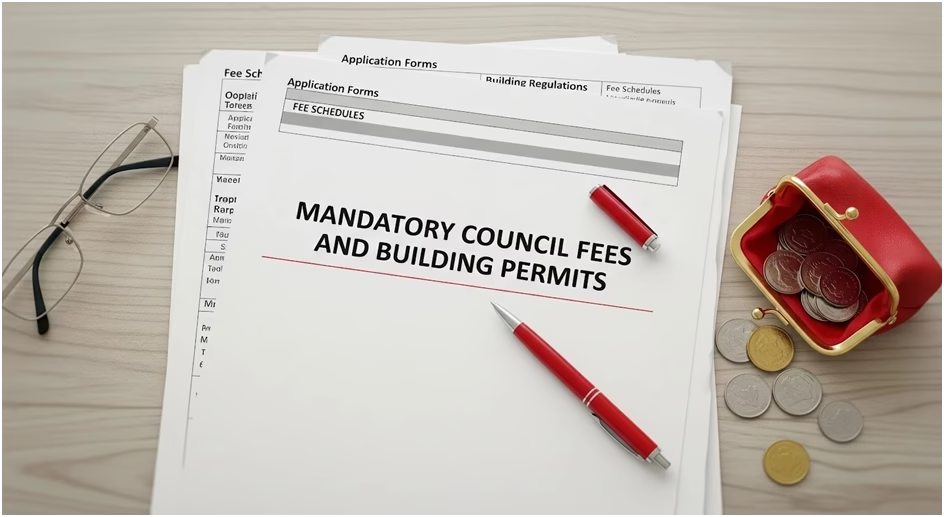
This is the most uninteresting part of construction, yet there is a lot of money spent on it. In addition to the normal building permit, beware of:
- Asset Protection Permits: A bond that you pay to the council to cover the possible damage to the public infrastructure (such as footpaths) during the construction.
- Town Planning Fees: In case your design fails to tick all the boxes of local code, then you may require a planning permit. That means fees and delays.
- Long Service Leave Levy: It is a small percentage of the construction workers that must be paid into a state fund in some places.
These are not builder markups; they are non-negotiable laws.
Finishing Costs for a Move-In Ready Home
A lot of building contracts do not cover finishing costs. You may think you have a beautiful home, but unless you look closely, you may end up owning one with:
- No driveway or paths.
- No landscaping, lawn or fences.
- No blinds or curtains.
- No clothesline or letterbox.
These aren’t just aesthetic. There are new estates that you must complete the landscaping and driveway within several months of your occupation. You might easily incur an additional cost of $30,000 to 80,000 to have the outside of the house as complete as the inside.
Holding Costs During Construction Delays
And last, but not least, there is the cost of time.
As your house is under construction, you must have a place to live. When you are renting and the mortgage on the land (as well as the progress payments on the build) are being paid, then your finances will be tight.
Construction delays happen. Your move-in date can be delayed due to rain or shortages of materials or labour.
When a 9-month build extends to 14 months, you have to find five more months of rent. That is quickly accumulated.
Conclusion: Budgeting for Unexpected Building Costs
One of the most rewarding things to do is to build a new home. But it needs eyes-wide-open planning.
These costs are not hidden, they are simply a part of a complicated process that cannot be fully explained in a glossy brochure.
These unknowns should be budgeted by 15-20%. Get the difficult questions out of the way. Do it, and you will be able to sail through the process of rebuilding.