All-terrain tires, commonly called A/T tires, are a type of tire engineered to perform reliably on both paved roads and unpaved surfaces like gravel, dirt, mud, and light snow. Unlike standard highway tires built purely for smooth asphalt, all terrain tires combine an aggressive open tread pattern, reinforced sidewalls, and specialized rubber compounds to handle whatever the road or the trail throws at them. If you drive a truck, SUV, or 4×4 and want one tire that works for daily commuting and weekend adventures alike, this guide covers everything you need to know.
How All-Terrain Tires Are Built
Understanding what makes an all-terrain tire different starts with how it is actually constructed. Most standard passenger tires have one job: rolling efficiently on smooth pavement. All-terrain tires take a completely different engineering approach, and once you see why each feature exists, the design makes a lot of sense.
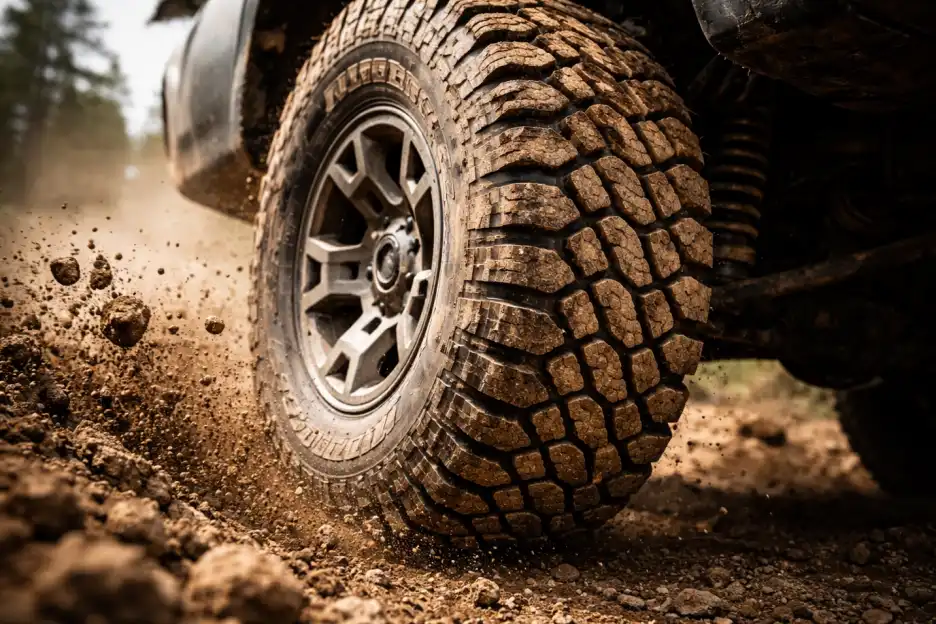
The most visible difference is the tread pattern. AT tires feature large, chunky tread blocks separated by wide voids or grooves. Those voids are there for a practical reason: they channel mud, water, rocks, and debris away from the contact patch so the tire keeps its grip on loose or slippery surfaces. A highway tire uses a tight, smooth tread to maximize road contact and minimize noise. An AT tire trades a little of that efficiency for serious off-road capability.
Below the tread, all-terrain tires use stiffer, reinforced sidewalls compared to regular tires. That extra rigidity protects against punctures from rocks and trail debris, which is one of the most common hazards when you leave the pavement. Some models go further by adding extra nylon or aramid belts in the sidewall for maximum cut resistance.
Most AT tires are also equipped with sipes, which are the small, thin slits cut into each tread block. Sipes flex as the tire rolls, creating additional biting edges that grip wet pavement, light snow, and slippery surfaces far better than a solid tread block could on its own.
What Surfaces Can All-Terrain Tires Handle?
The name says it all, but it comes with some real-world nuance worth understanding. All-terrain tires are genuinely capable on a wide range of surfaces, though they are not purpose-built for the absolute extremes. Here is an honest look at where they shine and where they have limits:
• Paved roads and highways: AT tires handle daily highway driving without a problem. You will notice slightly more road noise than you get from an all-season tire, and fuel economy typically dips by about 3%. In practical terms that works out to 1 to 2 MPG less at the pump, which is a real trade-off but a manageable one for most drivers.
• Gravel and dirt roads: This is where all-terrain tires are completely at home. The open tread blocks grip loose surfaces far better than any standard highway tire.
• Light to moderate mud: AT tires handle light mud effectively. The voids in the tread help evacuate soft material and prevent the tire from glazing over. For deep, sticky mud on a regular basis, a dedicated mud-terrain tire will outperform an AT.
• Sand: Airing down your AT tires slightly, meaning reducing tire pressure to widen the footprint, gives them strong traction on sand. This is a common technique among beach and dune drivers.
• Light snow and ice: Many AT tires carry the Three-Peak Mountain Snowflake (3PMSF) certification, which confirms they have passed industry testing for severe snow conditions. Tires with this rating handle snow noticeably better than standard all-season tires. That said, if you live somewhere with sustained heavy winter weather and daily ice, a dedicated winter tire still holds a clear performance edge.
All-Terrain vs All-Season vs Mud-Terrain: Quick Comparison
Shoppers often get tripped up by the similarities in naming. Here is a side-by-side look at how the three main tire types compare across the factors that matter most:
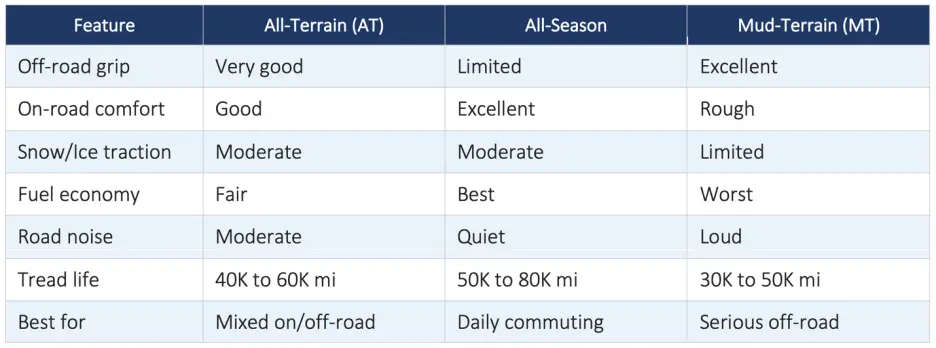
The big picture: all-terrain tires occupy a deliberate middle ground. They are the most versatile option for drivers who genuinely use their vehicles in multiple environments. If you never leave the pavement, an all-season tire will be more fuel efficient and quieter. If you tackle serious off-road trails every weekend, a mud-terrain tire is the better tool. All-terrain tires are built for the large group of drivers whose real-world driving falls somewhere in between those two extremes.
Who Should Actually Buy All-Terrain Tires?
Not every driver needs all-terrain tires, and being honest about your actual driving habits is the most important part of making this decision. AT tires make the most sense if you check most of the following boxes:
• You drive a truck, SUV, or 4×4 that spends time off paved roads at least occasionally
• You live in or frequently travel through areas with gravel roads, forest service roads, or unpaved routes
• You deal with winter weather but not the kind of extreme, sustained ice that requires dedicated winter tires
• You tow or haul loads occasionally since AT tires generally carry higher load ratings than standard passenger tires
• You want one set of tires that handles varied conditions year-round without swapping between sets
On the other hand, if your vehicle never leaves city streets or suburban commutes, the extra rolling resistance and road noise of an AT tire are trade-offs you take on without gaining much benefit. A quality all-season tire will serve you better in that situation.
How Long Do All-Terrain Tires Last?
Tread life is one of the most common questions from first-time AT tire buyers, and the answer varies more than most people expect. A well-maintained set of all-terrain tires typically lasts between 40,000 and 60,000 miles. Several popular models come with warranties in that range. The Cooper Discoverer AT3 XLT, for example, is warranted for up to 60,000 miles, which is competitive with many all-season options.
Driving habits are the biggest factor in how long your AT tires will last. Highway-heavy use with regular rotation and proper inflation will push a set toward the higher end of its tread life range. Frequent off-road use on abrasive rock surfaces wears tread faster. Consistent rotation every 5,000 to 7,500 miles is the single most effective maintenance step for maximizing tire life, as it evens out wear across all four tires before any one tire gets significantly lower than the others.
What About Fuel Economy?
This is a real trade-off and it is worth being clear about from the start. Because all-terrain tires have more aggressive tread patterns and heavier construction, they create more rolling resistance than a standard highway tire. Rolling resistance is essentially the energy your engine spends just to keep the tires turning, and more resistance means the engine has to work a bit harder, which burns more fuel.
Industry testing and real-world consumer data consistently show that AT tires reduce fuel economy by around 3% compared to highway-focused tires. For most vehicles that works out to roughly 1 to 2 MPG less. For a driver covering 15,000 miles per year at 20 MPG with fuel at around $3.50 per gallon, that difference costs about $60 to $90 extra per year. It is a real cost, but for most drivers who genuinely need the off-road capability, it falls well within the range of an acceptable trade-off.
Tire manufacturers have made real progress closing this gap in recent years. Modern AT tire designs use lower rolling resistance compounds and optimized tread geometries, so the fuel penalty today is noticeably smaller than it was a decade ago.
Frequently Asked Questions
Are all-terrain tires good for daily driving?
Yes, absolutely. All-terrain tires are designed to perform on paved roads as part of their core function. You will notice slightly more road noise and a small dip in fuel economy compared to a pure highway tire, but millions of truck and SUV owners run AT tires as their everyday tire without any real complaints about daily driving comfort.
Are all-terrain tires good in snow?
It depends on the specific tire. Many AT tires carry the Three-Peak Mountain Snowflake (3PMSF) certification, meaning they have been independently tested to meet minimum performance requirements in severe snow conditions. These tires perform noticeably better in snow than standard all-season tires. However, for drivers dealing with daily ice and packed snow throughout a long winter season, a dedicated winter tire still holds a clear performance advantage.
Are all-terrain tires louder than regular tires?
They can be, yes, though the gap has narrowed considerably with modern designs. The open tread blocks that give AT tires their grip create more contact noise at highway speeds than a smooth all-season tread. Some models, like the Nokian Outpost nAT, are specifically engineered to minimize road noise and have earned strong reviews for highway quietness even while being a capable off-road tire. If noise matters a lot to you, it is worth checking consumer noise ratings before purchasing.
Can I put all-terrain tires on a 2WD vehicle?
Yes, you can. All-terrain tires are not exclusive to 4×4 or AWD vehicles. They will improve traction on gravel, light snow, and unpaved surfaces regardless of your drivetrain. That said, a 2WD vehicle with AT tires will not match the off-road capability of a 4WD setup. Your traction improvement comes from the tire compound and tread pattern, not from having powered wheels at both axles.
How much do all-terrain tires cost?
Pricing varies widely by brand, size, and tier. Entry-level AT tires from value brands can start around $100 to $150 per tire. Mid-range options from established manufacturers like General or Falken typically fall in the $150 to $250 range. Premium choices from Michelin, BFGoodrich, or Toyo can reach $250 to $400 or more per tire. For most truck and SUV owners, a solid mid-range set delivers excellent real-world performance without paying for a premium brand name.
Key Takeaways
• All-terrain tires are built for both paved and unpaved surfaces using open tread patterns, reinforced sidewalls, and sipes that work together to handle varied conditions
• They outperform all-season tires on gravel, dirt, light mud, and snow while remaining comfortable enough for daily highway use
• Expect roughly 3% less fuel economy and slightly more road noise compared to a standard all-season tire
• Look for the Three-Peak Mountain Snowflake (3PMSF) rating if you need reliable snow performance
• Tread life typically runs 40,000 to 60,000 miles with regular rotation and proper inflation
• AT tires are the right call if you drive a truck or SUV in genuinely mixed conditions; they are not necessary if you strictly commute on city streets
Ready to Find Your Next Set of All-Terrain Tires?
All-terrain tires represent one of the smartest upgrades you can make to a truck or SUV that sees any kind of mixed-condition driving. They eliminate the compromise of running highway passenger car tires off-road or mud tires on your daily commute, landing in the versatile sweet spot that the majority of off-road-capable vehicle owners actually need.
The key is matching the tire to your real driving life, not the most extreme adventure you can imagine, but what you genuinely do week in and week out. When you are clear on your terrain, your climate, and your budget, choosing the right all-terrain tire becomes a straightforward decision rather than an overwhelming one.
Browse our full breakdown of the best all-terrain tires by category, from tire size guides to top brand comparisons, to find the exact model that fits your vehicle and your driving style.