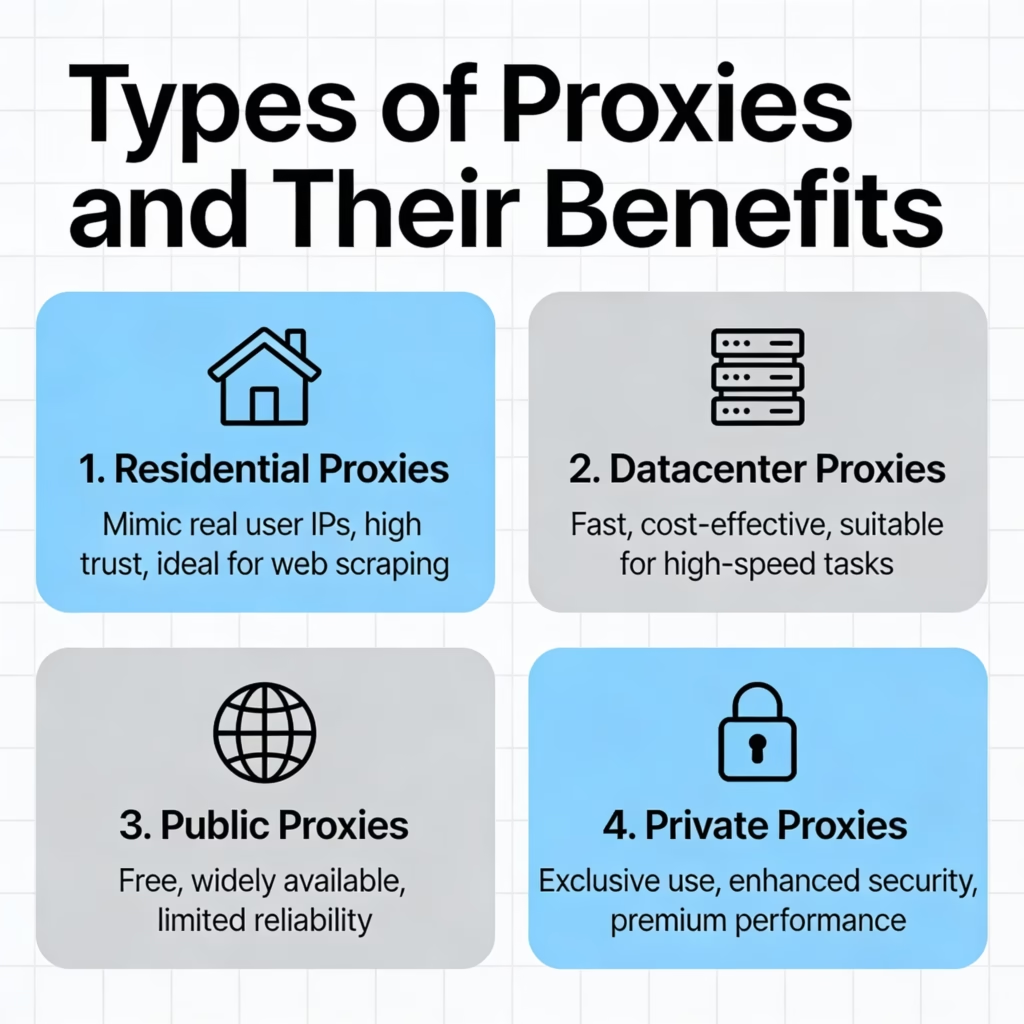
Proxies are tools that sit between you and the internet. They work like a middle layer. They take your request, send it forward, and bring back the result. They also mask your IP address, but different proxy types do this in different ways. Some are built for speed. Others are made for privacy. Many are used for business data tasks. Static IP is simple but limited. Rotating IP gives more cover. Each type has a purpose.
Let’s break it down cleanly, in simple words.
1. Residential Proxies
Residential proxies come from real home internet networks. They are linked to ISPs that serve regular users. Websites trust these IPs more than server IPs. They don’t look like bots easily. They work well for scraping product data. They handle blocks better. They work great for sneaker price checks, hotel scraping, job boards, and search result tracking.
Benefits:
- Harder to detect by websites
- Looks like normal user traffic
- Works better for large scraping jobs
- Can access many global locations
- Fewer CAPTCHAs than datacenter IPs
- Good for scraping public websites
- Helps run automation safer
Small example: If one home IP checks 200 pages, it seems real. If one server IP checks 200 pages, it projects as robotic.
Residential proxies win this test.
2. Mobile Proxies
Mobile proxies rotate through 4G and 5G network IPs. They are extremely trusted by platforms. Social apps love mobile traffic. They treat it like real phone users. These proxies are used to scrape Instagram, TikTok, and app-based platforms. They rotate fast. They give high anonymity. They reduce detection when managing multiple accounts.
Benefits:
- Most trusted by social platforms
- Very low detection risk
- Fast IP rotation for automation
- Works well for account-based tools
- Great for scraping mobile apps
- Handles social login spread better
- No repeated identity footprint
- Covers many countries cleanly
Mobile proxies are more costly than residential, but the trust factor makes them worth it for social scraping.
3. Datacenter Proxies
Datacenter proxies come from servers. They are not linked to ISPs serving home users. They are fast. They are cheap. They work well for simple browsing tasks. They fail faster in scraping. They get blocked more often on public websites.
Benefits:
- Very fast connection speed
- Low cost for bulk usage
- Good for non-heavy automation
- Easy to buy in large numbers
- Works well for basic browsing
- Good for testing simple server requests
Datacenter IP works fine until it repeats too often. Then it gets flagged.
4. ISP Proxies
ISP proxies are static but cleaner than datacenter proxies. They are linked to real ISPs, but they are not residential home IPs. They are hosted on ISP servers. They give good speed. They give a cleaner identity than datacenter IPs. They work well for scraping search engines, product pages, and local results one country at a time.
Benefits:
- Faster than residential proxies
- Cleaner identity than datacenter IPs
- Trusted more than server IP ranges
- Less CAPTCHA frequency than datacenter IPs
- Good for scraping location-based search results
- Good for SERP monitoring at scale
- Works better for public data collection
ISP proxies are a middle ground. They balance speed and trust.
5. Forward Proxies
Forward proxies sit between users and the internet. They send requests on your behalf. Companies use them for caching. Offices use them to filter web access. Schools use them to manage browsing. Forward proxies are used for content filtering. They also help reduce bandwidth use by storing cached copies.
Benefits:
- Speeds up browsing with caching
- Helps filter content in offices
- Saves bandwidth with cached requests
- Good for shared network setups
- Works well for filtering web traffic
- Used for internal network security
- Can block unsafe websites in companies
Forward proxies help network admins control browsing better.
6. Reverse Proxies
Reverse proxies sit in front of servers, not users. They handle incoming traffic. They balance the load. They cache server responses. They protect the server identity. They help websites handle millions of visitors. They are used by big companies to avoid server crashes and speed up page delivery.
Benefits:
- Protects servers from direct exposure
- Balances traffic to avoid server crashes
- Speeds up delivery with caching
- Helps apps handle high visitor loads
- Reduces server strain by caching content
- Works well with load balancers
- Protects the real server IP from being seen
- Helps reduce DDoS risk by hiding server identity
Reverse proxies help websites stay live during traffic spikes.
7. Transparent Proxies
Transparent proxies don’t hide your identity. They pass your real IP forward. They are used for caching. They are used for filtering. They are used by ISPs. Users don’t choose transparent proxies for privacy. Companies use them to control browsing and cache pages.
Benefits:
- Caches content to speed up browsing
- Filters content in office networks
- Helps reduce bandwidth usage
- Used by ISPs to cache popular content
- Helps network admins track usage
Transparent proxies are not for anonymity, but great for caching.
8. Anonymous Proxies
Anonymous proxies hide your IP but still reveal that a proxy is being used. They offer moderate privacy. They work well for browsing but fail faster than elite proxies for scraping jobs.
Benefits:
- Hides your IP from websites
- Gives a fair level of privacy
- Works for browsing geo content
- Not very strong for heavy scraping
Anonymous proxies are better than transparent but weaker than elite.
9. Elite Proxies (High Anonymity Proxies)
Elite proxies hide your IP and also hide that you are using a proxy. They are the best choice for scraping jobs. They are the safest option for automation. They rotate identities cleanly. They leave no repeated footprint. They reduce CAPTCHA frequency. They last longer without blocks.
Benefits:
- Hides real IP
- Hides proxy identity
- Best for heavy automation
- Best for scraping public websites
- Low detection risk
- Low CAPTCHA frequency
- Better for scaling scraping jobs
- Keeps flow running longer
Elite proxies are the safest choice for data scraping in 2026.
10. HTTP Proxies
HTTP proxies work for websites that don’t use encryption. They are fast. They work for simple web requests. They don’t work for HTTPS websites unless upgraded.
Benefits:
- Fast speed
- Low cost
- Works for simple web traffic
- Not good for encrypted sites
11. HTTPS Proxies
HTTPS proxies work for encrypted websites. They are safer than HTTP proxies. They help scrape secure websites.
Benefits:
- Works for encrypted sites
- Safer than HTTP proxies
- Good for scraping secure websites
- Fair speed
12. SOCKS Proxies
SOCKS proxies are very flexible. They support many traffic types. They support gaming. They support video streaming. They support heavy scraping. They are slower than HTTP/HTTPS sometimes, but flexibility is strong.
Benefits:
- Supports all traffic types
- High flexibility
- Good for scraping
- Good for gaming traffic
- Good for streaming
- Better anonymity than HTTP/HTTPS proxies
- Stable for long sessions
13. IPv4 Proxies
IPv4 proxies are the most common type. They are widely supported. They are trusted. They cost more than IPv6 proxies.
Benefits:
- Supported by most websites
- Trusted identity
- Works for scraping
- Works for automation
- More costly than IPv6
14. IPv6 Proxies
IPv6 proxies are new. They are cheap. Many websites still don’t support IPv6, but adoption is growing.
Benefits:
- Very low cost
- Large bulk IP availability
- Future-focused
- Limited support today
Rotating vs Static (Quick Summary)
| Rotating IP gives you many identities | Static IP gives you one identity |
| Rotating proxies work better for scraping | Static proxies fail early in scale tasks |
| Rotating proxies reduce rebuys | Static IP increases rebuys |
| Rotating proxies test one country at a time cleanly | Static IP can’t test multiple regions safely |
Final Words
Modern websites block repeated identity footprints faster. Rotating proxies help you scale scraping safely by changing IPs often and keeping every request fresh. Each proxy type has a purpose, but for scraping and automation, residential and mobile rotating pools with elite anonymity perform the best.
Pick proxies based on your job. Use one region per request. Rotate identities often. Avoid repeated footprints. Keep the flow looking real.