Every coating applied to a precision medical device is solving two problems simultaneously. The first is the obvious one: delivering the surface property the device needs — reduced friction, electrical insulation, chemical resistance, or some combination of these. The second problem is less visible but equally consequential: making the coating stay where it was applied, through the mechanical stresses of device use, the chemical environment of the body, and the thermal and chemical loads of sterilization processes.
The second problem — adhesion — is the one that kills more coating development efforts than the first. And for pure PTFE coatings applied to metal medical device substrates, it presents a challenge that is, at its root, a fundamental property of the material being used.
The PTFE paradox.
Polytetrafluoroethylene — PTFE, most recognizable by the brand name Teflon — has a coefficient of friction lower than almost any other solid material. Nothing sticks to it, which is precisely why it ended up on cookware and why engineers reach for it when friction reduction is a primary requirement. The fluorine atoms arranged along the carbon backbone of PTFE create a surface of exceptional chemical inertness — they are not reactive with other materials, they do not form chemical bonds with the surfaces they contact, and they resist both adhesive attachment and chemical interaction with the substrates or environments around them.
This is, of course, exactly the problem. The property that makes PTFE the ideal low-friction coating — its extreme reluctance to interact with other materials — is also what makes it reluctant to adhere to the metal substrate it needs to bond to. PTFE, applied to a stainless steel needle shaft or a nitinol guidewire without surface preparation or primer chemistry, will not form adequate adhesive bonds with the substrate. It sits on the surface rather than bonding to it, and under the mechanical loading, flexing, and tissue contact that medical device use involves, it separates.
Why this matters specifically for precision and miniature devices.
In large-area coating applications — industrial equipment, cookware, non-stick bakeware — the adhesion challenge is addressed through high-temperature sintering and primer systems that, while not perfectly solving the adhesion problem, provide enough bond strength for the service conditions involved. The coating thickness is also typically generous enough that even with some delamination at the edges or stress concentrations, the bulk of the coating remains functional.
Precision medical devices are a categorically different application. A needle tip measured in microns. A guidewire with an outer diameter of 0.014 inches. A hypotube with wall thickness measured in thousandths of an inch. These components have dimensional tolerances that cannot accommodate coating thickness variations that would be inconsequential on a larger structure.
The coating on these devices must be measured in microns — not millimeters — to preserve the dimensional precision that the device’s function depends on. At these thicknesses, the coating has essentially no bulk to fall back on if adhesion is imperfect. If the coating delaminates in any zone, it is gone from that zone — there is no underlying coating layer that remains functional beneath it. And for a device navigating the intravascular space, partially delaminated coating is not simply a functional compromise. It is a potential safety event: a coating fragment released into the vascular system represents a debris concern that regulatory frameworks take seriously.
How the adhesion problem is actually solved.
The engineering solution to PTFE’s adhesion challenges involves surface preparation and primer chemistry that modifies both the substrate and the coating system to create an interface that PTFE can adhere to, even though the outermost PTFE layer itself remains non-adhesive.
Surface preparation of the metal substrate — through chemical etching, plasma treatment, or abrasive preparation — increases surface energy and creates micro-scale topography that provides mechanical anchoring sites for the applied coating system. The prepared surface is not simply cleaner than an unprepared one; it has different surface energy characteristics that allow adhesive chemistry to wet and bond at the molecular level in ways that a smooth, oxidized metal surface does not.
Primer chemistry adds a layer of material between the metal substrate and the PTFE coating whose composition bridges the adhesion gap: it bonds chemically to the prepared metal surface and provides a substrate surface that the PTFE can adhere to more effectively than it adheres to bare metal. The primer is not the functional surface of the coating — the low-friction PTFE layer is — but it is the chemical foundation that makes the functional layer stay in place.
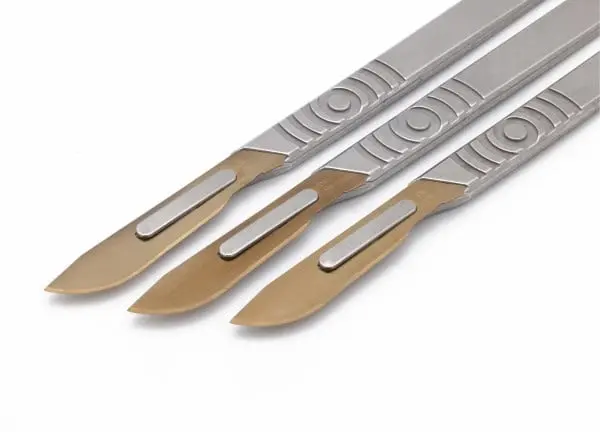
FluoroBond® N is a micron-thin, pure PTFE coating formulated for cutting edges, needles, hypotubes, guidewires, and other precision medical devices. Its formulation achieves ultra-low friction performance through the inherent lubricity of pure PTFE while addressing the adhesion challenge through surface preparation and application processes designed specifically for the dimensional and biocompatibility requirements of precision medical components.
The “pure PTFE” designation is meaningful in this context. Many lower-cost PTFE coatings for non-medical applications incorporate binders, fillers, or other additives that improve adhesion by making the PTFE coating more composite than pure — trading some lubricity for easier application. In a medical device context, every additive introduces a potential biocompatibility concern that must be characterized and validated independently. FluoroBond N coating avoids this complexity by working with pure PTFE chemistry and addressing the adhesion challenge through process engineering rather than formulation additives.
Why sterilization compatibility is the third requirement that complicates everything.
The coating that adheres during the ambient-temperature application process must also survive the sterilization process used to prepare the device for clinical use. Ethylene oxide sterilization, gamma irradiation, electron beam sterilization, and steam autoclave each expose the coating to specific chemical, thermal, or radiation conditions that can affect coating integrity.
PTFE’s chemical inertness is an advantage in this context — it is generally stable under most sterilization conditions and does not react chemically with the sterilant gases or radiation used in standard processes. But the adhesion interface — the primer and surface preparation that make the PTFE stay on the substrate — must also survive these conditions. An adhesion system optimized for mechanical strength at room temperature may behave differently after exposure to the thermal cycling of steam autoclave or the chemical penetration of ethylene oxide, and validating that the coating remains intact through the complete sterilization cycle is a mandatory step in medical device coating qualification.
The precision medical device that navigates arterial anatomy, punctures tissue with a precisely calibrated force, and delivers therapy through an instrument covered in low-friction coating that never delaminates is the product of solving these layered challenges simultaneously. The coating that makes it work is measured in microns and built on materials science that most users of the device never know exists.