

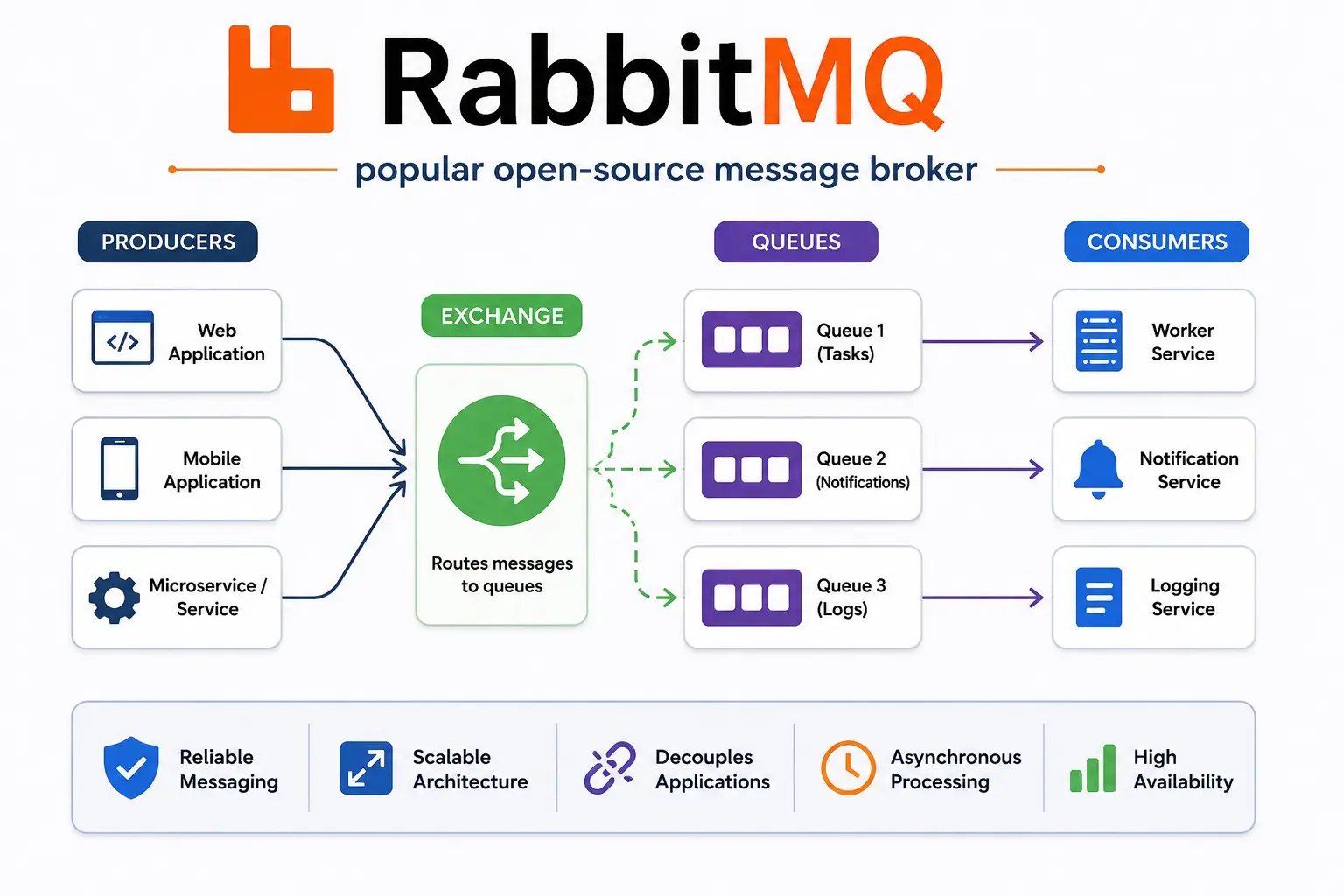
RabbitMQ is a popular open-source message broker used by businesses to manage communication between applications, services, and systems. It helps software teams build reliable workflows by allowing messages to move through queues, exchanges, and routing patterns instead of relying only on direct service-to-service communication.
For many companies, RabbitMQ becomes an important part of the technology stack. It may support order processing, payment events, notifications, background jobs, data synchronization, microservices communication, and other business-critical workflows. Because of this, companies should not only understand how RabbitMQ works technically, but also how its licensing and support model affects long-term use.
RabbitMQ is open source, but open source does not mean licensing and support can be ignored. Businesses need to understand what the license allows, what responsibilities may apply, and when commercial support becomes important. This is especially true for companies using RabbitMQ in production environments where downtime, delays, or security issues can directly affect customers and revenue.
Why RabbitMQ Licensing Matters
Software licensing explains how a product can be used, modified, shared, and distributed. For businesses, this matters because every software component in an application stack can create legal, operational, and compliance responsibilities.
RabbitMQ is commonly used inside commercial applications, SaaS platforms, enterprise systems, and cloud-based services. Before relying on it for important workloads, companies should know whether they can use it commercially, whether they can modify it, and whether their own application code is affected by the license.
Understanding licensing also helps during audits, enterprise sales, investor due diligence, security reviews, and vendor assessments. Many larger organizations ask what open-source software is being used and whether the company is following license requirements properly.
For teams that want expert guidance, RabbitMQ Licensing & Commercial Support can help businesses better understand their options and make informed decisions before scaling RabbitMQ across critical systems.
What License Does RabbitMQ Use?
RabbitMQ is released as open-source software under the Mozilla Public License 2.0, commonly known as MPL 2.0. This license allows companies and developers to use RabbitMQ in many different environments, including commercial projects.
MPL 2.0 is generally considered a business-friendly open-source license. It allows RabbitMQ to be used alongside proprietary software, which is important for companies that build private applications or commercial platforms.
However, MPL 2.0 is still a real license with conditions. It is often described as a file-level copyleft license. This means that if a business modifies RabbitMQ source files covered by the license and distributes those modified files, it may need to make those modifications available under the same license.
For many standard business use cases, this is not a major concern. Most companies do not modify RabbitMQ’s core source code. They install RabbitMQ, configure it, connect applications to it, and run it as part of their infrastructure. In those common cases, the license is usually straightforward to manage.
Can RabbitMQ Be Used Commercially?
Yes, RabbitMQ can be used in commercial environments. Businesses can use it to support internal systems, customer-facing applications, SaaS products, eCommerce platforms, financial workflows, logistics systems, and many other software solutions.
This is one reason RabbitMQ is widely adopted. It gives companies access to a reliable messaging broker without requiring a traditional software license fee for the open-source version.
However, companies should separate two different ideas: the right to use RabbitMQ and the ability to operate RabbitMQ successfully in production.
The license gives businesses permission to use RabbitMQ under its terms. Production operations require planning, monitoring, security, upgrades, performance tuning, backups, and incident response. These areas are not automatically solved by the open-source license.
A company may be legally allowed to use RabbitMQ for free, but still need expert support to run it safely and reliably.
Open Source RabbitMQ vs Commercial Support
One of the most common misunderstandings is the difference between open-source licensing and commercial support.
Open-source licensing explains what users are allowed to do with the software. Commercial support provides professional help for businesses that need reliability, guidance, troubleshooting, security assistance, upgrade planning, and long-term support.
For small projects, community documentation and internal technical knowledge may be enough. But for companies using RabbitMQ in production, commercial support can become very important.
If RabbitMQ supports payment processing, order fulfillment, healthcare systems, financial transactions, real-time alerts, or enterprise integrations, downtime can be expensive. In these cases, relying only on community resources may not be enough.
Commercial support can help businesses reduce risk by giving them access to experienced RabbitMQ professionals who understand production environments, complex architectures, and high-availability requirements.
When Commercial RabbitMQ Support Becomes Important
Commercial RabbitMQ support becomes valuable when RabbitMQ is no longer a small background tool and has become part of core business operations.
For example, a growing eCommerce business may start with a simple queue for sending emails. Over time, RabbitMQ may begin handling orders, inventory updates, payment events, shipment notifications, and customer alerts. At that point, RabbitMQ is not optional infrastructure. It is essential to daily operations.
Commercial support is also useful when message volumes increase. Higher traffic can create performance problems if RabbitMQ is not configured correctly. Queues may grow too large, consumers may fall behind, memory usage may increase, or messages may be delayed.
A support provider can review the architecture, identify bottlenecks, recommend configuration improvements, and help create a more stable system.
Support is also important during upgrades and migrations. RabbitMQ version changes, infrastructure moves, or cloud migrations should be planned carefully to avoid downtime or message loss.
Common RabbitMQ Support Needs
Businesses often need help with several RabbitMQ areas. One of the most common is architecture design. A RabbitMQ expert can help decide how exchanges, queues, routing keys, dead-letter queues, and consumers should be structured.
Another common need is performance tuning. RabbitMQ performance depends on many factors, including message size, queue type, acknowledgement behavior, consumer speed, memory limits, disk usage, connection management, and clustering strategy.
Monitoring is also important. Production RabbitMQ environments should track queue depth, message rates, node health, memory usage, disk usage, connection counts, consumer activity, and errors. Without monitoring, businesses may not notice problems until users are affected.
Security is another key area. RabbitMQ may handle sensitive messages, so access control, user permissions, TLS encryption, network rules, and credential management should be configured properly.
Businesses may also need help with disaster recovery, high availability, backups, cluster configuration, incident response, and documentation.
Why Licensing and Support Should Be Planned Together
Licensing and support are often discussed separately, but businesses should think about them together.
Licensing answers whether the company can use RabbitMQ and what rules apply. Support answers how the company will keep RabbitMQ reliable, secure, and available over time.
A company may start using RabbitMQ because it is open source and easy to install. But once it becomes part of production, the business needs a bigger plan. Who monitors it? Who upgrades it? Who handles incidents? Who checks security? Who reviews performance? Who ensures the system can scale?
These questions become even more important in regulated industries or enterprise environments. Companies may need to show that they understand their open-source usage and have a support process in place for critical infrastructure.
Best Practices for RabbitMQ Licensing and Support
Businesses should begin by documenting how RabbitMQ is used. This includes where it is deployed, which applications connect to it, which version is running, and whether any source-code modifications have been made.
Companies should also keep RabbitMQ included in their open-source software inventory. This helps with compliance, security reviews, and internal audits.
If the business modifies RabbitMQ source code, those changes should be tracked carefully. Teams should understand whether the modified files are distributed and whether license obligations apply.
From a support perspective, businesses should monitor RabbitMQ continuously. They should define alert thresholds, review queue performance, plan upgrades, and test recovery procedures.
It is also wise to avoid unnecessary complexity. RabbitMQ is powerful, but poor design can create long-term problems. Simple, well-documented architecture is usually easier to support than an overly complex setup.
Final Thoughts
RabbitMQ is a strong choice for businesses that need reliable messaging, background processing, and service communication. Its open-source license makes it flexible for commercial use, and its technical capabilities make it valuable in many modern software environments.
However, companies should not treat licensing and support as afterthoughts. The RabbitMQ license explains what businesses can do with the software, while commercial support helps ensure RabbitMQ runs properly in real production conditions.
For small projects, basic open-source usage may be enough. For larger companies, mission-critical systems, or high-volume applications, commercial support can provide extra confidence, stability, and expert guidance.
By understanding RabbitMQ licensing and commercial support early, businesses can reduce risk, improve reliability, and build a messaging infrastructure that supports long-term growth.
Technology Perspective
Technology continues to transform industries through artificial intelligence, cloud computing, automation, cybersecurity, digital platforms, and data-driven decision making. As organizations increasingly adopt digital solutions, understanding emerging technologies becomes essential for businesses, professionals, and consumers. DGM News regularly covers these developments through expert analysis, technology news, and educational resources.
Innovation Outlook
Rapid advances in artificial intelligence, automation, machine learning, cloud infrastructure, and digital transformation continue reshaping global industries. Monitoring these developments helps organizations adapt to changing technologies, improve efficiency, and prepare for future innovation.
Did you know?
Artificial Intelligence is expected to influence nearly every major industry over the coming decade, from healthcare and finance to transportation, manufacturing, education, and entertainment.
AI, Machine Learning, Deep Learning and Generative AI Explained
Google AI Updates
About DGM News
DGM News is an independent digital publication delivering the latest Technology News, AI News, and FinTech News. We provide expert insights on startups, innovation, cybersecurity, software, business, gadgets, cloud computing, artificial intelligence, and emerging technologies. Our mission is to publish informative, accurate, and regularly updated content that helps readers stay informed in today's rapidly evolving digital landscape.
Since our editorial focus includes technology, artificial intelligence, and financial technology, we continuously expand our coverage as new innovations emerge.
Editorial Standards
Every article published on DGM News undergoes editorial review before publication. We prioritize factual accuracy, clarity, transparency, and reader value while following responsible digital publishing practices.
Research Methodology
Our editorial team researches publicly available information from official announcements, technical documentation, research publications, developer resources, reputable industry reports, and trusted public sources whenever applicable. Information is reviewed to improve clarity and accuracy before publication.
Fact-Checking Policy
We make reasonable efforts to verify factual information before publishing. Articles are reviewed for accuracy, consistency, and relevance. If significant developments occur after publication, content may be revised to reflect updated information.
Update Policy
Technology evolves rapidly. Articles may be reviewed and updated periodically to reflect software releases, AI developments, security advisories, regulatory updates, product launches, and other important industry changes.
Source Verification
Whenever possible, DGM News reviews information using official company announcements, technical documentation, research publications, government resources, publicly available reports, and reputable industry references before updating articles.
Editorial Independence
DGM News maintains editorial independence in all publishing decisions. Editorial content is produced independently and is intended to provide balanced, informative, and reader-focused coverage without influence from advertisers or commercial partnerships.
AI Usage Disclosure
Artificial intelligence tools may assist with research organization, grammar improvement, formatting, or editorial workflows. Every article is reviewed by human editors before publication to help maintain quality, clarity, and factual accuracy.
Corrections Policy
Accuracy is important to us. If readers identify outdated information or factual inaccuracies, they are encouraged to contact our editorial team. Verified corrections are reviewed and incorporated whenever appropriate.
Reader Feedback
Reader feedback helps improve our journalism. We welcome suggestions, corrections, and constructive feedback through our Contact page to continuously improve the quality of our reporting.
Last Editorial Review
This article follows the DGM News editorial review process and may be updated periodically as new information becomes available.
Why Trust DGM News?
DGM News is committed to publishing technology journalism that emphasizes accuracy, transparency, editorial independence, and regularly updated information. Our editorial process is designed to provide readers with reliable coverage of technology, AI, fintech, startups, and digital innovation.
DGM News Resources
Topics We Cover
Artificial Intelligence • AI Tools • Machine Learning • FinTech • Cybersecurity • Cloud Computing • Programming • Software Development • Gadgets • Mobile Technology • Business Technology • Startups • Digital Marketing • Blockchain • Cryptocurrency • Science • Innovation • Consumer Technology • Enterprise Technology • Automation
