

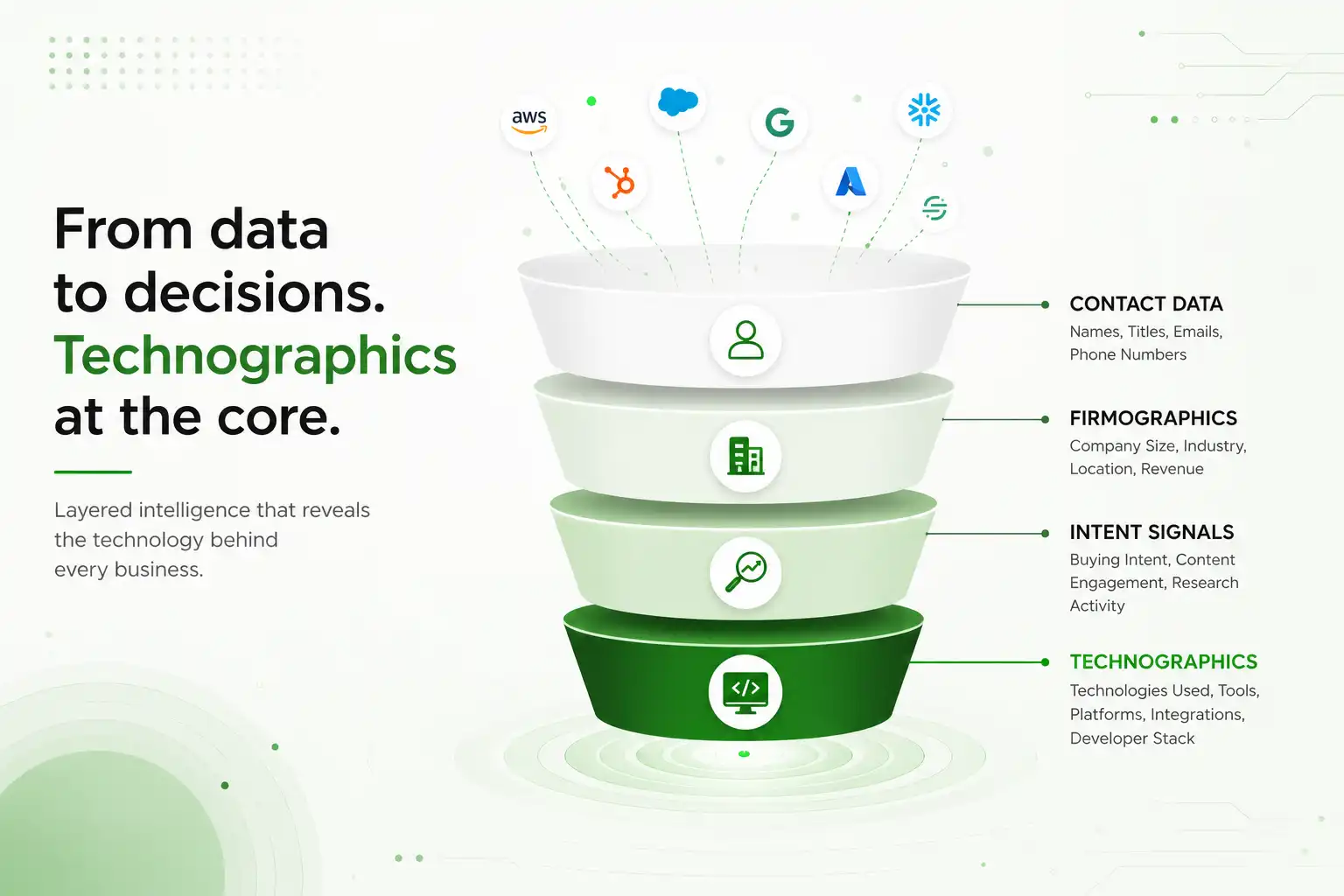
Technographic data has become essential for B2B companies sharpening their sales strategies. Understanding a prospect’s technology stack allows for more relevant outreach. This insight helps teams identify high-fit accounts and target competitive replacement opportunities.
Market trends reflect a major shift toward these deep technical insights. Around 75% of B2B organizations now leverage technographics to improve targeting. This data moves beyond firmographics to reveal actual business needs.
We’ll look at 5 B2B technographic data providers that help you move from broad targeting to more precise, insight-driven B2B growth. We compare their key features and ideal use cases for growth. This helps you choose the right partner to fuel execution.
1. Demand Curve Marketing (DCM)
Demand Curve Marketing focuses on building high-quality technographic intelligence around your target accounts. Instead of giving you raw lists, it provides structured insights into the technologies your prospects actually use.
It goes deeper into account-level infrastructure, helping you understand the prospect’s existing tools, systems, and dependencies. This allows you to align your messaging with real technical context and engage accounts with stronger relevance.
Pros
- Hybrid Verification Process: Hybrid verification combines AI validation with human audits to eliminate stale data for your team.
- No Credit Constraints: Operates on a TAM-based model, giving full access to a defined market without per-contact credit limitations.
- Cross-Platform Visibility: Tracks 30,000+ vendors across cloud, on-premise, and legacy hardware systems.
Cons
- Requires Strategic Partnership: This is not a self-service export tool and requires active account management.
- Needs Operational Overhead: Deep technographic triggers require a dedicated RevOps team to process. Without automation, massive data sets quickly become unmanageable noise.
2. Enlyft
Enlyft provides your sales organization with predictive insights powered by a massive technographic database. It helps you identify which companies are currently undergoing digital transformations. By analyzing millions of data points, it selects the best prospects for your specific solution.
Pros
- Propensity Scoring Models: Uses machine learning to rank your prospects by their likelihood to convert.
- Deep Microsoft Integration: Offers specialized workflows for teams using the Microsoft Dynamics 365 ecosystem.
- Digital Transformation Tracking: Helps your team identify companies moving from legacy systems to the cloud.
- Automated ICP Mapping: Builds detailed profiles of your best customers to find similar accounts.
Cons
- Significant Upfront Cost: The platform’s enterprise-grade features require a higher financial investment from your team.
- Data Granularity Limits: Some niche hardware signatures may be less detailed than the software-specific data.
- Custom Contract Requirements: API access and large-scale data exports typically require complex legal agreements.
3. Wappalyzer
Wappalyzer is an essential technographic data provider for identifying public-facing web technologies. It tracks everything from e-commerce platforms to specific analytics and advertising scripts. This is perfect for your teams that need to audit a prospect’s website instantly. You can use its programmatic tools to enrich your lead lists.
Pros
- Instant Technology Detection: Provides immediate visibility into a website’s software stack for your sales reps.
- Programmable Data Access: Features a robust API that allows your developers to automate tech-stack lookups.
- Low Barrier to Entry: Offers flexible pricing models that accommodate your smaller or experimental projects.
- Extensive Browser Support: Includes an extension that lets your team see tech data while they browse.
Cons
- Surface-Level Focus: Misses the internal backend or legacy tools that aren’t visible in the public domain.
- Minimal Contact Context: Does not include the verified phone numbers or emails your team needs.
- High Manual Effort: You must manually bridge the gap between technical data and actual sales outreach.
4. PredictLeads
PredictLeads helps your analysts understand the deeper movements within your target accounts. It scans job boards and news sources to reveal changes in customer technographics. This allows you to see which companies are investing in new skill sets.
Pros
- Growth Signal Correlation: Ties tech-stack changes to hiring trends and new office openings for your team.
- Historical Trend Analysis: Allows you to see how a company’s technology investment has changed over the years.
- Niche Signal Capture: Finds evidence of specific software usage buried within detailed job descriptions.
- Investment Intelligence: Useful for your strategic planners who need to forecast market shifts.
Cons
- Data Interpretation Required: Costs additional time and effort to analyze signals and identify actionable hooks.
- Implementation Latency: It takes longer to build a workflow around hiring signals than simple tech filters.
- Specific Target Volume: The dataset depends on active public signals like job postings and news.
5. Intricately
Intricately is another technographic data provider focused on cloud spend and infrastructure. It reveals how much your prospects are investing in specific cloud and hosting environments. This is vital for your teams selling high-value cloud services or security. You get visibility into the “plumbing” of the modern enterprise.
Pros
- Reflects Cloud Spend Data: Shows your team exactly where and how much prospects spend on cloud.
- Traffic Pattern Visibility: Monitors how much digital traffic a prospect’s infrastructure is currently handling.
- Infrastructure Maturity Scoring: Helps you rank accounts based on their readiness for advanced cloud solutions.
- Competitive Replacement Alerts: Notifies your team when an account makes a major change in their hosting.
Cons
- Hyper-Niche Focus: Primarily centers on cloud and infrastructure, which may limit your general SaaS prospecting.
- Technical Sales Requirement: Your reps need high technical literacy to use this infrastructure data effectively.
- Infrastructure Only: Does not typically track low-level SaaS applications used by individual marketing or sales teams.
Conclusion
Technographic data becomes valuable when it moves beyond visibility and supports execution. It helps you refine targeting, align messaging with real use cases, and engage accounts with stronger relevance.
Customer intelligence companies offer varying levels of depth and usability. The key is choosing one that fits into your workflow and supports how your team plans, prioritizes, and executes outreach. When used effectively, technographic data doesn’t just improve targeting, it helps build a more predictable and scalable pipeline.
Technology Perspective
Technology continues to transform industries through artificial intelligence, cloud computing, automation, cybersecurity, digital platforms, and data-driven decision making. As organizations increasingly adopt digital solutions, understanding emerging technologies becomes essential for businesses, professionals, and consumers. DGM News regularly covers these developments through expert analysis, technology news, and educational resources.
Innovation Outlook
Rapid advances in artificial intelligence, automation, machine learning, cloud infrastructure, and digital transformation continue reshaping global industries. Monitoring these developments helps organizations adapt to changing technologies, improve efficiency, and prepare for future innovation.
Did you know?
Artificial Intelligence is expected to influence nearly every major industry over the coming decade, from healthcare and finance to transportation, manufacturing, education, and entertainment.
AI, Machine Learning, Deep Learning and Generative AI Explained
Google AI Updates
About DGM News
DGM News is an independent digital publication delivering the latest Technology News, AI News, and FinTech News. We provide expert insights on startups, innovation, cybersecurity, software, business, gadgets, cloud computing, artificial intelligence, and emerging technologies. Our mission is to publish informative, accurate, and regularly updated content that helps readers stay informed in today's rapidly evolving digital landscape.
Since our editorial focus includes technology, artificial intelligence, and financial technology, we continuously expand our coverage as new innovations emerge.
Editorial Standards
Every article published on DGM News undergoes editorial review before publication. We prioritize factual accuracy, clarity, transparency, and reader value while following responsible digital publishing practices.
Research Methodology
Our editorial team researches publicly available information from official announcements, technical documentation, research publications, developer resources, reputable industry reports, and trusted public sources whenever applicable. Information is reviewed to improve clarity and accuracy before publication.
Fact-Checking Policy
We make reasonable efforts to verify factual information before publishing. Articles are reviewed for accuracy, consistency, and relevance. If significant developments occur after publication, content may be revised to reflect updated information.
Update Policy
Technology evolves rapidly. Articles may be reviewed and updated periodically to reflect software releases, AI developments, security advisories, regulatory updates, product launches, and other important industry changes.
Source Verification
Whenever possible, DGM News reviews information using official company announcements, technical documentation, research publications, government resources, publicly available reports, and reputable industry references before updating articles.
Editorial Independence
DGM News maintains editorial independence in all publishing decisions. Editorial content is produced independently and is intended to provide balanced, informative, and reader-focused coverage without influence from advertisers or commercial partnerships.
AI Usage Disclosure
Artificial intelligence tools may assist with research organization, grammar improvement, formatting, or editorial workflows. Every article is reviewed by human editors before publication to help maintain quality, clarity, and factual accuracy.
Corrections Policy
Accuracy is important to us. If readers identify outdated information or factual inaccuracies, they are encouraged to contact our editorial team. Verified corrections are reviewed and incorporated whenever appropriate.
Reader Feedback
Reader feedback helps improve our journalism. We welcome suggestions, corrections, and constructive feedback through our Contact page to continuously improve the quality of our reporting.
Last Editorial Review
This article follows the DGM News editorial review process and may be updated periodically as new information becomes available.
Why Trust DGM News?
DGM News is committed to publishing technology journalism that emphasizes accuracy, transparency, editorial independence, and regularly updated information. Our editorial process is designed to provide readers with reliable coverage of technology, AI, fintech, startups, and digital innovation.
DGM News Resources
Topics We Cover
Artificial Intelligence • AI Tools • Machine Learning • FinTech • Cybersecurity • Cloud Computing • Programming • Software Development • Gadgets • Mobile Technology • Business Technology • Startups • Digital Marketing • Blockchain • Cryptocurrency • Science • Innovation • Consumer Technology • Enterprise Technology • Automation
